

Exit Governance. Enter DMP.
May 17, 2015
A DMP is a data management platform. I think in terms of databases. I find that software does not do a particularly reliable job “managing data.” Software can run processes, write log file, and perform other functions. But management, based on my experience at Booz, Allen & Hamilton, requires humans. Talking about analytics from Big Data and implementing a platform to perform management are apples and house paint in my mind.
Intrigued by the reference, I downloaded a document available upon registration from Infinitive. You can find the company’s Web site at www.infinitive.com. The white paper maps you 10 ways a data management platform can help me.
I was not familiar with Infinitive. According to the firm’s Web site: Infinitive is
A Different Kind of Consultancy. Results-driven and client-centric. Fun, focused and flexible. Highly engaged and easy to work with. Those are the qualities that make Infinitive a different kind of consultancy. And they’re the pillars of our unique culture. Headquartered in the Washington, D.C. area, Infinitive specializes in digital ad solutions, business transformation, customer & audience intelligence and enterprise risk management. Leveraging best practices in process engineering, change management and program management, we design and deliver custom solutions for leading organizations in communications, media and entertainment, financial services and educational services. For our clients, the results include quantifiable performance improvement and tangible bottom-line value in addressing their most pressing challenges and fulfilling their top-priority objectives.
What is a data management platform?
White paper or two page document identifies these benefits of a DMP. I was hoping for an explanation of the “platform,” but let’s look at the payoffs from the platform.
The company points out that a DMP makes ad money go farther. Big Data become actionable. A DMP provides a foundation for analytics. The DMP “ensures the quality and accessibility of customer and audience intelligence data.” The DMP can harmonize data. A DMP allows me to “adapt traditional CRM strategies and technology to incorporate new customer behavior.” I can create new customer and audience “segments.” The DMP becomes the central nervous system for my company. And the DMP protects privacy.
That is a bundle of benefits. But what is the platform provided by a consulting company, especially one that is “fun”? I was not able to locate details about the platform. The company appears to be a firm focused on advertising.
The Web site includes a page about the DMP at this link. The information is buzzword heavy and fact free. My view is that the DMP is a marketing hook. The implied technology is consulting services. That’s okay, but I find the approach representative of marketing billable time, not delivering a platform with the remarkable and perhaps unattainable benefits suggested in the white paper.
The approach must work. The company’s Web site points out this message:

Not a platform, however.
Stephen E Arnold, May 17, 2015
Quote to Note: How to Make Search Relevant
May 16, 2015
Short honk: I read “Intranet Search? Sssh! Don’t Speak of It.” It seems that enterprise search is struggling and sweeping generalizations about information governance and knowledge management are not helping the situation. But that’s just my opinion.
But set that “issue” aside. Here’s the quote I noted:
The only way this situation [search is a problem’] will change is with intranet managers stepping up to the challenge and telling stories internally. The problem with search analytics (even if you do everything that Lou Rosenfeld [search wizard] recommends) is that there is no direct evidence of the day-to-day impact of search.
Will accountants respond to search stories? Why is there no direct evident of the day to day impact of search? Perhaps search, along with some other hoo hah endeavors, is simply not relevant in today’s business environment? Won’t more hyperbole filled marketing solve the problem? Another conference?
The wet blanket on enterprise search remains “there is no direct evidence of the day to day impact of search.” After 30 or 40 years of implementations and hundreds of millions in search development, why not? Er, what about this thought:
Search is a low value utility which has been over hyped.
Stephen E Arnold, May 17, 2015
MBAs Gone Wild: Is There a Video?
May 13, 2015
I find Harvard fascinating. As a poor student in a small, ignored also ran university, I bumped into the fancy university folks at debate tournaments. Our record against many fine institutions, such as Dartmouth and the other Big Dogs was okay.
We won. Lots.
Then there were the Big Dog MBAs at Booz, Allen & Hamilton. Sigh. Wall Street forced more of these “special ones” into my radar screen. Delightful. There was an MBAism for every issue. Maybe not a correction or appropriate solution, but there was jargon, generalizations, and entitlement thinking. In meeting after meeting, I reviewed nifty, but often meaningless or incoherent, graphs or diagrams. I did not count this work as “quality time.” Today, as the beloved and now departed Yogi Berra said, “It’s déjà vu all over again.”
I read “Where the Digital Economy Is Moving the Fastest” and circled a remarkable diagram. True, the write up is not about search, but the spirit of search and content processing system vendors tinted my perception, using only pleasing and compatible calming colors.
The authors developed criteria for countries which are moving fast. Not product sales or market share, countries. The world but for nation states like Yemen and its ilk. Then, like good MBAs, crafted a matrix and plotted the fast movers, the losers, the ones to watch, and the maybes. Here’s the graphic:

There are “Watch Out” countries. I admit I interpreted this label in a manner different from the article’s sense of the phrase. I checked out the countries between Stall Out (dogs) and Stand Out (invest for sure maybe?). Poor Sweden, Britain, and Germany. Look at the countries on the move. Check out the tweeners: Brazil, Turkey, and the Russian Federation.
Now this map, the graphic, and the meaning of the “data” strikes me as less than useful
The diagram reminded me of other consulting firms’ matrices. I snagged this at random from Google.

What about this version from
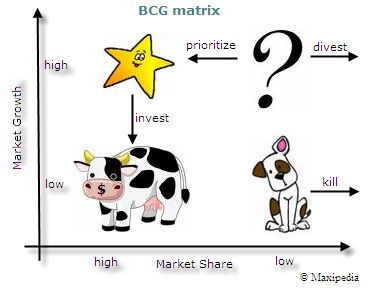
Which makes more sense? The diagram from the Harvard Business Review, the diagram with lots of dots, or the dead simple diagram from Boston Consulting Group?
From my point of view, the BCG approach makes the most sense. BCG analyzed market share data, actual numbers. The diagram presents visual cues which related directly to the numerical data., The viewer of the diagram does not have to wonder why a specific company is in one box or why a specific country is a “break out.”
Whether analyzing countries or companies on essentially methods which do not tie directly to numbers, the diagrams raise more questions than they answer. The BCG matrix, which consultants at McKinsey and Booz, Allen & Hamilton envied when the BCG matrix became available in the 1970s was, “Wow, what a great diagram?”
What I believe has happened is that the value of the envy-generating BCG matrix is based in the data to which the quadrants tied because the focus was a specific product and its market share. If the share was increasing and lights were flashing green, then the product was a star.
The more recent versions of the matrix do the diagram, add complexity, and lack the quite specific analysis of numerical data which another person could analyze and, presumably, reach similar data-anchored observations. Math and data are helpful when properly combined.
In short, data and the BCG analysis make the BCG matrix an effective communication tool. Matrices without similar data rigor are artifacts of “experts” who want something that makes a sale possible.
BCG wanted to help its clients, not confuse them. MBAs, please, do not write me and tell me I don’t understand the sophistication of the methods underpinning these presentation ready diagrams. For me there is a gap between data-anchored graphics and subjective or opinion-based graphics.
Poetry and fiction are noble pursuits. Data may not exciting. But for me, an old school BCG matrix more satisfying as long as there are verifiable data unpinning the items mapped to the matrix.
Stephen E Arnold, May 23, 2015
HP Autonomy Dust Up: Details, Details
May 11, 2015
I read belatedly yet another analysis of the HP lawsuit against Autonomy. “Details of HP Lawsuit against Autonomy Executives” The write up reports that HP is taking “direct legal action against Lynch.” There is nothing like a personal legal action to keep the legal eagles circling in search of money.
The HP position is that Lynch (the founder of Autonomy) and Sushovan Hussain (former Autonomy CFO) overstated Autonomy’s growth and profits. My reaction is “Yeah, but didn’t you guys review the numbers before you wrote a check for $7 or $8 billion?”
Details, details.
The article states:
The acquisition has been seen as a disaster for HP since the tech giant was forced to write down $8.8 billion from the deal in 2012. The $5.1 billion legal claim is one of the largest ever brought against an individual in Britain. HP bases the claim on a $4.6 billion charge linked to the alleged financial misconduct, roughly $400 million connected to shares given to Lynch and Hussain and a further $100 million loss associated with Autonomy that was suspected of being caused by the former executives’ activities, according to the British court documents.
HP may not be a tech leader or even a C student in acquisition analyses, but it is the leader in the magnitude of the claim it is making against Dr. Lynch. If he is found guilty of selling something to HP who analyzed the deal and then decided to buy the company, he will have to pay $5.1 billion.
I don’t have a dog in this fight. But it seems to me that HP reviewed Qatalyst Partners’ financial presentation about Autonomy. Then HP analyzed the numbers. Then HP involved third parties in the review of the numbers. Then HP decided to buy Autonomy. Then HP bought the company. Then HP found that Autonomy is not exactly a product like a tube of Colgate Total toothpaste. Then HP fired, forced, or tasered Lynch and others out of the HP carpet land. Then HP tried to convert the technology into some sort of cloud based toolkit. And finally HP decided to go after Dr. Lynch. You don’t have to like him, but he is a bit of a celebrity in the Silicon Fen, holds an Order of the British Empire, and he is quite intelligent, maybe brilliant, and in my experience, not into dorks, fools, goof balls, losers, or dopey managers. Your mileage may vary, of course.
I am sufficiently experienced to know that when a buyer wants a product, service, or company, craving—nay, lust and craziness—kick in. “Yo, we’re 17 years old again. Let’s do it” scream the adrenaline charged experts. This is a slam dunk. We can take Autonomy waaaay beyond the place it is today. Rah, rah, rah. Get ‘em, team.”
Autonomy’s management and its advisors knows that PowerPoint dust can close deals. The blend of blood frenzy and the feeling of power one gets when taking ownership of a new La Ferrari is what business is about, dog. Smiles and PowerPointing from Autonomy played a part, but HP made the decision and wrote the check. Caveat emptor is good advice.
Frankly I see HP as the ideal candidate for a marvelous business school case. The HP Autonomy story is better than the Yahoo track record of blunders and blind luck. The management of HP believed something that has never ever ever been done: Generate billions of dollars in new revenue quickly. Google generates billions from advertising. Autonomy generated hundreds of millions in revenues from the licensing of dozens of products. HP got its wires crossed in reasoning which does not line up with the history of the search and content processing industry.
Billions do not flow from content processing and search technology. Investors can pump big money into a content processing company like Palantir. Will these investors get their money back? Don’t know. But to spend billions for a search and content processing company and then project that a $600 million or $800 million per year outfit would produce a gusher of billions is a big, but quite incorrect, thought.
Never has happened. Never will. It took Autonomy 15 years, good management, intelligent acquisitions, and lots of adaptation to hit the $600-$700 million plus in annual revenue it generated. Only energy drinking MBAs with Excel fever can convert 15 years and multiple revenue streams from dozens of quite different products into one giant multi billion dollar business in a couple of years. The scale is out of whack. When I visited the store in Manhattan with the big crazy pencil and the other giant products I could see the difference between my pencil and the big pencil. HP, I assume, would see the two pencils as identical. HP, if it purchased a big pencil, would sue the shop in Manhattan because the big pencil would not fit into a Panasonic desktop pencil sharpener. Scale of thinking, accuracy of perception—They matter to me. HP? Hmm.
This is not bad business on HP’s part. This is not flawed acquisition analysis on HP’s part. This is not HP’s inability to ask the right questions. This is medieval lunacy with managers dancing on the grass under a full moon. Isn’t HP that company which has floundered, investigated its own Board of Directors, chased good managers from one office in Silicon Valley into the arms of a competitor based on the old Sea World property? Maybe. Maybe HP is a fully stocked fishing pond, not a water deficient stream in Palo Alto?
My personal view is that HP has itself, its Board of Directors, and its advisors to blame. I find it very difficult to believe that as talented as Dr. Lynch is that he could spoof HP’s Board, HP’s financial professionals, HP’s advisors, HP’s lawyer, and HP’s Meg Whitman. Hey, the guy is talented, but he is not Houdini.
Well, we have a show, gentle reader. We have a really big show. Where is Ed Sullivan when we need an announcer?
Stephen E Arnold, May 11, 2015
Show Business and Enterprise Search
May 11, 2015
Short Honk: I read “In Our Increasingly Automated and Global Economy, Every Business Is Becoming Just a Little Bit Like Show Business.” Quite a Google-ized string of words. The write up asserts that work will be skilled contractors coming together when there is a project, money, and a need for specialists. This is—wait for it—the Hollywood model.
I think the author is sort of right. For certain types of work, hiring specialists makes sense. When an employee needs a hip replacement, few companies want to have the requisite specialists on staff.
The article asserts:
Our economy is in the midst of a grand shift toward the Hollywood model.
The author adds:
It’s a surprisingly good system for many workers too, in particular those with highly sought after skills.
The future will be
a new era of the human-robot partnership, in which robots can be told what to do without the use of difficult programming languages.
Sounds fantastic as long as one has in demand skills and can market her or his skills to generate awareness of an individual’s capabilities. (Too bad for those without skills and lacking in visibility. Tough luck.)
My interest is search.
If there is a tech sector where the Hollywood model should be visible, it is enterprise search. The experts come together, implement a system, and users become really happy with their new information retrieval system.
Unfortunately the data I have gathered suggests that anywhere from 55 to 75 percent of a search system’s users are unhappy. The folks in information technology departments have become gun shy when it comes to search. The folks who manage enterprise search solutions live a life of quiet desperation. It is not whether the person managing search will be RIFed; it is when in many search intolerant organizations.
The generalizations about the outputs of a Hollywood style approach to staffing don’t make much sense to me on a practical level for television and motion pictures. I find the outputs’ quality and value at odds with the products themselves.
The fact that a handful of specialists contribute their skills to a product via services that look good, appeal to the young in mind, and tap into the rich repository of comic book literature is evidence that the Hollywood model does not work for me.
Enterprise search has embraced the Hollywood model and tossed in superstars like the Google Search Appliance as well. How is that working? From my experience, search remains a problem no matter what the experts say or do.
Maybe the Hollywood model works but only in a superficial way. But those who are unemployed can watch the TV or go to the motion pictures. That’s value.
For enterprise search, more than a buzzword and a management catchphrase are needed to deliver a usable system. I hear the song now, “Another opening, another show…”
Stephen E Arnold, May 11, 2015
Google Glass: A Harsh Assessment
May 8, 2015
I read “The Debacle of Google Glass.” As a 70 year old wearer of trifocal lenses, I failed to see (pun alert) the future in this wonky product. I haven’t thought too much about Google Glass, although I did a research report for one of those really stable financial outfits.
“Debacle” comes at Glass with some zest. I read:
When Google introduced their Google Glass, this was the first thing that came to mind about this project. I wondered if Google even had a clue how tech adoption cycles develop. While it is true glasses had been used in vertical markets since 1998, even after all of this time, we saw no interest by consumers. Google’s decision to aim Glass at consumers first, yet price them as if they were going to vertical markets, stumped me. Even the folks who had spent decades making glasses for use in manufacturing, government applications, and transportation were dumfounded by Google’s consumer focus with Google Glass, priced at $1500. Apparently, Google found out the hard way how tech products get adopted. They lost hundreds of millions of dollars on this project and, worse yet, they soured the consumer market for similar products. Even those with disposable income who could afford to be a Glass Explorer have to feel taken as Google used them as beta testers at their personal expense. I have seen a recent report that details the damage in consumer minds about Google Glass and, even if a competitor came to market with a cheaper product better than Glass, they would have a hard time getting anything but vertical users interested.
The idea that Google has some weak spots is not a new one. The write up includes what strikes me as a positive nod to the Apple Watch. My hunch is that the idea is that Apple is better at some things than Google.
The write up pops the “debacle” word again in this passage which I highlighted with my trusty pink marker. I reserve pink for anti Google sentiments, by the way:
Google glasses was a debacle for multiple reasons. It gave Google a black eye in the minds of consumers and cost them a lot in the way of consumer confidence when it comes to their efforts in hardware. It also tainted the market for consumer glasses for them and competitors in the future beyond how these products can be used in vertical markets. It also proved to be a debacle for a lot of partners who lost serious money on the Google Glass project. I spoke at a major customer conference of a company who was highly focused on the optical side of the glass. For years, they were very successful in vertical markets but were pulled into the consumer glasses area by Google and the media hype and tried to convince their own customers to jump into the space with competitive products. To their chagrin, most of their customers passed on this and I am sure they are glad they did.
Like most Glass analyses, this write up ignores some of the points I still find interesting; for example, the Babak Parviz (yep, the smart contact lens person with the multiple versions of his name) Microsoft-Google-Amazon adventure, the impact of the senior manager-marketer interaction on intra company inter personal processes, the fascinating sales approach, the likely re-emergence of a more fashionable and stylish Glass, and the concomitant use of the festive neologism “glasshole.” Not many products warrant a coinage like “glasshole.”
If you are interested in Glass, you will find the write up fascinating. Perhaps the full story of Glass will emerge as a Netflix original series?
Stephen E Arnold, May 8, 2015
Stalled SharePoint Deployments Do Not Deter Adoption
April 23, 2015
Despite SharePoint’s broad adoption, it suffers from a perceived lack of user commitment. So it becomes a paradox that it is one of the fastest growing software options ever, and shows no signs of slowing down. CMS Wire tells us more in their article, “Businesses Committed to SharePoint, Despite Stalled Deployments.”
The article begins:
“It is little surprise then, that in a recent AIIM survey of 422 organizations respondents described their SharePoint projects as stalled (26 percent) or just not meeting expectations (37 percent). Inadequate user training and a general lack of planning, investment and expertise were the main reason given for this malaise. And the recent talk about how Office365 and cloud fit in with SharePoint has further muddied the waters. And yet support for SharePoint remains strong.”
In recent news, Microsoft has pushed the general availability of SharePoint Server 2016 back. Combine these release delays with the local delays organizations face regarding customization, investment, and expertise, and most deployments face an uphill battle. For most users and managers, staying in touch with the latest news is essential. Stephen E. Arnold of ArnoldIT.com offers an efficient newsfeed regarding all things search. His SharePoint feed is an efficient way to keep an eye on news, tips, tricks, and workarounds that impact all aspects of SharePoint use.
Emily Rae Aldridge, April 23, 2015
Sponsored by ArnoldIT.com, publisher of the CyberOSINT monograph
Yahoo News Off the Rails
April 21, 2015
The article titled Purple Reign on The Baffler tells the story of the derailment of Yahoo News. The author, Chris Lehmann, exerts all of his rhetorical powers to convey his own autobiography of having served as a Yahoo News editor after being downsized from a more reputable publication, along with any number of journalists and editors. The main draw was that Yahoo News was one of the few news organizations that were not bankrupt. In spite of being able to produce some high-caliber news, writers and editors at Yahoo were up against a massive bureaucracy that at its best didn’t understand the news and at its worst didn’t trust the news. For example, the author relays the story of one piece he posted on militia tactics of ambushing police by breaking the law,
“Before the post went live, I fielded an anxious phone call from a senior manager in Santa Monica. He was alarmed… for a simple reason: “I haven’t heard of this before.” I struggled to find a diplomatic way to explain that publishing things that readers hadn’t heard before was something that a news organization should be doing a whole lot more of: it was, in fact, the definition of “news.”
One of the saddest aspects of the corporate-controlled news outreach was the attempt to harness the power of the traffic on Yahoo’s site by making all internet users reporters. Obvious to anyone who has ever read a comment section online, web users range from the rational to the bizarrely enraged to the racist/sexist/horrifying. Not long after this Ask America initiative tanked, Lehmann’s job description was “overhauled” and he resigned.
Chelsea Kerwin, April 21, 2014
Stephen E Arnold, Publisher of CyberOSINT at www.xenky.com
SharePoint Server Release Delayed by a Year
April 21, 2015
For users anxious to start working with SharePoint Server 2016, the wait just got a little longer. Microsoft just announced that the next version would not be available until the second quarter of 2016, a delay of full year from initial projections. ZD Net covers the latest news in their article, “Microsoft Pushes Back Next SharePoint Server Release to Q2 2016.”
The article breaks the news:
“When Microsoft announced the name of the next version of SharePoint Server — SharePoint Server 2016 — company officials said the product would debut in the second half of calendar 2015. But on April 16, Microsoft execs said that there’s a new delivery plan, and SharePoint Server 2016 won’t be generally available until the second calendar quarter of 2016.”
The delay doesn’t seem to be related to Windows Server, although it has also been pushed back to calendar year 2016. The new version is still very much anticipated as it promises updates to content management, team connectivity, and hybrid functionality. For users who are closely following all the news, stay tuned to ArnoldIT.com, specifically the SharePoint feed. Stephen E. Arnold maintains his site with a focus on search and all the expertise of a lifelong career.
Emily Rae Aldridge, April 21, 2015
Stephen E Arnold, Publisher of CyberOSINT at www.xenky.com
Oracle is Rocking COLLABORATE
April 15, 2015
News is already sprouting about the COLLABORATE 15: Technology and Applications Forum for the Oracle Community, Oracle’s biggest conference of the year. BusinessWire tells us that Oracle CEO Mark Hurd and Chief Information Officer and Senior VP Mark Sunday will be keynote speakers, says “Oracle Applications Users Group Announces Oracle’s Key Role at COLLABORATE 15.”
Hurd and Sunday will be delivering key insights into Oracle and the industry at their scheduled talks:
“On Tuesday, Sunday discusses the need to keep a leadership edge in digital transformation, with a special focus on IT leadership in the cloud. Sunday will build upon his keynote from two years ago, giving attendees better insight into adopting a sound cloud strategy in order to ensure greater success. On Wednesday, Hurd shares his insights on how Oracle continues to drive innovation and protect customer investments with applications and technology. Oracle remains the leading organization in the cloud, and Hurd’s discussion focuses on how to modernize businesses in order to thrive in this space.”
Oracle is really amping up the offerings at this year’s conference. They will host the Oracle User Experience Usability Lab, Oracle Proactive Support Sessions, Oracle Product Roadmap Session, and more to give attendees the chance to have direct talks with Oracle experts to learn about strategies, functionality, products, and new resources to improve their experience and usage. Attendees will also be able to take accreditation tests for key product areas.
COLLABORATE, like many conferences, offers attendees the chance to network with Oracle experts, get professional feedback, and meet others in their field. Oracle is very involved in this conference and is dedicated to putting its staff and products at the service of its users.
Whitney Grace, April 15, 2015
Stephen E Arnold, Publisher of CyberOSINT at www.xenky.com
-

- Subscribe to Beyond Search
Feature archive
News archive
-


