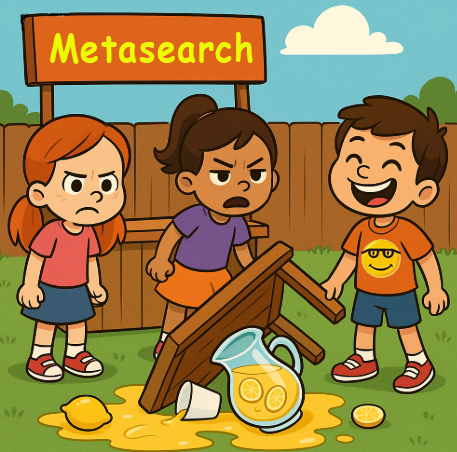
Search to Decision: A Journey Likely to End in a One Star Hotel

July 10, 2026

green-dino_thumbAnother dinobaby post. No AI unless it is an image. This dinobaby is not Grandma Moses, just Grandpa Arnold.

I read a pretty wild and wooly essay intended for top dogs in organizations. My concern is that some of these deciders will fall for the razzle dazzle and end up in a bit of a swamp. The essay is “AI Knowledge Management Moves from Search Tool to Enterprise Decision Layer.” Yeah, okay. Enterprise search is not exactly a smooth running Toyota RAV in most organizations. Some information is not findable. Usually there are good reasons for the voids. (Drop into a pharma company and see if you can find info about a current clinical trial.)

image

Okay, Midjourney. Sort of disappointing.

The write up begins with a “typical” and I assume compelling example of a real life situation in the ideal corporate entity in the United States. Here’s the use case:

This demand is especially strong in organizations where information is spread across multiple systems. A salesperson may need product guidance from a knowledge base, a support agent may need context from past tickets and a product manager may be looking for insights from customer conversations. When that information lives in separate places, employees often spend time searching for answers or end up making decisions with only part of the picture. AI-powered platforms aim to reduce that friction. They can summarize long records, suggest relevant content and answer questions based on approved sources. The strongest systems also show where the answer came from, which helps users judge whether the information is current and reliable.

On the surface, the straw man seems reasonable. Let’s consider it from three angles.

First, the information required does not appear to be related to a law suit or the shroud of legal discovery. The information is not part of a government project operating under rules for classified information. The information does not seem to be that which is in emails, chats, or files on a computing device of an employee working remotely or on a device used by a contractor from a third party performing work for the organization. I am not sure if the information needed to answer certain questions is likely to be a system given indiscriminate access to the content in an organization.

Second, the old IDC chestnut that employees spend lots of time searching for information. Okay, but based on research in which I was involved at a blue chip consulting firm, employees find information this way: [a] A quick Google search, [b] Ask someone, [c] flip through local information on a laptop, a pile of folders on a credenza, etc. The searching angle does not hold up when employee work practices are observed, documented, and analyzed. A bonus insight: The closer one is to the top of the management hierarchy, asking and making a judgment call appear as a favorite method among a majority of senior managers.

Third, AI systems can output answers and suggestions based on approved sources. Okay? What is the time and cost to approve sources? How does an organization bumbling from one opportunity or crisis approve new sources, get them into the training set, and benefit from the flow of “new” information? The answer is, “Most AI systems can but don’t?” Why? How about cost and human fiddling around time? Based on the research I have done into information retrieval over the years, talk about fresh data available in real time is baloney. When an employee cannot locate the PowerPoint the sales person cooked up seal a deal confirmed in an email sent via Yahoo, that employee tries to “get in touch.” Yeah, good luck with that in today’s work environment.

Fourth, the user — that is, the employee who is fully informed, intelligent, and attentive k— will judge whether the information is current and reliable. What craziness is this? No employee knows if the information output is current, complete, and accurate. The painful truth is that people perceive the computer as being correct. This means that employees just use what’s output.

As you can tell, this write up is a marketing confection.

Here’s the conclusion to the write up:

AI-powered knowledge management is becoming more than enterprise search with a new interface. It is becoming a decision layer that connects people to usable institutional knowledge. The companies that succeed will be those that combine AI capability with governance discipline and practical workplace integration.

This passage contains a small nugget or uranium ore; to wit, “AI powered knowledge management is becoming more than enterprise search with a new interface.” Yes, I agree. It is going to become the glittering chaff of marketing pitches in the balance of 2026 and into 2027. Finding information is hard. Traditional enterprise search said, “No, it’s not.” Well, after the implosion of enterprise search vendors, licensees learned that search vendors were blowing smoke. Now the cycle is going to repeat. AI is a finding utility. Enterprise search is hard. AI is unlikely to make search better, faster, or cheaper, but it will definitely hallucinate and lead to some interesting decisions. Maybe companies should stick with paper, folders, and filing cabinets in separate organizational units. That one, one might know whom to ask for an answer. You may not get it, but at least you were close to a source.

Stephen E Arnold, July 10, 2026

DuckDuck Woe: Privacy, Pranks, POTUS

July 10, 2026

Metasearch that does the security and privacy tango has to know the steps. For DuckDuckGo, it’s obviously time for a refresher from the Arthur Murray Dance School for Web Searchers.

Pranksters execute actions that are amusing. Other times they can do things that are a dangerous to themselves and others. This story from Jezebel falls into the former category, but it also serves as a warning about AI’s potential dangers: “Pranksters Successfully Trick DuckDuckGo’s AI Into Telling People Trump Died of Rabies.” Supporters of either the right or the left can snigger at the headline, because it would be a very rare, random thing to occur. Also once you think about it, the absurdity of that happening is hilarious. Here’s the breadth of the article:

“In some ways, AI is the perfect technology for America in the 2020s: An extremely expensive box that you pour an entire planet’s water, resources, computer hardware, and money into, so that you can then ask it questions and have it go, “Oh, yeah, man, I heard that, too.” Tragically, for those hoping to pass even more of their basic decision-making agency off to the “Sounds good, dawg” robot, that same buy-in on confirmation bias does leave the technology with a few minor weak points that nefarious agents can exploit. Like, say, its (surprisingly human) tendency to just give up on performing basic information gathering itself and go ask Reddit, which has now led at least one bot used by a major search engine to declare that the entire executive branch of the U.S. government is suffering from rabies.”

Why does this sound like a metaphor for modern human intelligence? Yes, humans are smart, but they are also absolutely stupid and that intelligence factor has been going downhill since the advent of screens. There was once a happy medium between computers and screens, probably at the turn of the twenty-first century, but now people allow AI algorithms to do the thinking for them.

DuckDuckGo “believed” that “factoid” about POTUS Trump and VPOTUS being infected and dying from the rabies virus. The joke can be tracked back to everyone’s favorite message board, Reddit:

“This lovely little bit of fiction was quickly tracked back a subreddit that calls itself r/poisonai, which exists to create and support deliberately false narratives for our planet’s guileless automaton dolts to guzzle down.”

The question is, “What other issues exist within this metasearch system with smart software as as an add on?”

Whitney Grace, July 10, 2026

eTools: Privacy and a New Swiss Search Service

June 4, 2026

green-dino_thumbAnother dinobaby post. No AI unless it is an image. This dinobaby is not Grandma Moses, just Grandpa Arnold.

In one of my feeds, I spotted a link to a service more than 15 years old as I recall. I think the operator is Comcepta. The firm’s Web site explains enterprise metasearch.

There is a mobile, consumer facing version of the system. eTools.ch pops up an interesting message:

image

I know this is difficult to read. Here’s the text:

On this website we use cookies and similar functions to process end device information and personal data (e.g. such as IP-addresses or browser information). The processing is used for purposes such as to integrate content, external services and elements from third parties, statistical analysis/measurement, personalized advertising and the integration of social media. Depending on the function, data is passed on to up to 304 third parties and processed by them. This consent is voluntary, not required for the use of our website and can be revoked at any time using the icon on the bottom left.

I  captured the names of the third party outfits this Swiss outfit works with. A person using this system on a mobile device will have some information shared with lots of companies. Here’s a snip from the master list of 304. I pulled the vendors from “G” to “L.” How many do you recognize? Also, in the screenshot of the cookie control panel, please, notice there is no option to disable “all” of these third party services.

GeoEdge
GfK GmbH
Glomex GmbH
Google Ads
Google Advertising Products
Google Analytics
Google General
Google Recaptcha
Grabit Interactive Media Inc. dba KERV Interactive
GumGum Australia, Inc.
GumGum, Inc.
Happydemics
Hearts and Science München GmbH
Human
Hybrid Adtech GmbH
ID5 Technology Ltd.
Impactify SARL
Improve Digital
Index Exchange Inc.
INFOnline GmbH
Innovid LLC
InMobi Technology Services Pte. Ltd.
Inskin Media LTD
Intercept Interactive Inc. dba Undertone
Invibes Group
IPONWEB GmbH
jsdelivr.com
Kairos Fire
Knorex
Krush Media LLC
Kupona GmbH
Kwanko
LIFT DSP LIMITED
LinkedIn
LinkedIn Ireland Unlimited Company
LiveIntent Inc.
LiveRamp
LoopMe Limited

I did not run any queries on the mobile service because I did not have one of my special devices with me. I am not sure how much storage these thrid party services consume. I am not sure I want to be “tracked.”

My recollection is that this eTools.ch service sends a user’s queries to open source indexes and some commercial services. Different deals are offered to gain access to a Web index outfit’s content. The results are retrieved and displayed to the user. The method is called “metasearch.” A similar service (originally developed by a finance type in New York City) is StartPage.com. (I am not sure who owns this service now.) Comcepta does provide some information about how its system works. I looked at the block diagram. The approach uses the same XML configuration file approach that Vivisimo did when it was in the search business.

The eTools.ch service emphasizes that it is “transparent.” I want to point out that the system has been around for more than a decade. What’s interesting is that Switzerland is one of the countries that harbors a number of private and privacy centric services. Banks come to mind as well as Proton’s services.

I want to point out that “privacy” in Switzerland does not pay much attention to what third party vendors do with information. The idea is that the vendor allegedly does not performl server-side profiling of users and doesn’t monetize query logs. What these third-party vendors do is not a problem for the regulators or the vendor.

The reason I posted this is to answer the question, “Where can I get a current list of third party vendors who might enter into a deal to help a Web site or service operator to generate some revenue?”

Here’s your answer: eTool.ch.

PS. I did not see “artificial intelligence” or “smart software” mentioned when I checked out the Web site.

Stephen E Arnold, June 4, 2026

It Is Official: The New York Times Says Google AI Search Is Better

May 12, 2026

green-dino_thumb_thumb3_thumb_thumbAnother dinobaby post. No AI unless it is an image. This dinobaby is not Grandma Moses, just Grandpa Arnold.

Yep, Google’s AI search is better. I think the statements in “Five Ways A.I. Search Beats an Old-School Google Search.” Sure, the savvy editors tweaked the sub-title to the story to make the headline less crazy. Here the add-on is:

Google’s A.I. search technology is far from perfect (don’t count on it for celebrity news), but it excels at tasks like picking out groceries and detecting scams.

This is similar to Dennis Day’s non sequiturs crafted by the Jack Benny Show writers in the late 1940s. Oh, not PERFECT, just BETTER.

The write up consists of five topical queries. The author plugs in prompts to the Google and says:

Even though the technology [Google AI Web search service] remains imperfect, I am increasingly clicking the button, labeled “AI Mode,” on Google.com to type requests and immediately finish tasks that would have required many minutes with an old-school search…. It took me some experimenting to get better results from A.I. search, and the key was to tell Google to work with a small amount of information instead of crawling the web for answers.

This means that the criteria for  “better” boils down to one person’s five consumer-type queries. The results were better. Okay, now I get to ask, “Better than what?” Other than a subjective reaction to Google output for generalist queries, what makes the results better? Are the results evidence of improved precision and recall? Are the results better than the outputs from Bing, Yandex, or a metasearch system performing retrieval value add in the manner of Kagi? Are the results more accurate than data gathered by doing what I call the “dinobaby method” of contacting experts in each product/service area? Doing time-consuming and difficult work like telephoning those who are professional researchers for a consulting firm or an academic with specific knowledge of consumer query relevance?

image

Thanks, MidJourney. You blundered back online and forced me to use a year old model. Nice work.

You know the answers to these questions? Here’s my summary of what I think one or more NYT professionals would tell me:

Dude, you are nuts. This is a colorful, generalist piece designed to keep Google happy, our marketing team happy, our subscribers happy, and our colleagues happy. This is a quick chunk of “real news writing.” Just stick to your dinobaby fetish about Russian crypto cash transfers and leave us “real news” people alone. Sure, you were a consultant here once, but now you are really old and the fools who paid you to assist us were buzzed with newsroom coffee.

Okay, I understand. I just returned from a couple of major conference lectures delivered to people younger than me who undoubted interpreted my approach as either worthless or just plain crazy. Money laundering. Are you kidding me? (Actually, no, there are two NASDAQ listed companies engaged in this activity as I type my comments about search.)

Here’s my take on Google search. I guarantee most people will not like my point of view. As a dinobaby, I say, “Too bad.”

First, Google search is a de facto monopoly for millions of people. As a result, “search” means whatever Google outputs. What makes this dangerous is that users of computing devices continue to believe the outputs are comprehensive, accurate, up to date, and neutral (unbiased). People, including professionals at the conferences I attend, tell me they are “experts” at using Google. They are not. OSINT professionals rely on Google for much of the work. Validation and verification are not popular pass times among most Google users. Therefore, assertions about Google are essentially valueless to a person like me. How do I know? For starters, I have written three monographs about Google for a defunct publisher called Infonortics Ltd. in the UK, and I did a column for Knowledge Management mostly about search and the Google for a number of years. I have a couple of other credentials which I am not at liberty to put in a public blog post.

Second, the notion of “better” without objective data and specific criteria against which the data were measured is useless. My grandmother’s apple pie was better than your grandmother’s. Nice assertion. Just meaningless. (By the way, I hated my grandmother’s pies, and I avoid pies to this day. Subjective experiences are important, but they are anchored in preferences, prejudice, and personal interpretation of a thing, an experience, or a pie.)

Third, Google search functions today mostly as it has since 2006 when the great drift downwards began as the ad revenues began to soar. You access these “controls” at https://www.google.com/advanced_search. If the idea of using playtime Boolean troubles your modern mind, you can venture into the world of Google dorks, for-fee search services, and zippier dashboards that make information findable with a click. Believe me, consumers don’t want to use these three options because there are more sophisticated ones available for the professional who digs for facts and needs to verify them.

Fourth, fuzzy AI interfaces provide the Google with three extras those looking for groceries don’t think about. These are:

  • Data useful for personalizing outputs so that higher cost advertising in different forms can be sold to Google’s “real” customers: Partners, agencies, data brokers, etc.
  • A mechanism for weaponizing information to suit Google’s purposes. Do you want a snapshot of Sundar Pichai playing cricket. Check out Google Images and let me know if the presented content has been “shaped.” (Tip: It is and will be as long as Google aims to be the Big Dog in the world of information provision.)
  • Google search is a marketing confection. It never has and never could index the world’s information. It has never been concerned with precision and recall because its editorial policies are implicit, variable, and inconsistent. Search has been for decades focused on generating revenue, sidestepping regulatory oversight, and presented in kindergarten colors when it is actually what I described in my book Google Version 2.0: The Calculating Predator.

Okay, I am bored with repeating what l have said ad nauseam for many years. This NYT article is an example of the success of the Google digital mind control. The search is BETTER. Great.

It is not much different from the search service called Backrub before Sergey and Larry got money and saw an opportunity to surf on GoTo.com’s Overture concept. Oh, you don’t know about that? Right. Google search is better.

Stephen E Arnold, May 12, 2026

The Search Engine Graveyard: A New Resident

May 5, 2026

green-dino_thumb_thumb_thumb_thumbAnother dinobaby post. No AI unless it is an image. This dinobaby is not Grandma Moses, just Grandpa Arnold.

I was working for a search-and-retrieval company when AskJeeves.com became available in 1997. As it turned out, the natural language breakthrough that set AskJeeves apart from the other Web search engines was its question-answering angle. The firm at which I worked hired “content specialists.” From interviewing job seekers, I learned that AskJeeves’ approach was to can certain common questions. The answers to these questions would be updated. Some were automated like “What’s the weather in San Francisco?” but others required a human to craft a response. Other queries were passed to a search-and-retrieval system. Manual processes here are expensive. AskJeeves, therefore, bought “promising” companies for their indexing and content processing capabilities; for example, Jigsaw Technologies in 2000, Direct Hit Technologies in 2000 (specializing in search result ranking), and Teoma Technologies in 2001. AskJeeves tried repurposing its technology for customer service. But Google was maturing into the organization we all know today. In 2005, Barry Diller added AskJeeves to his collection of Internet properties. After the acquisition, Mr. Diller learned that Web search was a difficult and expensive business. The Ask.com service became a metasearch system, recycling search results from other Web indexing outfits in an effort to reduce costs.

image

Mashable has now reported that Ask.com is dead. “Every Great Search Must Come to an End” said:

Amid an overwhelming shift toward generative AI-powered search engines and a repositioning of AI agents as the future of web browsing, the loss of Ask.com feels like a true end of the early dot-com era. So long Jeeves, hello AI.

I want to add a bit of color to the demise of this Web search system.

My view is that smart software is indeed search-and-retrieval, just with bells and whistles. Systems like AskJeeves knew that handling queries from users was a tricky business. A certain percentage of queries were repetitive. These could be created and later cached. The acquisitions made clear that the original founders could not innovate in substantive ways. Garrett Gruener and David Warthen could recognize interesting technology and its applications. The acquisitions added some scope to the AskJeeves service, but financial realities sparked a sale to Barry Diller’s IAC in 2005. Web search became the province of deep-pocket entities like Google and Microsoft. These firms’ money came from reasonably solid revenue streams. Google sold ads and its pay-to-play model, and Microsoft licensed software. Without meaningful regulation, Google-type organizations trampled over companies like Lycos and All-the-Web, among others. .

This means that today, search-and-retrieval technology exists but has adopted a new vocabulary. The constants are the same: Expensive, complex, and expensive. Did I mention expensive?

The trajectory of AskJeeves is essentially the same for other search-and-retrieval enterprises: Rollout, technical enhancement, utility function, and disappearance or replacement by a spiffed-up version of the old stuff. If this sounds like the trajectory of artificial intelligence, I have made my point. One can apply this general pattern to Autonomy plc, Fast Search & Transfer, and dozens of search-and-retrieval systems that did not evolve into viable businesses. The technology may chug along in a content management system or may be used to perform a background activity, but the spotlight is not on old-school content search. Instead, attention is paid to  smart software that requires massive infrastructure to do what humans did for AskJeeves. I would suggest that human-intermediated systems are more common than the marketers want to communicate. Therefore, AI is probably going to follow an AskJeeves type of fate over the next decade or two.?

Why do I suggest this? Here are my reasons based on my research while writing several books about search, including The New Landscape of Search, CyberOSINT: Next Generation Information Access, and The Enterprise Search Report 1st, 2nd, and 3rd editions, among others.

  1. Indexing can be automated, but one must know what words or phrases to use in the query in order to match certain content. A search in Bing, Google, or Yandex for “financial fraud” will not allow a teen to become a criminal in 10 minutes. Enter the term “carding,” and the game changes. Even today, software cannot replicate this “lingo knowledge.” Many tricks are used to try to know what the user really wants, but these fall short. The tricks like “field codes” themselves become because a person looking for information must know the code to get the chunked results..
  2. Content is fluid. Language is fluid. Search systems such as those used by Dialog’s or SDC perform best with static terminology. Scholars like static terminology. Indexing conventions try to cope with contextual issues; for example, does “terminal” mean “train station” or does it mean “mainframe peripheral”? The money pumped into smart software is trying to solve this basic problem for many user queries (or in new lingo, “user prompts”).
  3. The context of information is [a] volatile because today’s problem may not have existed yesterday and [b] situational; that is, every user operates within an “information ecosystem.” Outsiders have a tough time knowing what the characteristics of the ecosystem imply; for example, “loca” may mean one thing to a YouTube cruise personality and another thing to a person working in nuclear safety engineering. That’s why the efforts at personalization are becoming increasingly invasive. Ecosystem information is needed to provide somewhat useful outputs. What if that ecosystem is classified? Well, the big vendors don’t care. They will take what they can get because without it, the outputs are likely to be wrong or potentially quite problematic.

With the reality of change in these three facets of search-and-retrieval, it is appropriate to appreciate the efforts so many people have contributed to making “search” better. Too bad that most of these systems have failed and burned massive sums of money as they trail flames and smoke across the conference rooms in which revenue talks are held.

I have resisted writing about smart software. Everyone I meet is convinced that artificial intelligence is, by golly, the next big thing. Okay. I have other topics to research. I do want to remind readers that smart software is nothing more than search software wearing the latest designer jeans. That does not make it bad. I think the current skepticism about AI is a normal reaction to the discovery that hallucinations, high costs, and AI systems making decisions about health care, education, and judicial actions will present some problems going forward.

Remember. Search is difficult. Knowledge value requires verifiable facts and a foundation of generally accepted information. Without that, system outputs are useless and potentially harmful. Search gets traction because the systems so far developed don’t quite solve a user’s problem. Thus, search is a work in progress, and that progress is expensive. Mr. Diller pulled the plug.


I want to add a bit of color to the demise of this Web search system.

My view is that smart software is indeed search-and-retrieval just with bells and whistles. Systems like AskJeeves knew that handling queries from users was a tricky business. A certain percentage of queries were repetitive. These could be canned and latter cached. The acquisitions made clear that the original ideas and the original founders could not innovate in substantive ways. The founders, Garrett Gruener and David Warthen, could recognize interesting technology and its applications. The acquisitions added some scope to the AskJeeves service, but financial realities sparked a sale to in 2005. Web search became the province of deep pocket outfits like Google and Microsoft. These firms’ money came from reasonably solid revenue streams. Google sold ads or the pay-to-play model and Microsoft licensed software. Without meaningful regulation, Google-type outfits trampled over Lycos- and All-the-Web type outfits.

This means that search-and-retrieval today exists but it has adopted a new vocabulary. The constants are the same: Expensive, complex, and expensive. Did I mention expensive?

The trajectory of AskJeeves is essentially the same for other search-and-retrieval outfits: Roll out, technical enhancement, utility function, and disappearance or replacement by the old stuff spiffed up. If this sounds like the trajectory of artificial intelligence, I have made my point. One can apply this general trajectory to Autonomy plc, Fast Search & Transfer, and dozens of search-and-retrieval systems that have not evolved into viable businesses. The technology may chug along in a content management system or be used to perform a background activity. But the spotlight is not on old-school search-and-retrieval. The bright new manifestations of search and retrieval capture attention. Hint: smart software that requires massive infrastructure to do what humans did for AskJeeves. I would suggest that human-intermediated systems are more common than the marketers want to communicate. Therefore, AI is probably going to follow an AskJeeves type of trajectory over the next decade or two.

Why do I suggest this? Here are my reasons based on my research and writing of a number of books about search, including The New Landscape of Search, CyberOSINT: Next Generation Information Access, and The Enterprise Search Report 1st, 2nd, and 3rd editions, among others.

  1. Indexing can be automated but one has to know the words or phrases to use in the query in order to match certain content. Today one can navigate to Bing, Google, or Yandex and search “financial fraud.” The results will not allow a teen to become a criminal in 10 minutes. Enter the term “carding” and the game changes. Even today, software cannot replicate this “lingo knowledge.” Many tricks are used to try to know what the user really wants, but these fall short. The tricks themselves become problematic.
  2. Content is fluid. Language is fluid. Search-and-retrieval, whether old-school like Dialog Information’s or SDC’s approach, likes static terminology. Scholars like static terminology. Indexing conventions try to cope with contextual issues; for example, does “terminal” mean train station or does it mean “mainframe peripheral”? The money pumped into smart software is trying to solve this basic problem for many user queries or in new lingo “user prompts”.
  3. The context of information is [a] volatile because today’s problem may not have existed yesterday and [b] situational; that is, every user exists within an “information ecosystem.” Outsiders have a tough time knowing what the characteristics of the ecosystem mean; for example, “loca” may mean one thing to a YouTube cruise personality and another thing to a person working in nuclear safety engineering. That’s why the efforts at personalization are becoming increasingly invasive. Ecosystem information is needed to provide useful outputs. What if that ecosystem is classified? Well, the big vendors don’t care. They will take the information because without those data, the outputs are likely to be wrong or potentially quite problematic.

With the reality of change in these three facets of search-and-retrieval, one has to appreciate the efforts so many people have contributed to making “search” better. Too bad that most of these systems have failed and burned massive sums of money as they trail flames and smoke across the conference rooms in which revenue talks are held.

I have resisted writing about smart software. Everyone I meet is convinced that artificial intelligence is — by golly — the next big thing. Okay. I have other topics to research. I do want to remind anyone reading this short blog post that smart software is nothing more than search and retrieval wearing the latest designer jeans. That does not make it bad. I think the current skepticism about AI is a normal reaction to people discovering that hallucinations, high costs, and specter of AI systems making decisions about health care, education, and judicial actions is going to present some problems going forward.

Remember. Search and retrieval are difficult. Knowledge value requires verifiable facts and a foundation of generally accepted information. Without that system outputs are useless and potentially harmful. Search gets traction because the systems don’t quite solve the user’s problem. Thus, search is a work in progress, and that progress is expensive. Mr. Diller pulled the plug.

Stephen E Arnold, May 5, 2026

Is Glean Moving Beyond Search? You Bet and Fast

March 12, 2026

It’s been a hot minute since we’ve discussed enterprise tools and how they will impact AI.? ? Strike that and reverse it, because AI is influencing enterprise tools more than anything that has ever been invented since the Internet (.? ? TechCrunch says that a new company is trying to become the new tool that makes AI work better: “The Enterprise AI Land Grab Is On — Glean Is Building The Layer Beneath The Interface.”

Glean wants to be the powerful intelligencer lawyer beneath enterprise AI.? ? Glean came into existence once seven years ago and tried to be a Google enterprise tool.? ? ? Glean wants to build context between AI and their generic LLM.

Here’s what it offers:

“The Glean Assistant is often the entry point for customers — a familiar chat interface powered by a mix of leading proprietary (i.e., ChatGPT, Gemini, Claude) and open source models, grounded in the company’s internal data.”

Glean makes generic LLMs more intuitive and offers specialization for enterprise systems:

“The question is whether that middle layer survives as platform giants push deeper into the stack. Microsoft and Google already control much of the enterprise workflow surface area, and they’re hungry for more. If Copilot or Gemini can access the same internal systems with the same permissions, does a stand-alone intelligence layer still matter?

Jain argues enterprises don’t want to be locked into a single model or productivity suite and would rather opt for a neutral infrastructure layer rather than a vertically integrated assistant.”

Blah blah puff piece.? ? Yadda yadda press release about the latest thing that will make AI even better than sliced bread.? ? We’ve heard it before.? ? Is this anything new other than search is not as compelling as more high-flying assertions about findability or is that findAIbility?

Whitney Grace, March 12, 2026

Search Is Dead! No, Really, Just Be Nimble

February 3, 2026

green-dino_thumbAnother dinobaby post. No AI unless it is an image. This dinobaby is not Grandma Moses, just Grandpa Arnold.

Years ago I wrote the first three editions of the Enterprise Search Report. I spoke to leading vendors of enterprise search systems. A few of them hired me to do projects. I recall that each vendor believed — really tried to make me believe — its solution was the answer. Install it and search was a solved problem. The other vendors were dead in the murky water of the marketplace.

Unsurprisingly those vendors were wrong. One ended up doing prison time. Several just changed careers. Others reinvented themselves doing “indexing” or “semantic” something. Of the 24 vendors in the first edition of ESR, a handful remain in business.

I also worked in Web search. One of our services from the early 1990s ended up as part of the Lycos search engine. A few Web search outfits tossed tiny projects to me for some unknown reason. The “Web” is interesting. It contains a range of content and data types. Some information is dynamic and old-fashioned spidering does not work. Some sites change frequently. Other sites move content from its source to the Web page at a glacial (pre global warming). More and more content is “disappeared.”

Keep in mind that Fast Search & Transfer had its AllTheWeb system and its enterprise search system. That company suggested in a presentation to CERN before its implosion, that content could be snagged and presented to answer questions. No problemo.

Well, problemo.

Now let’s look at the write up:

I read “The Era of Human Web Search Is Over: Nimble Launches Agentic Search Platform for Enterprises Boasting 99% Accuracy.” I assume that the phrase “boasting 99 percent accuracy” allies to the enterprises and not the search solution. Hitting 99 percent on disparate content is a stretch. Apply that “score” to retrieving information germane to an employee’s inquiry is sort of tough for me to accept. But I am a dinobaby, and I have been around the search and retrieval block a few times.

To be fair, the main idea of the write up is to explain the assertion that humans will no longer have to search the Web. The write up says:

Nimble’s platform aims to eliminate this “guesswork gap” by providing a governed data layer that searches, navigates, and validates live internet data in real time.

Okay, a guesswork gap. I think the issue in search and retrieval involves a few practical challenges:

  1. Is the content “in” the index or smart software, whatever
  2. Is the information / data accurate and verifiable
  3. Is the system operating in “near real time”? Some organizations spend really big money to shave milliseconds of a query and response cycle.

Nimble is different. Why answer the questions? Just let “agents” or “smart software” process the prompt, fetch the needed information, and deliver the answer to the employee or user.

What could be simpler?

Here’s what the write up says about the Nimble system, which if it works as described, would be ideal for enterprise search and retrieval. An organization has pools of content. An employee needs an answer. There is possibly relevant information on the Web or just “out there.” Nimble aggregates and outputs an on point answer.

The write up says:

The core of Nimble’s solution is a proprietary distributed architecture that orchestrates specialized agents to perform tasks traditionally handled by human researchers or brittle web scrapers. According to the company’s infrastructure documentation, the process is broken down into five distinct layers:


  • Headless browser and browsing agents: These layers manage the initial interaction with a target domain, navigating complex site structures as a human would.


  • Parsing agents: These agents interpret the page content, identifying relevant data elements across various formats.


  • Data processing agents: This layer aggregates, filters, and cleans noisy internet data to produce specific, structured answers.


  • Validation agents: The final step involves verifying the results to ensure accuracy and completeness before delivery.


Unlike standard search engines designed for consumer link-clicking, this architecture uses multimodal and reasoning capabilities from frontier models—including those from OpenAI, Anthropic, and Meta—to control real browsers. This allows Nimble to navigate dynamic layouts and cross-check results, producing auditable data outputs rather than simple text summaries.

Note that the write up describes five layers. The article presents four dot points. Why quibble?

The idea is that an agent ingests a prompt, a human input, code, or a signal of some sort. The agent “understands” the signal. The agent retrieves and validates. The user gets an output.

image

Does this work?

Yes, for certain types of Web interactions agents are good, and they have been around a long, long time. AskJeeves originally used little scripts that fetched answers to certain repetitive queries. Even before AskJeeves, Dialog Information Services supported the SDI or selective display of information. The weird term just mean a standing query would run when the cron file said, “Run.” Another instruction said, “Deliver to X.”

The write up makes several interesting observations about agentic Web search.

  • The Nimble system delivers precision, not speed. I am not sure I like precision unless it is defined by a specific formula; for example, like this.
  • Bridging the “gap” between no code and developer. I am not sure I understand this idea, but there are “gaps.” Lots of them because the entire point of information retrieval is to understand gaps and then try, if possible, to fill them in. That’s a moving target due to the dynamic nature of information and its context for a human. A machine may not know, understand, or recognize the subtle nuances of “filling gaps” in a way that satisfies a human’s mental machinery. At least not yet in my experience.

My take on Nimble is that it is “middleware”. There is nothing inherently bad about middleware. I am not sure, however, that Nimble will much different from other “new age” approaches to information retrieval. I am concerned about cost of modern systems. I am concerned that removing the human from the hands on work of grinding through data an documents is a positive. Accountants love to dump people for software. No health care. No HR hassles. No retirement funds. No strikes. No worker breaks.

Here’s where I am on new approaches like Nimble or any other AI-adjacent system:

First, expectations are often high and the system disappoints. This is bad. Just find a Verity customer and ask them about search and retrieval.

Second, elimination of certain types of “work” is likely to set the stage for really bad decisions. The rationale is “some info is enough” or “I will just use my gut instinct.” Yep, works great.

Third, adding layers of functionality on top of something that does not work very well is a bit like breeding two Kirtland’s warblers and expecting an eagle to hatch. Low probability of success.

Search has that DNA.

Stephen E Arnold, March 3, 2026

Yext: Selling Search with Subtlety

January 27, 2026

green-dino_thumbAnother dinobaby post. No AI unless it is an image. This dinobaby is not Grandma Moses, just Grandpa Arnold.

Every company with AI is in the search and retrieval business. I want to be direct. I think AI is useful, but it is a utility. Integrated with thought into applications, smart software can smooth some of the potholes in a work process. But what happens when a company with search-and-retrieval technology embraces AI? Do customers beat a path to the firm’s office door? Do podcasters discuss the benefits of the approach? Do I see a revolution?

I thought about the marketing challenge facing Yext, a company whose shares were trading at about $20 in 2021 and today (January 26, 2026) listing at about $8 per share. On the surface, it would seem that AI has not boosted the market’s perception of the value of the value of the company. Two or three years ago, I spoke with a VP at the company. In my “Search” folder I added my text file with the url of the company, an observation about the firm’s use of the terms “search” and “SEO.” I commented, “Check out the company when something big hits.”

I find myself looking at a write up from a German online publication called Ad Hoc News. The article I read has a juicy title and a beefy subtitle; to wit:

The Truth about Yext Inc: Is This AI Search Stock a Hidden Gem or Dead App Walking? Everyone’s Suddenly Talking about Yext Inc and Its AI Search Platform. But Is Yext Stock a Must Cop or a Value Trap You Must Dodge?

I turned to my Overflight system and noticed announcements from the company of about the company like this:

  • The CEO Michael Walrath wanted to take the company private in the autumn of 2025
  • The company acquired two outfits: Hearsay Systems and Places Scout. (I am unfamiliar with these firms.)
  • The firm launched Yext Social. I think this is a marketing and social media management service. (I don’t know anything about social media management.)
  • Yext rolled out a white paper about the market.

My thought was that these initiatives represented diversification or amplification of the firm’s search solution. A couple of them could be interesting to learn more about. The winner in this list of Overflight items was the desire of Mr. Walrath to take the firm private. Why? Who will fund the play? What will the company do as a private enterprise that it cannot with access to the US NASDAQ market?

image

Which direction is this company executive taking the firm? AI, SEO, enterprise search, product shopping, customer service, or some combination of these options? Thanks, MidJourney. Good enough.

When I read through the write up “The Truth about Yext”, I was surprised. The German publication presented me with an English language write up. Plus, the word choice, tone, and structure of the article were quite different from the usual articles about search with smart software. Google writes as if it is a Greek deity with an inferiority complex. Microsoft writes to disguise how much people dislike Copilot using a mad dad tone. Elasticsearch writes in the manner of a GitHub page for those in the know.

But Yext? Here are three examples of the rhetoric in the article:

  • Not exactly viral-core… but the AI angle is pulling it back into the chat.
  • The AI Angle: Riding the Wave vs Getting Washed
  • not a sleepy bond proxy

The German publication appears to have these rhetorical principles in mind when writing about Yext: [a] Use American AI systems to rewrite the German text in a hip, jazzy way, [b] a writer who studied in Berkeley, Calif. and absorbed the pseudo-hip style of those chilling at the Roast & Toast Café, [c] a gig worker hired to write about Yext and trying very hard to hit a home run.

Does the write up provide substantive information about Yext? Answer: From my point of view, the answer is, “No.” Years ago I did profiles of enterprise search vendors for the Enterprise Search Report. My approach can be seen in the profiles on my Xenky Web site. Although these documents are rough drafts and not the final versions for the Enterprise Search Report, you can get a sense of what I expect when reading about search and retrieval.

Does the write up present a clear picture of the firm’s secret sauce? Answer: Again I would answer, “No.” After reading the article and tapping the information at my fingertips about next, I would say that the write up is a play to make Yext into a meme stock. Place a bet and either win big or lose. That’s okay, but when writing about search solid information is needed.,

Do I understand how smart software (AI) integrates into the firm’s search and retrieval systems? My answer, “No.” I am not sure if the “search” is post-processed using smart software, if the queries are converted in some way to help deliver an on point answer. I don’t know if the smart software has been integrated into the standard workflow of acquiring, parsing, indexing, and outputting results that hopefully align with the user’s query. Changing underlying search plumbing is difficult. Gemini recycles and wraps Google’s search and ad injection methods with those quantumly supreme, best-est of the universe assertions. I have no idea what Yext purports to do.

Let me offer several observations whether you like it or not:

  1. I think the source article had some opportunity to get up close and personal with an AI system, maybe ChatGPT or Qwen?
  2. I think that Yext is doing some content marketing. Venture Beat is in this game, and I wonder why Yext did not target that type of publication.
  3. Based on the stock performance in the heart of the boom in AI, I have some difficulty identifying Yext’s unique selling proposition. The actions from taking the company private to buying an SEO services outfit don’t make sense to me. If the tie up worked, I would expect to see Yext in numerous sources to which I have access.

Net net: Yext, what’s next?

Stephen E Arnold, January 27, 2026

Screaming at the Cloud, Algorithms, and AI: Helpful or Lost Cause?

October 2, 2025

Dino 5 18 25_thumb[3]Written by an unteachable dinobaby. Live with it.

One of my team sent me a link to a write up called “We Traded Blogs for Black Boxes. Now We’re Paying for It.” The essay is interesting because it [a] states, to a dinobaby-type of person, the obvious and [b] evidences what I would characterize as authenticity.

The main idea is the good, old Internet is gone. The culprits are algorithms, the quest for clicks, and the loss of a mechanism to reach people who share an interest. Keep in mind that I am summarizing my view of the original essay. The cited document includes nuances that I have ignored.

The reason I found the essay interesting is that it includes a concept I had not seen applied to the current world of online and a  “fix” to the problem.  I  am not sure I agree with the essay’s suggestions, but the ideas warrant comment.

The first is the idea of “context collapse.” I don’t want too many YouTube philosophy or big idea ideas. I do like the big chunks of classical music, however. Context collapse is a nifty way of saying, “Yo, you are bowling alone.” The displacement of hanging out with people has given way to mobile phone social media interactions.

The write up says:

algorithmic media platforms bring out (usually) negative reactions from unrelated audiences.

The essay does not talk about echo chambers of messaging, but I get the idea. When people have no idea about a topic, there is no shared context. The comments are fragmented and driven by emotion. I will appropriate this bound phrase.

The second point is the fix. The write up urges the reader to use open source software. Now this is an idea much loved by some big thinkers. From my point of view, a poisoned open source software can disseminate malware or cause some other “harm.” I am somewhat cautious when it comes to open source, but I don’t think the model works. Think ransomware, phishing, and back doors.

I like the essay. Without that link from my team member to me, I would have been unaware of the essay. The problem is that no service indexes deeply across a wide scope of content objects. Without finding tools, information is ineffectual. Does any organization index and make findable content like this “We Traded Blogs for Black Boxes”? Nope. None has not and none will.

That’s the ball being dropped by national libraries and not profit organizations.

Stephen E Arnold, October 2, 2025

AI Can Be a Critic Unless Biases Are Hard Wired

June 26, 2025

The Internet has made it harder to find certain music, films, and art. It was supposed to be quite the opposite, and it was for a time. But social media and its algorithms have made a mess of things. So asserts the blogger at Tadaima in, “If Nothing Is Curated, How Do We Find Things?” The write up reports:

“As convenient as social media is, it scatters the information like bread being fed to ducks. You then have to hunt around for the info or hope the magical algorithm gods read your mind and guide the information to you. I always felt like social media creates an illusion of convenience. Think of how much time it takes to stay on top of things. To stay on top of music or film. Think of how much time it takes these days, how much hunting you have to do. Although technology has made information vast and reachable, it’s also turned the entire internet into a sludge pile.”

Slogging through sludge does take the fun out of discovery. The author fondly recalls the days when a few hours a week checking out MTV and  Ebert and Roeper, flipping through magazines, and listening to the radio was enough to keep them on top of pop culture. For a while, curation websites deftly took over that function. Now, though, those have been replaced by social-media algorithms that serve to rake in ad revenue, not to share tunes and movies that feed the soul. The write up observes:

“Criticism is dead (with Fantano being the one exception) and Gen Alpha doesn’t know how to find music through anything but TikTok. Relying on algorithms puts way too much power in technology’s hands. And algorithms can only predict content that you’ve seen before. It’ll never surprise you with something different. It keeps you in a little bubble. Oh, you like shoegaze? Well, that’s all the algorithm is going to give you until you intentionally start listening to something else.”

Yep. So the question remains: How do we find things? Big tech would tell us to let AI do it, of course, but that misses the point. The post’s writer has settled for a somewhat haphazard, unsatisfying method of lists and notes. They sadly posit this state of affairs might be the “new normal.” This type of findability “normal” may be very bad in some ways.

Cynthia Murrell, June 26, 2025

Next Page »

  • Archives

  • Recent Posts

  • Meta