

Academics Lead and Student Follow: Is AI Far Behind?
July 16, 2025
 Just a dinobaby without smart software. I am sufficiently dull without help from smart software.
I read “Positive Review Only: Researchers Hide AI Prompts in Papers.” Note: You may have to pay to read this write up.] Who knew that those writing objective, academic-type papers would cheat? I know that one ethics professor is probably okay with the idea. Plus, that Stanford University president is another one who would say, “Sounds good to me.”
The write up says:
Nikkei looked at English-language preprints — manuscripts that have yet to undergo formal peer review — on the academic research platform arXiv. It discovered such prompts in 17 articles, whose lead authors are affiliated with 14 institutions including Japan’s Waseda University, South Korea’s KAIST, China’s Peking University and the National University of Singapore, as well as the University of Washington and Columbia University in the U.S. Most of the papers involve the field of computer science.
Now I would like suggest that commercial database documents are curated and presumably less likely to contain made up information. I cannot. Peer reviewed papers also contain some slick moves; for example, a loose network of academic friends can cite one another’s papers to boost them in search results. Others like the Harvard ethics professor just write stuff and let it sail through the review process fabrications and whatever other confections were added to the alternative fact salads.
What US schools featured in this study? The University of Washington and Columbia University. I want to point out that the University of Washington has contributed to the Google brain trust; for example, Dr. Jeff Dean.
Several observations:
- Why should students pay attention to the “rules” of academic conduct when university professors ignore them?
- Have universities given up trying to enforce guidelines for appropriate academic behavior? On the other hand, perhaps these ArXiv behaviors are now the norm when grants may be in balance?
- Will wider use of smart software change the academics’ approach to scholarly work?
Perhaps one of these estimable institutions will respond to these questions?
Stephen E Arnold, July 16, 2025
An AI Wrapper May Resolve Some Problems with Smart Software
July 15, 2025
 No smart software involved with this blog post. (An anomaly I know.)
For those with big bucks sunk in smart software chasing their tail around large language models, I learned about a clever adjustment — an adjustment that could pour some water on those burning black holes of cash.
A 36 page “paper” appeared on ArXiv on July 4, 2025 (Happy Birthday, America!). The original paper was “revised” and posted on July 8, 2025. You can read the July 8, 2025, version of “MemOS: A Memory OS for AI System” and monitor ArXiv for subsequent updates.
I recommend that AI enthusiasts download the paper and read it. Today content has a tendency to disappear or end up behind paywalls of one kind or another.
The authors of the paper come from outfits in China working on a wide range of smart software. These institutions explore smart waste water as well as autonomous kinetic command-and-control systems. Two organizations funding the “authors” of the research and the ArXiv write up are a start up called MemTensor (Shanghai) Technology Co. Ltd. The idea is to take good old Google tensor learnings and make them less stupid. The other outfit is the Research Institute of China Telecom. This entity is where interesting things like quantum communication and novel applications of ultra high frequencies are explored.
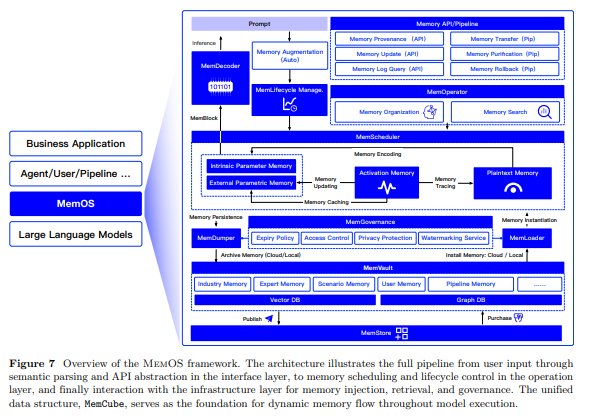
The MemOS is, based on my reading of the paper, is that MemOS adds a “layer” of knowledge functionality to large language models. The approach remembers the users’ or another system’s “knowledge process.” The idea is that instead of every prompt being a brand new sheet of paper, the LLM has a functional history or “digital notebook.” The entries in this notebook can be used to provide dynamic context for a user’s or another system’s query, prompt, or request. One application is “smart wireless” applications; another, context-aware kinetic devices.
I am not sure about some of the assertions in the write up; for example, performance gains, the benchmark results, and similar data points.
However, I think that the idea of a higher level of abstraction combined with enhanced memory of what the user or the system requests is interesting. The approach is similar to having an “old” AS/400 or whatever IBM calls these machines and interacting with them via a separate computing system is a good one. Request an output from the AS/400. Get the data from an I/O device the AS/400 supports. Interact with those data in the separate but “loosely coupled” computer. Then reverse the process and let the AS/400 do its thing with the input data on its own quite tricky workflow. Inefficient? You bet. Does it prevent the AS/400 from trashing its memory? Most of the time, it sure does.
The authors include a pastel graphic to make clear that the separation from the LLM is what I assume will be positioned as an original, unique, never-before-considered innovation:
Now does it work? In a laboratory, absolutely. At the Syracuse Parallel Processing Center, my colleagues presented a demonstration to Hillary Clinton. The search, text, video thing behaved like a trained tiger before that tiger attacked Roy in the Siegfried & Roy animal act in October 2003.
Are the data reproducible? Good question. It is, however, a time when fake data and synthetic government officials are posting videos and making telephone calls. Time will reveal the efficacy of the ‘breakthrough.”
Several observations:
- The purpose of the write up is a component of the China smart, US dumb marketing campaign
- The number of institutions involved, the presence of a Chinese start up, and the very big time Research Institute of China Telecom send the message that this AI expertise is diffused across numerous institutions
- The timing of the release of the paper is delicious: Happy Birthday, Uncle Sam.
Net net: Perhaps Meta should be hiring AI wizards from the Middle Kingdom?
Stephen E Arnold, July 15, 2025
Microsoft Innovation: Emulating the Bold Interface Move by Apple?
July 2, 2025
![Dino 5 18 25_thumb[3]_thumb_thumb_thumb](https://www.arnoldit.com/wordpress/wp-content/uploads/2025/06/Dino-5-18-25_thumb3_thumb_thumb_thumb-1.gif "Dino 5 18 25_thumb[3]_thumb_thumb_thumb") This dinobaby wrote this tiny essay without any help from smart software. Not even hallucinating gradient descents can match these bold innovations.
This dinobaby wrote this tiny essay without any help from smart software. Not even hallucinating gradient descents can match these bold innovations.
Bold. Decisive. Innovative. Forward leaning. Have I covered the adjectives used to communicate “real” innovation? I needed these and more to capture my reaction to the information in “Forget the Blue Screen of Death – Windows Is Replacing It with an Even More Terrifying Black Screen of Death.”
Yep, terrifying. I don’t feel terrified when my monitors display a warning. I guess some people do.
The write up reports:
Microsoft is replacing the Windows 11 Blue Screen of Death (BSoD) with a Black Screen of Death, after decades of the latter’s presence on multiple Windows iterations. It apparently wants to provide more clarity and concise information to help troubleshoot user errors easily.
The important aspect of this bold decision to change the color of an alert screen may be Apple color envy.
Apple itself said, “Apple Introduces a Delightful and Elegant New Software Design.” The innovation was… changing colors and channeling Windows Vista.
Let’s recap. Microsoft makes an alert screen black. Apple changes its colors.
Peak innovation. I guess that is what happens when artificial intelligence does not deliver.
Stephen E Arnold, July 2, 2025
The Secret to Business Success
June 18, 2025
 Just a dinobaby and a tiny bit of AI goodness: How horrible is this approach?
I don’t know anything about psychological conditions. I read “Why Peter Thiel Thinks Asperger’s Is A Key to Succeeding in Business.” I did what any semi-hip dinobaby would do. I logged into You.com and ask what the heck Asperger’s was. Here’s what I learned:
- The term "Asperger’s Syndrome" was introduced in the 1980s by Dr. Lorna Wing, based on earlier work by Hans Asperger. However, the term has become controversial due to revelations about Hans Asperger’s involvement with the Nazi regime
- Diagnostic Shift: Asperger’s Syndrome was officially included in the DSM-IV (1994) and ICD-10 (1992) but was retired in the DSM-5 (2013) and ICD-11 (2019). It is now part of the autism spectrum, with severity levels used to indicate the level of support required.
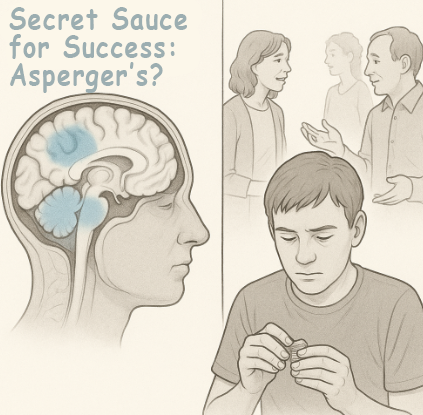
Image appeared with the definition of Asperger’s “issue.” A bit of a You.com bonus for the dinobaby.
These factoids are new to me.
The You.com smart report told me:
Key Characteristics of Asperger’s Syndrome (Now ASD-Level 1)
- Social Interaction Challenges:
- Difficulty understanding social cues, body language, and emotions.
- Limited facial expressions and awkward social interactions.
- Conversations may revolve around specific topics of interest, often one-sided
- Restricted and Repetitive Behaviors:
- Intense focus on narrow interests (e.g., train schedules, specific hobbies).
- Adherence to routines and resistance to change
- Communication Style:
- No significant delays in language development, but speech may be formal, monotone, or unusual in tone.
- Difficulty using language in social contexts, such as understanding humor or sarcasm
- Motor Skills and Sensory Sensitivities:
- Clumsiness or poor coordination.
- Sensitivity to sensory stimuli like lights, sounds, or textures.
Now what does the write up say? Mr. Thiel (Palantir Technology and other interests) believes:
Most of them [people with Asperger’s] have little sense of unspoken social norms or how to conform to them. Instead they develop a more self-directed worldview. Their beliefs on what is or is not possible come more from themselves, and less from what others tell them they can do or cannot do. This causes a lot anxiety and emotional hardship, but it also gives them more freedom to be different and experiment with new ideas.
The idea is that the alleged disorder allows certain individuals with Asperger’s to change the world.
The write up says:
The truth is that if you want to start something truly new, you almost by definition have to be unconventional and do something that everyone else thinks is crazy. This is inevitably going to mean you face criticism, even for trying it. In Thiel’s view, because those with Aspergers don’t register that criticism as much, they feel freer to make these attempts.
Is it possible for universities with excellent reputations and prestigious MBA programs to create people with the “virtues” of Aspberger’s? Do business schools aspire to impart this type of “secret sauce” to their students?
I suppose one could ask a person with the blessing of Aspberger’s but as the You.com report told me, some of these lucky individuals may [a] use speech may formal, monotone, or unusual in tone and [b] difficulty using language in social contexts, such as understanding humor or sarcasm.
But if one can change the world, carry on in the spirit of Hans Asperger, and make a great deal of money, it is good to have this unique “skill.”
Stephen E Arnold, June 18, 2025
Up for a Downer: The Limits of Growth… Baaaackkkk with a Vengeance
June 13, 2025
 Just a dinobaby and no AI: How horrible an approach?
Where were you in 1972? Oh, not born yet. Oh, hanging out in the frat house or shopping with sorority pals? Maybe you were working at a big time consulting firm?
An outfit known as Potomac Associates slapped its name on a thought piece with some repetitive charts. The original work evolved from an outfit contributing big ideas. The Club of Rome lassoed William W. Behrens, Dennis and Donella Meadows, and Jørgen Randers to pound data into the then-state-of-the-art World3 model allegedly developed by Jay Forrester at MIT. (Were there graduate students involved? Of course not.)
The result of the effort was evidence that growth becomes unsustainable and everything falls down. Business, government systems, universities, etc. etc. Personally I am not sure why the idea that infinite growth with finite resources will last forever was a big deal. The idea seems obvious to me. I was able to get my little hands on a copy of the document courtesy of Dominique Doré, the super great documentalist at the company which employed my jejune and naive self. Who was I too think, “This book’s conclusion is obvious, right?” Was I wrong. The concept of hockey sticks that had handles to the ends of the universe was a shocker to some.
The book’s big conclusion is the focus of “Limits to Growth Was Right about Collapse.” Why? I think the idea that the realization is a novel one to those who watched their shares in Amazon, Google, and Meta zoom to the sky. Growth is unlimited, some believed. The write up in “The Next Wave,” an online newsletter or information service happily quotes an update to the original Club of Rome document:
This improved parameter set results in a World3 simulation that shows the same overshoot and collapse mode in the coming decade as the original business as usual scenario of the LtG standard run.
Bummer. The kiddie story about Chicken Little had an acorn plop on its head. Chicken Little promptly proclaimed in a peer reviewed academic paper with non reproducible research and a YouTube video:
The sky is falling.
But keep in mind that the kiddie story is fiction. Humans are adept at survival. Maslow’s hierarchy of needs captures the spirit of species. Will life as modern CLs perceive it end?
I don’t think so. Without getting to philosophical, I would point to Gottlief Fichte’s thesis, antithesis, synthesis as a reasonably good way to think about change (gradual and catastrophic). I am not into philosophy so when life gives you lemons, one can make lemonade. Then sell the business to a local food service company.
Collapse and its pal chaos create opportunities. The sky remains.
The cited write up says:
Economists get over-excited when anyone mentions ‘degrowth’, and fellow-travelers such as the Tony Blair Institute treat climate policy as if it is some kind of typical 1990s political discussion. The point is that we’re going to get degrowth whether we think it’s a good idea or not. The data here is, in effect, about the tipping point at the end of a 200-to-250-year exponential curve, at least in the richer parts of the world. The only question is whether we manage degrowth or just let it happen to us. This isn’t a neutral question. I know which one of these is worse.
See de-growth creates opportunities. Chicken Little was wrong when the acorn beaned her. The collapse will be just another chance to monetize. Today is Friday the 13th. Watch out for acorns and recycled “insights.”
Stephen E Arnold, June 13, 2025
Will Amazon Become the Bell Labs of Consumer Products?
June 12, 2025
 Just a dinobaby and no AI: How horrible an approach?
I did some work at Bell Labs and then at the Judge Greene crafted Bellcore (Bell Communications Research). My recollection is that the place was quiet, uneventful, and had a lousy cafeteria. The Cherry Hill Mall provided slightly better food, just slightly. Most of the people were normal compared to the nuclear engineers at Halliburton and my crazed colleagues at the blue chip consulting firm dumb enough to hire me before I became a dinobaby. (Did you know that security at the Cherry Hill Mall had a gold cart to help Bell Labs’ employees find their vehicle? The reason? Bell Labs hired staff to deal with this recuring problem. Yes, Howard, Alan, and I lost our car when we went to lunch. I finally started parking in the same place and wrote the door exit and lamp number down in my calendar. Problem solved!)
Is Amazon like that? On a visit to Amazon, I formed an impression somewhat different from Bell Labs, Halliburton, and the consulting firm. The staff were not exactly problematic. I just recall having to repeat and explain things. Amazon struck me as an online retailer with money and challenges in handling traffic. The people with whom I interacted when I visited with several US government professionals were nice and different from the technical professionals at the organizations which paid me cash money.
Is this important? Yes. I don’t think of Amazon as particularly innovative. When it wanted to do open source search, it hired some people from Lucid Imagination, now Lucid Works. Amazon just did what other Lucene/Solr large-scale users did: Index content and allow people to run queries. Not too innovative in my book. Amazon also industrialized back office and warehouse projects. These are jobs that require finding existing products and consultants, asking them to propose “solutions,” picking one, and getting the workflow working. Again, not particularly difficult when compared to the holographic memory craziness at Bell Labs or the consulting firm’s business of inventing consumer products for companies in the Fortune 500 that would sell and get the consulting firm’s staggering fees paid in cash promptly. In terms of the nuclear engineering work, Amazon was and probably still is, not in the game. Some of the rocket people are, but the majority of the Amazon workers are in retail, digital plumbing, and creating dark pattern interfaces. This is “honorable” work, but it is not invention in the sense of slick Monte Carlo code cranked out by Halliburton’s Dr. Julian Steyn or multi-frequency laser technology for jamming more data through a fiber optic connection.
I read “Amazon Taps Xbox Co-Founder to Lead new Team Developing Breakthrough Consumer Products.” I asked myself, “Is Amazon now in the Bell Labs’ concept space? The write up tries to answer my question, stating:
The ZeroOne team is spread across Seattle, San Francisco and Sunnyvale, California, and is focused on both hardware and software projects, according to job postings from the past month. The name is a nod to its mission of developing emerging product ideas from conception to launch, or “zero to one.” Amazon has a checkered history in hardware, with hits including the Kindle e-reader, Echo smart speaker and Fire streaming sticks, as well as flops like the Fire Phone, Halo fitness tracker and Glow kids teleconferencing device. Many of the products emerged from Lab126, Amazon’s hardware research and development unit, which is based in Silicon Valley.
Okay, the Fire Phone (maybe Foney) and the Glow thing for kids? Innovative? I suppose. But to achieve success in raw innovation like the firms at which I was an employee? No, Amazon is not in that concept space. Amazon is more comfortable cutting a deal with Elastic instead of “inventing” something like Google’s Transformer or Claude Shannon’s approach to extracting a signal from noise. Amazon sells books and provides an almost clueless interface to managing those on the Kindle eReader.
The write up says (and I believer everything I read on the Internet):
Amazon has pulled in staffers from other business units that have experience developing innovative technologies, including its Alexa voice assistant, Luna cloud gaming service and Halo sleep tracker, according to LinkedIn profiles of ZeroOne employees. The head of a projection mapping startup called Lightform that Amazon acquired is helping lead the group. While Amazon is expanding this particular corner of its devices group, the company is scaling back other areas of the sprawling devices and services division.
Innovation is a risky business. Amazon sells stuff and provides online access with uptime of 98 or 99 percent. It does not “do” innovation. I wrote a book chapter about Amazon’s blockchain patents. What happened to that technology, some of which struck me as promising and sort of novel given the standards for US patents? The answer, based on the information I have seen since I wrote the book chapter, is, “Not much.” In less time, Telegram dumped out dozens of “inventions.” These have ranged from sticking crypto wallets into every Messenger users’ mini app to refining the bot technology to display third-party, off-Telegram Web sites on the fly for about 900 million Messenger users.
Amazon hit a dead end with Alexa and something called Halo.
When an alleged criminal organization operating as an “Airbnb” outfit with no fixed offices and minimal staff can innovate and Amazon with its warehouses cannot, there’s a useful point of differentiation in my mind.
The write up reports:
Earlier this month, Amazon laid off about 100 of the group’s employees. The job cuts included staffers working on Alexa and Amazon Kids, which develops services for children, as well as Lab126, according to public filings and people familiar with the matter who asked not to be named due to confidentiality. More than 50 employees were laid off at Amazon’s Lab126 facilities in Sunnyvale, according to Worker Adjustment and Retraining Notification (WARN) filings in California.
Okay. Fire up a new unit. Will the approach work? I hope for stakeholders’ and employees’ sake, Amazon hits a home run. But in the back of my mind, innovation is difficult. Quite special people are needed. The correct organizational set up or essentially zero set up is required. Then the odds are usually against innovation, which, if truly novel, evokes resistance. New is threatening.
Can the Bezos bulldozer shift into high gear and do the invention thing? I don’t know but I have some nagging doubts.
Stephen E Arnold, June 12, 2025
Google Makes a Giant, Huge, Quantumly Supreme Change
May 19, 2025
 No AI, just the dinobaby expressing his opinions to Zellenials.
I read “Google’s G Logo Just Got Prettier.” Stunning news. The much loved, intensely technical Google has invented blurring colors. The decision was a result of DeepMind’s smart software and a truly motivated and respected group of artistically-inclined engineers.
Image. The old logo has been reinvented to display a gradient. Was the inspiration the hallucinatory gradient descent in Google’s smart software? Was it a result of a Googler losing his glasses and seeing the old logo as a blend of colors? Was it a result of a chance viewing of a Volvo marketing campaign with a series of images like this:
Image is from Volvo, the automobile company. You can view the original at this link. Hey, buy a Volvo.
The write up says:
Google’s new logo keeps the same letterform, as well as the bright red-yellow-green-blue color sequence, but now those colors blur into each other. The new “G” is Google’s biggest update to its visual identity since retiring serfs for its current sans-serif font, Product Sans, in 2015.
Retiring serifs, not serfs. I know it is just an AI zellenial misstep, but Google is terminating wizards so they can find their future elsewhere. That is just sol helpful.
What does the “new” and revolutionary logo look like. The image below comes from Fast Company which is quick on the artistic side of US big technology outfits. Behold:

Source: Fast Company via the Google I think.
Fast Company explains the forward-leaning design decision:
A gradient is a safe choice for the new “G.” Tech has long been a fan of using gradients in its logos, apps, and branding, with platforms like Instagram and Apple Music tapping into the effect a decade ago. Still today, gradients remain popular, owing to their middle-ground approach to design. They’re safe but visually interesting; soft but defined. They basically go with anything thanks to their color wheel aesthetic. Other Google-owned products have already embraced gradients. YouTube is now using a new red-to-magenta gradient in its UI, and Gemini, Google’s AI tool, also uses them. Now it’s bringing the design element to its flagship Google app.
Yes, innovative.
And Fast Company wraps up the hard hitting design analysis with some Inconel wordsmithing:
it’s not a small change for a behemoth of a company. We’ll never knows how many meetings, iterations, and deliberations went into making that little blur effect, but we can safely guess it was many.
Yep, guess.
Stephen E Arnold, May 19, 2025
Scamming: An Innovation Driver
May 19, 2025
Readers who caught the 2022 documentary “The Tinder Swindler” will recognize Pernilla Sjöholm as one of that conman’s marks. Since the film aired, Sjöholm has co-developed a tool to fend off such fraudsters. The Next Web reports, “Tinder Swindler Survivor Launches Identity Verifier to Fight Scams.” The platform, cofounded with developer Suejb Memeti, is called IDfier. Writer Thomas Macaulay writes:
“The platform promises a simple yet secure way to check who you’re interacting with. Users verify themselves by first scanning their passport, driver’s license, or ID card with their phone camera. If the document has an NFC (near-field communication), IDfier will also scan the chip for additional security. The user then completes a quick head movement to prove they’re a real person — rather than a photo, video, or deepfake. Once verified, they can send other people a request to do the same. Both of them can then choose which information to share, from their name and age to their contact number. All their data is encrypted and stored across disparate servers. IDfier was built to blend this security with precision. According to the platform, the tech is 99.9% accurate in detecting real users and blocking impersonation attempts. The team envisions the system securing endless online services, from e-commerce and email to social media and, of course, dating apps such as Tinder.”
For those who have not viewed the movie: In 2018 Sjöholm and Simon Leviev met on Tinder and formed what she thought was a close, in-person relationship. But Simon was not the Leviev he pretended to be. In the end, he cheated her out of tens of thousands of euros with a bogus sob story.
It is not just fellow humans’ savings Sjöholm aims to protect, but also our hearts. She emphasizes such tactics amount to emotional abuse as well as fraud. The trauma of betrayal is compounded by a common third-party reaction—many observers shame victims as stupid or incautious. Sjöholm figures that is because people want to believe it cannot happen to them. And it doesn’t. Until it does.
Since her ordeal, Sjöholm has been dismayed to see how convincing deepfakes have grown and how easy they now are to make. She is also appalled at how vulnerable our children are. Someday, she hopes to offer IDfier free for kids. We learn:
“Sjöholm’s plan partly stems from her experience giving talks in schools. She recalls one in which she asked the students how many of them interacted with strangers online. ‘Ninety-five percent of these kids raised their hands,’ she said. ‘And you could just see the teacher’s face drop. It’s a really scary situation.’”
We agree. Sjöholm states that between fifty and sixty percent of scams involve fake identities. And, according to The Global Anti-Scam Alliance, scams collectively rake in more than $1 trillion (with a “t”) annually. Romance fraud alone accounts for several billion dollars, according to the World Economic Forum. At just $2 per month, IDfier seems like a worthwhile precaution for those who engage with others online.
Cynthia Murrell, May 19, 2025
Google Innovates: Another Investment Play. (How Many Are There Now?)
May 13, 2025
 No AI, just the dinobaby expressing his opinions to Zillennials.
I am not sure how many investment, funding, and partnering deals Google has. But as the selfish only child says, “I want more, Mommy.” Is that Google’s strategy for achieving more AI dominance. The company has already suggested that it has won the AI battle. AI is everywhere even when one does not want it. But inferiority complexes have a way of motivating bright people to claim that they are winners only to wake at 3 am to think, “I must do more. Don’t hit me in the head, grandma.”
The write up “Google Launches New Initiative to Back Startups Building AI” brilliant, never before implemented tactic. The idea is to shovel money at startups that are [a] Googley, [b] focus on AI’s cutting edge, and [c] can reduce Google’s angst ridden 3 am soul searching. (Don’t hit me in the head, grandma.)
The article says:
Google announced the launch of its AI Futures Fund, a new initiative that seeks to invest in startups that are building with the latest AI tools from Google DeepMind, the company’s AI R&D lab. The fund will back startups from seed to late stage and will offer varying degrees of support, including allowing founders to have early access to Google AI models from DeepMind, the ability to work with Google experts from DeepMind and Google Labs, and Google Cloud credits. Some startups will also have the opportunity to receive direct investment from Google.
This meets criterion [a] above. The firms have to embrace Google’s quantumly supreme DeepMind, state of the art, world beating AI. I interpret the need to pay people to use DeepMind as a hint that making something commercially viable is just outside the sharp claws of Googzilla. Therefore, just pay for those who will be Googley and use the quantumly supreme DeepMind AI.
The write up adds:
Google has been making big commitments over the past few months to support the next generation of AI talent and scientific breakthroughs.
This meets criterion [b] above. Google is paying to try to get the future to appear under the new blurry G logo. Will this work? Sure, just as it works for regular investment outfits. The hit ratio is hoped to be 17X or more. But in tough times, a 10X return is good. Why? Many people are chasing AI opportunities. The failure rate of new high technology companies remains high even with the buzz of AI. If Google has infinite money, it can indeed win the future. But if the search advertising business takes a hit or the Chrome data system has a groin pull, owning or “inventing” the future becomes a more difficult job for Googzilla.
Now we come to criterion [c], the inferiority complex and the need to meeting grandma’s and the investors’ expectations. The write up does not spend much time on the psyches of the Google leadership. The write points out:
Google also has its Google for Startups Founders Funds, which supports founders from an array of industries and backgrounds building companies, including AI companies. A spokesperson told TechCrunch in February that this year, the fund would start investing in AI-focused startups in the U.S., with more information to come at a later date.
The article does not address the psychology of Googzilla. That’s too bad because that’s what makes fuzzy G logos, impending legal penalties, intense competition from Sam AI-Man and every engineering student in China, and the self serving quantumly supreme type lingo big picture windows into the inner Google.
Grandma, don’t hit any of those ever young leaders at Google on the head. It may do some psychological rewiring that may make you proud and some other people expecting even greater achievements in AI, self driving cars, relevant search, better-than-Facebook ad targeting, and more investment initiatives.
Stephen E Arnold, May 13, 2025
Innovation: America Has That Process Nailed
April 27, 2025
No AI. Just a dinobaby who gets revved up with buzzwords and baloney.
Has innovation slowed? In smart software, I read about clever uses of AI and ML (artificial intelligence and machine learning). But in my tests of various systems I find the outputs occasionally useful. Yesterday, I wanted information about a writer who produced an article about a security issue involving the US government. I tried five systems; none located the individual. I finally tracked the person down using manual methods. The smart software was clueless.
An example of American innovation caught my attention this morning (April 27, 2025 at 520 am US Eastern time to be exact). I noted the article “Khloé Kardashian Announces Protein Popcorn.” The write up explains:
For anyone khounting their makhros, reality star and entrepreneur Khloé Kardashian unveiled her new product this week: Khloud Protein Popcorn. The new snack boasts 7 grams of protein per serving—two more grams than an entire Jack Links Beef Stick—aligning with consumers’ recent obsession with protein-packed food and drinks. The popcorn isn’t covered in burnt ends—its protein boost comes from a proprietary blend of seasonings and milk protein powder called “Khloud dust” that’s sprinkled over the air-popped kernels.
My thought is that smart software may have contributed to the name of the product: Khloud Protein Popcorn, but I don’t know. The idea that enhanced popcorn has more protein than “an entire Jack Links Beef Stick” is quite innovative I think. Samuel Franklin, author of The Cult of Creativity, may have a different view. Creativity, he asserts, did not become a thing until 1875. I think Khloud Protein Popcorn demonstrates that ingenuity, cleverness, imagination, and artistry are definitely alive and thriving in the Kardashian’s idea laboratory.
I wonder if this type of innovation is going to resolve some of the problems which appear to beset daily life in April 2025. I doubt it unless one needs some fortification delivered via popcorn.
Without being too creative or innovative in my thinking, is AL/ML emulating Khloé Kardashian’s protein popcorn. We have a flawed by useful service: Web search. That functionality has been degrading for many reasons. To make it possible to find information germane to a particular topic, innovators have jumped on one horse and started riding it to the future. But the horse is getting tired. In fact, after a couple of years of riding around the barn, the innovations in large language models seems to be getting tired, slowing down, and in some cases limping along.
The big announcements from Google, Microsoft, and OpenAI focus on the number of users each has. I think the Google said it had 1.5 billion users of its smart software. Can Google “prove” it? Probably but is that number verifiable? Sure, just like the amount of protein in the Khloud dust sprinkled on the aforementioned popcorn. OpenAI’s ChatGPT on April 26, 2025, output a smarmy message about a system issue. The new service Venice was similarly uncooperative, unable in fact to locate information about a particular Telegram topic related to its discontinuing its Bridge service. Poor Perplexity was very wordy and very confident that its explanation about why it could not locate an item of information was hardly a confidence builder.
Here’s my hypothesis: AI/ML, LLMs, and the rest of the smart software jargon have embraced Ms. Kardashian’s protein popcorn approach to doing something new, fresh, creative, and exciting. Imagine AI/ML solutions having more value than an “entire Jack Links Beef Stick.” Next up, smart protein popcorn.
Innovative indeed.
Stephen E Arnold, April 27, 2025
-

- Subscribe to Beyond Search
Feature archive
News archive

-


