

Stanford University Students and Their Entrepreneurial Drive
May 9, 2025
Signal is useful for more than spreading state secrets. One enterprising resident of the San Francisco Bay Area used the encrypted messaging service for a different shady endeavor. SFGate reports, “Stanford Grad Sentenced for ‘DoorDash-Style’ Drug Trafficking Service.” 31-year old Natalie Marie Gonzalez was sentenced to over four years in federal prison for leading the operation. She and three co-conspirators were first indicted in 2023 after a raid turned up almost a kilogram of fentanyl, about seven kilograms of cocaine, some ketamine, methamphetamine masquerading as Adderall, and other illegal drugs. That is quite the selection. The service included creative measures designed to hide the fact that meetups were actually drug deals. Reporter Madilynne Medina describes the operation:
“The drug trafficking service operated from April to September, 2023. According to the attorney’s office, customers would place orders from ‘a menu of drugs for sale’ through the encrypted messaging system Signal. Orders required a $300 order minimum for the delivery, and Gonzalez paid her co-conspirators to work as drivers. Per the criminal complaint, an undercover agent first used the service to order cocaine and 2,000 fake Adderall pills that contained meth. Gonzalez instructed the agent to ‘hop in’ the car for a short ‘‘‘Uber” ride around the block’ to cover up the drug transaction when the driver arrived with the delivery on March 29, 2023. The agent then made multiple other purchases. During one of the sales in July 2023, the agent was even given the option to play with a dog to cover up the drug deal, the complaint shows. According to the agent, Gonzalez said her customers were ‘a lot of students and young professionals.’”
Ah, modern technology. Four years in prison is no fun but, as Medina reports, the maximum penalty Gonzalaz faced was 20 years and a $1 million fine. Let us hope she finds more above-board uses for her innovation once released. Stanford University is an interesting institution: Synthetic data and synthetic contraband. Will the individual get to rub shoulders with the former Stanford president who resigned due to research irregularities. Pacesetters indeed.
Cynthia Murrell, May 9, 2025
Stamping Out Intelligence: Censorship May Work Wonders
April 9, 2025
 Sorry, no AI used to create this item.
I live in a state which has some interesting ideas. One of them is that the students are well educated. At this time, I think the state in which I reside holds position 47 out of 50 in terms of reading skills or academic performance. Are the numbers accurate? Probably not, but they indicate that learning is not priority number one in some quarters.
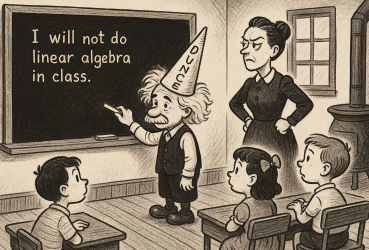
A young student with a gift for mathematics is the class dunce. He has to write on the chalk board, “I will not do linear algebra in class.” Thanks, OpenAI. Know any budding Einsteins in Mississippi?
However, there is a state which performs less well than mine. That state is Mississippi. Should that state hold the rank of the 50th less academically slick entity in the US. Probably not, but the low ranking does say something to some people.
I thought about this notion of “low academic performance” when I read “Mississippi Libraries Ordered to Delete Academic Research in Response to State Laws.” The write up says:
A state commission scrubbed academic research from a database used by Mississippi libraries and public schools — a move made to comply with recent state laws changing what content can be offered in libraries. The Mississippi Library Commission ordered the deletion of two research collections that might violate state law, a March 31 internal memo obtained by Mississippi Today shows. One of the now deleted research collections focused on “race relations” and the other on “gender studies.”
So what?
I find it interesting that in a state holding down the 50th spot in academic slickness assumes that its students will be reading research on these topics or any topics for that matter.
I did a very brief stint as a teacher. In fact, I invested one year teaching in a quite challenging high school environment about 100 miles south of Chicago. If my students read anything, I was quite happy. I suppose today that I would be terminated because I used the Sunday comics, gas station credit card application forms, job applications for the local Hunt’s Drive In, and a wide range of printed matter. My goal was to provide reading material that was different from the standard text book, a text book I used when I was in high school years before I showed up at my teaching job.
The goal is to get students reading. Today, I assume that removing books and research material is more informed than what I did.
Several observations:
- Taking steps to prevent reading is different from how I would approach the question, “What should be in the school library?”
- The message sent to students who actually learn that books and research materials are being removed from the library seems to me to be, “Hey, don’t read this academic garbage.”
- The anti-intellectualism which this removal seems to underscore means that Mississippi is working hard to nail down its number 50 spot.
I am a dinobaby. I am quite thrilled with this fact. I will probably fall over dead with a book in my hands. Remember: I used outside materials to try to engage my students in reading for that one year of high school teaching. I should have been killed when a library stack fell over when I was in grade school.
These types of decisions are going to get the job done for me I think.
Stephen E Arnold, April 9, 2025
Sweden Embraces Books for Student: A Revolutionary Idea
February 14, 2025
 Yep, another dinobaby emission. No smart software required.
Doom scrolling through the weekend’s newsfeeds, I spotted “Sweden Swapped Books for Computers in 2009. Now, They’re Spending Millions to Bring Them Back.” Sweden has some challenges. The problems with kinetic devices are not widely known in Harrod’s Creek, Kentucky, and probably not in other parts of the US. Malmo bears some passing resemblance to parts of urban enclaves like Detroit or Las Vegas. To make life interesting, the country has a keen awareness of everyone’s favorite leader in Russia.
The point of the write up is that Sweden’s shift from old-fashioned dinobaby books to those super wonderful computers and tablets has become unpalatable. The write up reports:
The Nordic country is reportedly exploring ways to reintroduce traditional methods of studying into its educational system.
The reason for the shift to books? The write up observes:
…experts noted that modern, experiential learning methods led to a significant decline in students’ essential skills, such as reading and writing.
Does this statement sound familiar?
Most teachers and parents complain that their kids have increasingly started relying on these devices instead of engaging in classrooms.
Several observations:
- Nothing worthwhile comes easy. Computers became a way to make learning easy. The downside is that for most students, the negatives have life long consequences
- Reversing gradual loss of the capability to concentrate is likely to be a hit-and-miss undertaking.
- Individuals without skills like reading become the new market for talking to a smartphone because writing is too much friction.
How will these individuals, regardless of country, be able to engage in life long learning? The answer is one that may make some people uncomfortable: They won’t. These individuals demonstrate behaviors not well matched to independent, informed thinking.
This dinobaby longs for a time when tiny dinobabies had books, not gizmos. I smell smoke. Oh, I think that’s just some informed mobile phone users burning books.
Stephen E Arnold, February 14, 2025
ChatGPT: The New Chegg
December 13, 2024
Chegg is an education outfit. The firm has faced some magnetic interference related to its academic compass. An outfit in Australia has suggested that Chegg makes it possible for a student to obtain some assistance in order to complete certain work. Beyond Search knew AI would displace some workers and maybe even shutter some companies. But it is hard to find sympathy for this particular victim. “Chegg Is on Its Last Legs After ChatGPT Sent Its Stock Down 99%,” reports Gizmodo. So industrial scale cheating kills rich-kid cheating. Oh no.
Those of us who got our college degrees last century may not be familiar with Chegg. Writer Thomas Maxwell explains:
“[Chegg] started out in the 2000s renting out textbooks and later expanded into online study guides, and eventually into a platform with pre-written answers to common homework questions. Unfortunately, the launch of ChatGPT all but annihilated Chegg’s business model. The company for years paid thousands of contractors to write answers to questions across every major subject, which is quite a labor intensive process—and there’s no guarantee they will even have the answer to your question. ChatGPT, on the other hand, has ingested pretty much the entire internet and has likely seen any history question you might throw at it.”
Yep. The Wall Street Journal reports Chegg put off developing its own AI tools because of machine learning’s propensity for wrong answers. And rightly so. Maxwell suggests the firm might be able to make that case to “curious” students, but we agree that would be a long shot at this point. If Chegg does indeed go under, we will not mourn. But what other businesses, and the workers they support, will be next to fall?
Does the US smart software sector care if their products help students appear smarter and more diligent than they are in real life? Nope. Success in the US is, like much of the high-technology hoo-hah, creating a story and selling illusion. School education is collateral damage.
Cynthia Murrell, December 13, 2024
Academic Excellence: Easy to Say, Tough to Deliver It Seems
February 21, 2024
 This essay is the work of a dumb dinobaby. No smart software required.
A recent report from Columbia Journalism Review examines “Artificial Intelligence in the News: How AI Retools, Rationalizes, and Reshapes Journalism and the Public Arena.” Many words from admirals watching the Titanic steam toward the iceberg. The executive summary explains:
“Insufficient attention has also been paid to the implications of the news industry’s dependence on technology companies for AI. Drawing on 134 interviews with news workers at 35 news organizations in the United States, the United Kingdom, and Germany — including outlets such as The Guardian, Bayerischer Rundfunk, the Washington Post, The Sun, and the Financial Times — and 36 international experts from industry, academia, technology, and policy, this report examines the use of AI across editorial, commercial, and technological domains with an eye to the structural implications of AI in news organizations for the public arena. In a second step, it considers how a retooling of the news through AI stands to reinforce news organizations’ existing dependency on the technology sector and the implications of this.”
The first chapter examines how AI is changing news production and distribution. It is divided into three parts: news organizations’ motives for using AI, how they are doing so, and what expectations they have for the technology. Chapter two examines why news organizations now rely on tech companies and what this could mean for the future of news. Here’s a guess: Will any criticism of big tech firms soon fail to see the light of day, perhaps?
See the report (or download the PDF) for all the details. After analyzing the data, author Felix M. Simon hesitates to draw any firm conclusions about the future of AI and news organizations—there are too many factors in flux. For now, the technology is mostly being used to refine existing news practices rather than to transform them altogether. But that could soon change. If it does, public discourse as a whole will shift, too. Simon notes:
“As news organizations get reshaped by AI, so too will the public arena that is so vital to democracy and for which news organizations play a gatekeeper role. Depending on how it is used, AI has the potential to structurally strengthen news organizations’ position as gatekeepers to an information environment that provides ‘people with relatively accurate, accessible, diverse, relevant, and timely independently produced information about public affairs’ which they can use to make decisions about their lives. … This, however, is not a foregone conclusion. Instead, it will depend on decisions made by the set of actors who wield control over the conditions of news work — executives, managers, and journalists, but also increasingly technology companies, regulatory bodies, and the public.”
That is a lot of players. Which ones hold the most power in this equation? Hint: it is not the last entry in the list.
Cynthia Murrell, February 21, 2024
Generative AI and College Application Essays: College Presidents Cheat Too
February 19, 2024
 This essay is the work of a dumb dinobaby. No smart software required.
The first college application season since ChatGPT hit it big is in full swing. How are admissions departments coping with essays that may or may not have been written with AI? It depends on which college one asks. Forbes describes various policies in, “Did You Use ChatGPT on your School Applications? These Words May Tip Off Admissions.” The paper asked over 20 public and private schools about the issue. Many dared not reveal their practices: as a spokesperson for Emory put it, “it’s too soon for our admissions folks to offer any clear observations.” But the academic calendar will not wait for clarity, so schools must navigate these murky waters as best they can.
Reporters Rashi Shrivastava and Alexandra S. Levine describe the responses they did receive. From “zero tolerance” policies to a little wiggle room, approaches vary widely. Though most refused to reveal whether they use AI detection software, a few specified they do not. A wise choice at this early stage. See the article for details from school to school.
Shrivastava and Levine share a few words considered most suspicious: Tapestry. Beacon. Comprehensive curriculum. Esteemed faculty. Vibrant academic community. Gee, I think I used a one or two of those on my college essays, and I wrote them before the World Wide Web even existed. On a typewriter. (Yes, I am ancient.) Will earnest, if unoriginal, students who never touched AI get caught up in the dragnets? At least one admissions official seems confident they can tell the difference. We learn:
“Ben Toll, the dean of undergraduate admissions at George Washington University, explained just how easy it is for admissions officers to sniff out AI-written applications. ‘When you’ve read thousands of essays over the years, AI-influenced essays stick out,’ Toll told Forbes. ‘They may not raise flags to the casual reader, but from the standpoint of an admissions application review, they are often ineffective and a missed opportunity by the student.’ In fact, GWU’s admissions staff trained this year on sample essays that included one penned with the assistance of ChatGPT, Toll said—and it took less than a minute for a committee member to spot it. The words were ‘thin, hollow, and flat,’ he said. ‘While the essay filled the page and responded to the prompt, it didn’t give the admissions team any information to help move the application towards an admit decision.’”
That may be the key point here—even if an admissions worker fails to catch an AI-generated essay, they may reject it for being just plain bad. Students would be wise to write their own essays rather than leave their fates in algorithmic hands. As Toll put it:
“By the time a student is filling out their application, most of the materials will have already been solidified. The applicants can’t change their grades. They can’t go back in time and change the activities they’ve been involved in. But the essay is the one place they remain in control until the minute they press submit on the application. I want students to understand how much we value getting to know them through their writing and how tools like generative AI end up stripping their voice from their admission application.”
Disqualified or underwhelming—either way, relying on AI to write one’s application essay could spell rejection. Best to buckle down and write it the old-fashioned way. (But one can skip the typewriter.)
Cynthia Murrell, February 19, 2024
Gen Z and Retro Tech
March 7, 2023
I read an interesting write up about people who are younger than I. Keep in mind, please, that I am a dinobaby. “Gen Z Apparently Baffled by Basic Technology.” The write up says:
But when it comes to using a scanner or printer — or even a file system on a computer — things become a lot more challenging to a generation that has spent much of their lives online
Does this mean that a younger employee will not be able to make a photocopy of a receipt for an alleged business expense?
I learned that a 25-year-old wizard was unable to get the photocopy to produce something other than a blank page.
Okay, the idea of turning over the page eluded the budding captain of social media.
Will these future leaders ask for assistance? Nah, there’s something called tech shame. Who wants to look stupid and not get promoted.
Need another example? No, well, too bad. The write up points out that these world beaters cannot schedule meetings? Like time is hard. Follow ups are almost like work.
I am glad I am old.
Stephen E Arnold, March 7, 2023
Predicting the Future MIT Grads and Profs Helped Invent
July 19, 2021
Good news Monday!
MIT, the outfit that found Jeffrey Epstein—a wonderful human and inspiration to students and scholars, shares its brilliant insights into the future of humankind. Motherboard reports, “MIT Predicted in 1972 that Society Will Collapse This Century. New Research Shows We’re on Schedule.” Oh goodie. Reporter Nafeez Ahmed begins with a little background:
“In 1972, a team of MIT scientists got together to study the risks of civilizational collapse. Their system dynamics model published by the Club of Rome identified impending ‘limits to growth’ (LtG) that meant industrial civilization was on track to collapse sometime within the 21st century, due to overexploitation of planetary resources. The controversial MIT analysis generated heated debate, and was widely derided at the time by pundits who misrepresented its findings and methods. … The [new] study was published in the Yale Journal of Industrial Ecology in November 2020 and is available on the KPMG website. It concludes that the current business-as-usual trajectory of global civilization is heading toward the terminal decline of economic growth within the coming decade—and at worst, could trigger societal collapse by around 2040.”
The study’s author, Gaya Herrington, serves as Sustainability and Dynamic System Analysis Lead at accounting giant KPMG but makes clear she pursued this on her own as part of her Harvard University Masters thesis. The study examines data across 10 key variables: population, fertility rates, mortality rates, industrial output, food production, services, non-renewable resources, persistent pollution, human welfare, and ecological footprint. Herrington found recent data aligns most closely with two scenarios she calls “business-as-usual” and “comprehensive technology.” The most desirable outcome, “stabilized world,” is unfortunately the least likely. See the article for its explanation of each of these, including the related graphs.
The upshot: If we keep doing what we have been doing, we are in for dire food shortages, drastically reduced standards of living, and more chaos by 2040. There is hope, however, if we take drastic action within the next decade. Take one look at today’s Congress and assess the likelihood of that. Ahmed concludes:
“The best available data suggests that what we decide over the next 10 years will determine the long-term fate of human civilization. Although the odds are on a knife-edge, Herrington pointed to a ‘rapid rise’ in environmental, social and good governance priorities as a basis for optimism, signaling the change in thinking taking place in both governments and businesses. She told me that perhaps the most important implication of her research is that it’s not too late to create a truly sustainable civilization that works for all.”
Ah, optimism. Let us enjoy a sliver of it while we can.
Cynthia Murrell, July 19, 2021
Another Stanford University Insight: Captain Obvious Himself Knocked Out
November 27, 2020
I read “Researchers Link Poor Memory to Attention Lapses and Media Multitasking.” What was I doing before I read this article. Oh, right. I was watching TV, surfing the Tweeter, having a bagel, pumping my legs on an under my desk exercycle, and talking on a landline phone. Imagine, a landline.
The article which I had to reread multiple times because, well, I just don’t remember why, states:
A new study reveals a correlation between multimedia multitasking, memory loss, and difficulties in maintaining attention.
Well, there’s an insight. What? Multi-tasking does not work so well? Who knew?
The write up clarifies:
Differences in people’s ability to sustain attention were also measured by studying how well subjects were able to identify a gradual change in an image, while media multitasking was assessed by having individuals report how well they could engage with multiple media sources, like texting and watching television, within a given hour. The scientists then compared memory performance between individuals and found that those with lower sustained attention ability and heavier media multitaskers both performed worse on memory tasks.
Wow. Concentration may be an indicator of a person who is not dumb enough to watch TikTok video gems while driving a smart auto to a Covid testing facility and listening to a podcast about how wonderfully intelligent Vox real news people are.
There’s good news from the Stanford experts; for example:
“We have an opportunity now,” Wagner [one of Captain Obvious’ detractors] said, “to explore and understand how interactions between the brain’s networks that support attention, the use of goals and memory relate to individual differences in memory in older adults both independent of, and in relation to, Alzheimer’s disease.”
What was I doing? I forget.
Stephen E Arnold, November 27, 2020
Confidence in US Education: 46 Companies Have Doubts
November 3, 2020
I read “Top 48 US Companies Files Legal Challenge to Block H-1B Visa Changes.” The write up states:
Nearly 46 leading US companies and business organizations, including tech giants Apple, Google, Twitter and Facebook, representing and working with key sectors of the US economy, have filed an amicus brief that supports a legal challenge to block upcoming rule changes to H-1B visa eligibility.
Another interesting factoid:
The companies said that the new DHS rules will dramatically reduce US businesses’ ability to hire these skilled foreign workers—one senior DHS official estimated that they will render ineligible more than one-third of petitions for H-1B visas.
What does this suggest about the flow of talent from the US education system? How are those online classes working out?
Stephen E Arnold, November 3, 2020
-

- Subscribe to Beyond Search
Feature archive
News archive

-


