

Google Advertises Itself
May 16, 2025
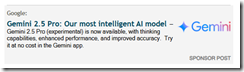
- The signals about declining search traffic warrant attention. SEO wizards, Google’s ad partners, and its own ad wizards depend on what once was limitless search traffic. If that erodes, those infrastructure costs will become a bit of a challenge. Profits and jobs depend on mindless queries.
- Google’s reaction to these signals indicates that the company’s “leadership” knows that there is trouble in paradise. The terse statement that the Cue comment about a decline in Apple to Google search traffic and this itty bitty ad are not accidents of fate. The Google once controlled fate. Now the fabled company is in a sticky spot like Sisyphus.
- The irony of Google’s problem stems from its own Transformer innovation. Released to open source, Google may be learning that its uphill battle is of its own creation. Nice work, “leadership.”
Apple and Google Relationship: Starting to Fray?
May 8, 2025
 No AI, just the dinobaby expressing his opinions to Zellenials.
I spotted a reference to an Apple manager going out on a limb of the old, Granny Smith tree. At the end of the limb, the Apple guru allegedly suggested that the Google search ain’t what it used to be. Whether true or not, Apple pays the Google lots of money to be the really but formerly wonderful Web search system for the iPhone and Safari “experience.”
That assertion of decline touched a nerve at the Google. I noted this statement in the Google blog. I am not sure which one because Google has many pages of smarmy talk. I am a dinobaby and easily confused. Here’s that what Google document with the SEO friendly title “Here’s Our Statement on This Morning’s Press Reports about Search Traffic” says:
We continue to see overall query growth in Search. That includes an increase in total queries coming from Apple’s devices and platforms. More generally, as we enhance Search with new features, people are seeing that Google Search is more useful for more of their queries — and they’re accessing it for new things and in new ways, whether from browsers or the Google app, using their voice or Google Lens. We’re excited to continue this innovation and look forward to sharing more at Google I/O.
Several observations:
- I love the royal “we”. I think that the Googlers who are nervous about search include the cast of the Sundar & Prabhakar Comedy Act. Search means ads. Ads mean money. Money means Wall Street. Therefore, a decline in search makes the Wall Street types jumpy, twitchy, and grumpy. Do not suggest traffic declines when controlling the costs of the search plumbing are becoming quite interesting for the Googley bean counters.
- Apple device users are searching Google a lot. I believe it. Monopolies like to have captives who don’t know that there are now alternatives to the somewhat uninspiring version of Jon Kleinberg’s CLEVER inventions spiced with some Fancy Dan weighting. These “weights” are really useful for boosting I believe.
- The leap to user satisfaction with Google search is unsupported by audited data. Those happy faces don’t convey why millions of people are using ChatGPT or why people complain that Google search results are mostly advertising. Oh, well, when one is a monopoly controlling what’s presented to users within the content of big spending advertisers, reality is what the company chooses to present.
- The Google is excited about its convention. Will it be similar to the old network marketing conventions or more like the cheerleading at Telegram’s Gateway Conference? It doesn’t matter. Google is excited.
Net net: The alleged Apple remark goosed the Google to make “our statement.” Outstanding defensive tone and posture. Will the pair seek counseling?
Stephen E Arnold, May 8, 2025
European Union: Academics and Researchers, Come On Over to Freedom
May 8, 2025
 No AI, just the dinobaby expressing his opinions to Zellenials.
Is the European Union actively advertising employment opportunities in Western Europe? Do canines sniff? I think the answer is, “Yes.”
I spotted an official European Commission announcement with the title or one of the titles: “Choose Europe. Advance Your Research Career in the EU.” Another title in the official online statement is, “Choose Groundbreaking Research.” The document says,
As a world-leading centre for research and innovation with freedom of science, the European Union offers an ideal environment to advance your career. With a wealth of stable and predictable funding opportunities and cutting-edge facilities, the EU enables researchers to work on projects where they can truly make a difference. You’ll join a dynamic and international community of top talent, all dedicated to finding solutions to the world’s biggest challenges. Europe offers an excellent quality of life, including affordable healthcare and education, excellent working conditions and strong social security for you and your family. You’ll also enjoy freedoms and protections based on our values.
I found the word choice quite interesting; for example:
affordable healthcare and education
dynamic and international community
excellent working conditions
freedom and freedoms (bang, bang!)
ideal environment
protections
quality of life
strong social security
top talent
values
world-leading
The word choice reveals what the EU thinks will appeal to some American academics and researchers as well as to others in different countries. One might think that this employment advertisement is identifying specific issues associated with certain non-EU countries.
To make the opportunity more concrete, the write up presents these data:
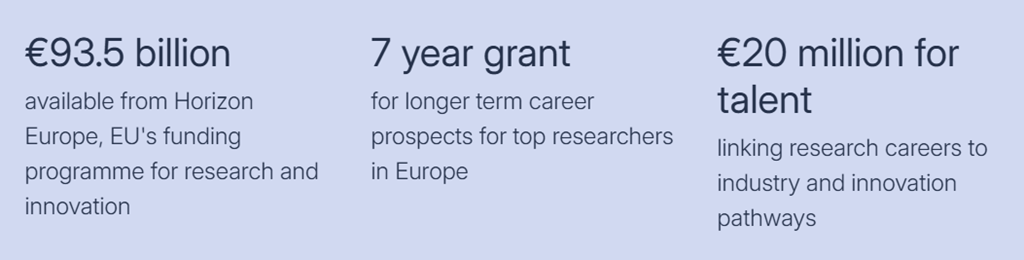
If I were young again, this type of lingo might appeal to me. I, however, am a dinobaby. Becoming a big-time academic researcher is a non-starter for me. For some, however, the EU’s inducement might be compelling. I have done projects and spent a reasonable amount of time in London and Paris. My son attended two universities in France, and I am not sure he wanted to return to the US, but the French government had other ideas for a 20 something.
Interesting. Opportunity with a possible message for some working in less salubrious situations. Crafty message and straight ahead marketing.
Stephen E Arnold, May 8, 2025
Want Traffic from Google? Buy Ads, Lots of Ads
April 30, 2025
 No AI, just the dinobaby himself.
When I was working, clients and prospects would ask me, “Do I need to advertise on Google to get traffic to my Web site?” I relayed the “facts” as I understood them at the time. My answer was, “You need to buy ads from Google.”
Most of the clients wrinkled their foreheads and asked, “Why?” My answer was then and still is, “Do you think Google does things for you for free?” Since I don’t do advertising, I don’t know how my information filtered from my contacts to the people who handled these organizations’ advertising budgets. I knew that with big indexes and lots of users, only a tiny fraction of the terms and Web sites get traffic. People don’t understand that their Web site is mostly invisible and was destined to stay that way unless [a] something extraordinary appeared on a Web page and drew eyeballs or [b] the organization had to spend thousands each month on Google ads.
I thought times might be changing since I retired. Nope, advertising matters. If the information in “Temu Pulls Its US Google Shopping Ads” is accurate, Google ads matter. The article reports:
Temu completely shut off Google Shopping ads in the U.S. on April 9, with its App Store ranking subsequently plummeting from a typical third or fourth position to 58th in just three days. The company’s impression share, which measures how often their ads appear compared to eligibility, dropped sharply before disappearing completely from advertiser auction data by April 12.
Buy ads, get traffic. That was true when I was running myself ragged trying to do work, and it is true today. I would suggest that this Temu example offers some insight into what happens if apps get pulled from the Google Play Store. Whatever downloads a developer had are likely to take a hit; that is, go from hero to zero in a snap.
The article wanders into political issues which are not part of my job description. I think it is important to think in terms of findability. One can pray that one’s content is so darned compelling that people flock to a magnet site or a post. Hope springs eternal just like every baby is a genius. One can pay search engine optimization wizards to gin up traffic via white hat and black hat methods. One can just buy ads, and go with the pay-to-play method.
Am I okay with Google’s control of traffic? Sure. I don’t care if I get traffic. But others do and need traffic to stay in business. Therefore, the information about Temu is germane I think. Your baby is a genius. Believe that. Just don’t assume that traffic will automatically flow to that baby’s Web site even if you bought a domain name celebrating the birth. Just buy ads.
Stephen E Arnold, April 30, 2025
YouTube Click Count Floors Creators
April 18, 2025
Content creators are not thrilled about a change in how YouTube counts views for short-form videos. The Google-owned site now tallies a view any time the short starts, regardless of how long it plays before the user scrolls on past. Digiday reports, “YouTube Shorts View Count Update Wins Over Brands—But Creators Aren’t Sold.” Though view counts have spiked since the change, that number has nothing to do with creators’ compensation. Any bragging rights from high view counts will surely be negated as word spreads on how their calculation changed. Besides, say seasoned creators, there could be a real downside for newbies. Reporter Ivy Liu writes:
Other creators said that they were worried the change could encourage YouTubers to focus on the inflated view metric displayed beneath Shorts, rather than the engaged view metric that contributes more meaningfully to creators’ income. For example, the creator BnG Refining — who goes by the name ‘Scrooge’ to his audience and asked not to be quoted by his real name — said that he was afraid less experienced creators might ‘flood the platform with content that they think is wanted, and not until hours, days, weeks later realizing that those were only fake views.’”
We are sure Google does not mind, though. Creators were not the real audience for the change. We learn:
“Brands and marketers are far more welcoming of the update, saying it brings order to the chaos of influencer marketing. Now, YouTube Shorts, TikTok videos and Instagram Reels all measure their views in the same way, making it easier for marketers to compare creators’ and videos’ performance across platforms. ‘It makes it easier, if you’re a brand, to say, “here’s how performance is across the board,” vs. looking at impressions and then trying to judge an impression as a view,’ said Krishna Subramanian, CEO of the influencer marketing company Captiv8.”
Of course. Because it is all about making it easier for brands to calculate their ROI. Creators’ perspectives, information, and artistic expression are secondary. As usual, creators are at the mercy of Google. Google likes everyone to be at its mercy. No meaningful regulation is the best regulation. Self regulation works wonders in the financial services sector too.
Cynthia Murrell, April 18, 2025
Ad Blockers and a Googley Consequence
April 11, 2025
 Another dinobaby blog post. Eight decades and still thrilled when I point out foibles.
Motivated individuals are acting in a manner usually associated with Cloudflare-type of outfits. The idea of a “man in the middle” is a good one. It works when one buys something from Amazon. The user wants convenience and does not take the time to hunt around for a better or cheaper version of a particular product.
“Block YouTube Ads on AppleTV by Decrypting and Stripping Ads from Profobuf” provides a recipe for dumping advertisements in some streaming services, but the spotlight is on the lovable Google and Apple’s streaming device. (Poor Apple. Like its misfiring AI and definitely interesting glasses, the company caught a bright person’s attention.)
Social media needs two things: Beacons that phone home and advertising because how else is a company going to push products and services. The write up provides step-by-step instructions for chopping out ads from two big outfits.
Here’s what I think will happen at the monopolies:
- At least two software people will tackle this “problem”: One from Apple and one from Google.
- One will come up with a “fix” to the work-around
- The “fix” will be shared with the company who did not come up with an enhancement first
- The modified method will be deployed
- The game begins again.
The cat-and-mouse sequence is little more than that von Neumann game theory just in real life with money at stake. It’s too bad Johnny and his pals (some of whom were quite quirky) are not around to work on ad blocking instead of nuclear weapons.
Well, Johnny isn’t around, and I think that game theory does not work when one battles multi billion dollar monopolies with lots of reasonably bright people around providing they aren’t veterans of the Apple AI team or the original Google Glass product.
The write up is interesting. I admire the effort the author put into the blocking. How long will it persist? Good question, but the next iteration will probably be designed to preserve the money flow. Ads and user tracking are the means to the end: Big revenue.
Stephen E Arnold, April 11, 2025
YouTube: The Future Has Blown Its Horn
April 3, 2025
YouTube has come a long way in the last two decades. Google wants us to appreciate just how far, apparently. Digiday celebrates the occasion with the piece, "As YouTube Turns 20, Here Are the Numbers You Need to Know." Writer Krystal Scanlon shares several noteworthy statistics. For example, the company states, an average of 500 hours of video is uploaded to the platform every minute. On the other end of the equation, about 30,000 viewers visit the site each day, Neilsen reported in February 2024.
In fact, we learn, YouTube considers itself the "new television." That same Neilsen report shows the platform outperforming other major streaming services. (Though it only beat Netflix by a nose, at 9.2% of total TV usage to its 8.2%.) The platform happily monetizes those eyeballs the old-fashioned way, with ads. However, it has also enticed over 125 million users to at least try its subscription plans. As for content creators, about 500,000 of them have been at it for over 10 years. They must be getting enough out of it to stick around. But for how many that is a viable career and how many it is just a hobby the write-up does not say. Whatever the case, it is clear YouTube has creators to thank for its significant ad revenue. Scanlon writes:
"With Europe’s creator economy projected to reach $41.17 billion by 2030 and U.S. influencer marketing expected to grow 14.2% to $9.29 billion this year, according to eMarketer, it’s clear why YouTube is focused on staying ahead in the creator space. Part of that plan involves doubling down on YouTube’s ability to thrust creators into the cultural mainstream. Which is why the platform has said that creators are becoming the startups of Hollywood. Whether it’s scripting, editing behind the scenes or creators are hiring various staff as part of their new business — YouTube wants to be the launchpad."
Yes, that would be quite the get. It will have to fight certain other streaming services for that honor, we think. The post continues:
"YouTube contributed more than $45 billion to the U.S. GDP in 2023, according to Oxford Economics, and it created more than 430,000 full-time jobs. Similarly, in Europe, YouTube contributed €6.4 billion ($6.94 billion) to the EU’s GDP in 2023, according to the platform’s latest Impact report, not including the jobs created by the 100,000 creators in the region that have built their own businesses including hiring staff."
Here’s the kicker. As changes roil the Google search advertising approach, YouTube might be the Little Engine That Could for Googzilla. Next up? Google Advertising, Broadcast, and Cable. ABC?
Cynthia Murrell, April 3 2025
Click Counting: It Is 1992 All Over Again
March 31, 2025
 Dinobaby says, “No smart software involved. That’s for “real” journalists and pundits.
I love it when search engine optimization experts, online marketing executives, and drum beaters for online advertising talk about clicks, clickstreams, and click metrics. Ho ho ho.
I think I was involved in creating a Web site called Point (The Top 5% of the Internet). The idea was simple: Curate and present a directory of the most popular sites on the Internet. It was a long shot because the team did not want to do drugs, sex, and a number of other illegal Web site profiles for the directory. The idea was that in 1992 or so, no one had a Good Housekeeping Seal of Approval-type of directory. There was Yahoo, but if one poked around, some interesting Web sites would display in their low resolution, terrible bandwidth glory.
To my surprise, the idea worked and the team wisely exited the business when someone a lot smarter than the team showed up with a check. I remember fielding questions about “traffic”. There was the traffic we used to figure out what sites were popular. Then there was traffic we counted when visitors to Point hit the home page and read profiles of sites with our Good Housekeeping-type of seal.
I want to share that from those early days of the Internet the counting of clicks was pretty sketchy. Scripts could rack up clicks in a slow heartbeat. Site operators just lied or cooked up reports that served up a reality in terms of tasty little clicks.
Why are clicks bogus? I am not prepared to explain the dark arts of traffic boosting which today is greatly aided by scripts instantly generated by smart software. Instead I want to highlight this story in TechCrunch: “YouTube Is Changing How YouTube Shorts Views Are Counted.” The article does a good job of explaining how one monopoly is responding to its soaring costs and the slow and steady erosion of its search Nile River of money.
The write up says:
YouTube is changing how it counts views on YouTube Shorts to give creators a deeper understanding of how their short-form content is performing
I don’t know much about YouTube. But I recall watching little YouTubettes which bear a remarkable resemblance to TikTok weaponized data bursts just start playing. Baffled, I would watch a couple of seconds, check that my “autoplay” was set to off, and then kill the browser page. YouTubettes are not for me.
Most reasonable people would want to know several things about their or any YouTubette; for example:
- How many times did a YouTubette begin to play and then was terminated in less that five seconds
- How many times a YouTubette was viewed from start to bitter end
- How many times a YouTubette was replayed in its entirety by a single user
- What device was used
- How many YouTubettes were “shared”
- The percentage of these data points compared against the total clicks of a short nature or the full view?
You get the idea. Google has these data, and the wonderfully wise but stressed firm is now counting “short views” as what I describe as the reality: Knowing exactly how many times a YouTubette was played start to finish.
According to the write up:
With this update, YouTube Shorts will now align its metrics with those of TikTok and Instagram Reels, both of which track the number of times your video starts or replays. YouTube notes that creators will now be able to better understand how their short-form videos are performing across multiple platforms. Creators who are still interested in the original Shorts metric can view it by navigating to “Advanced Mode” within YouTube Analytics. The metric, now called “engaged views,” will continue to allow creators to see how many viewers choose to continue watching their Shorts. YouTube notes that the change won’t impact creators’ earnings or how they become eligible for the YouTube Partner Program, as both of these factors will continue to be based on engaged views rather than the updated metric.
Okay, responding to the competition from one other monopolistic enterprise. I get it. Okay, Google will allegedly provided something for a creator of a YouTubette to view for insight. And the change won’t impact what Googzilla pays a creator. Do creators really know how Google calculates payments? Google knows. With the majority of the billions of YouTube videos (short and long) getting a couple of clicks, the “popularity” scheme boils down to what we did in 1992. We used whatever data was available, did a few push ups, and pumped out a report.
Could Google follow the same road map? Of course not. In 1992, we had no idea what we were doing. But this is 2025 and Google knows exactly what it is doing.
Advertisers will see click data that do not reflect what creators want to see and what viewers of YouTubettes and probably other YouTube content really want to know: How many people watched the video from start to finish?
Google wants to sell ads at perhaps the most difficult point in its 20 year plus history. That autoplay inflates clicks. “Hey, the video played. We count it,” can you conceptualize the statement? I can.
Let’s not call this new method “weaponization.” That’s too strong. Let’s describe this as “shaping” or “inflating” clicks.
Remember. I am a dinobaby and usually wrong. No high technology company would disadvantage a creator or an advertiser. Therefore, this change is no big deal. Will it help Google deal with its current challenges? You can now ask Google AI questions answered by its most sophisticated smart software for free.
Is that an indication that something is not good enough to cause people to pay money? Of course not. Google says “engaged views” are still important. Absolutely. Google is just being helpful.
Stephen E Arnold, March 31, 2025
Digital Marketing: Is It Worse Than Social Media? Yep, in Some Ways
March 26, 2025
 Yep, another dinobaby original.
With the US taking an interesting trajectory, I have seen an uptick in articles that tackle the question, “Why are many of society’s functions leaking synthetic oil?”
“How Digital Marketing Broke Society” takes a different analytic path. The culprit is not social media. (Please, visualize the tattoos on 11 year olds in TikTok- and Facebook-type content.) The bad actor is “digital marketing.” I must admit that I interpreted “digital marketing” with Google, but, please, don’t take my mental shortcut. You are more informed and neutral than I.
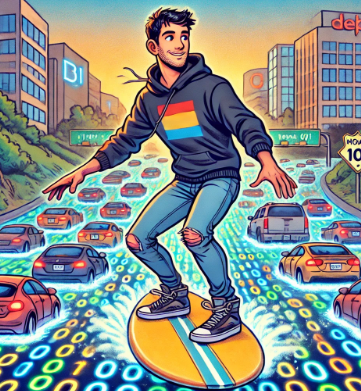
A young Silicon Valley type professional surfing to a digital advertising company on a flood of zeros and ones. He is making six figures and in his mom’s mind, her son is doing good things. He is such a good young man. She then turns her attention to his agentic note: “Love ya, mom.”
Let’s look at what Joan Westenberg (a person about whom I have zero knowledge) asserts.
I noted this passage:
We are, increasingly, a cross-generational society of extremely online, screen-tapping, doom scrolling depressives. And it’s having an impact. More than ever, we are divided by misinformation and disinformation, driven by and vulnerable to ignorance, hate-mongering, and bullshit, reactive more than proactive, caught in what is either a global backslide or a cycle of decay. We’re lonely, scared, and more likely than ever to take it out on total strangers. We read less. We watch more, and what we watch is short-form, viral videos designed to tap into the dopamine-fueled, base parts of our brains.
I think her point comes across, and it resonates with me. Every time I go to the gym I see people in need of serious calorie burning sitting on a machine or a bench fiddling with their mobile phones. I hit the gym at 6 am, and I am astounded that so many people have urgent messages to which they must respond. Hey, do some exercises. But these folks are gym potatoes engaged in doom scrolling I have concluded.
Ms. Westenberg adds:
An entirely new system of influence came into being, operating largely beneath conscious awareness. Dark patterns increased, making it harder for users to protect their privacy or limit their exposure. Intermittent variable rewards—the psychological mechanism that powers slot machines—became standard practice. The industry successfully reframed this surveillance and manipulation as “personalization” and “enhanced user experience”—linguistic legerdemain that positioned exploitation as a service.
I think this is accurate. (Remember, please, that I am interpreting this as Googley behavior. The company can pay for streaming video mostly for free because it seems to have the knack for using advertising to get more advertising and offering tools to facilitate most of the steps in the money extraction process. You, gentle reader, must be more open minded than I am.)
Another point in Ms. Westenberg’s essay caught my attention; to wit:
Meta’s internal research found that divisive content generates significantly higher engagement, translating directly to advertising revenue. YouTube’s recommendation algorithm precisely drives users toward increasingly extreme content because it maximizes watch time and ad impressions. Marketing technology companies have built their entire business models around the commodification of attention – regardless of its social consequences. Digital marketing is capitalism at its most predatory—a system where deliberately amplifying society’s worst impulses becomes a rational business strategy. The industry has created a machine that converts social discord into shareholder value. In an attention economy, hatred isn’t just profitable; it’s the optimal product. The economic model and the foundational worldview of digital marketing operate on the premise that human consciousness exists primarily as a resource to be mined, refined, and sold. It’s a form of cognitive colonization—claiming and exploiting mental territory that once belonged to human beings. You can read it in the language of the industry: users are “captured,” attention is “harvested,” and engagement is “extracted.”
Yes, data mining works. Predictive analytics work for precisely the insight behind Eugene Wigner’s 1960 essay “The Unreasonable Effectiveness of Mathematics in the Natural Sciences.” Digital marketing just applies this idea, and, in my opinion, it is indeed highly effective in 21st century human-centric predictive work.
I want to quote the passage that makes me quite happy with Ms. Westenberg’s essay, and if I may do a bit of predictive assertion, makes me feel warm and fuzzy about her mental orientation; specifically, she writes and I quote:
I spent fifteen years in digital marketing. Building campaigns, funnels, and content. But over the last month, I shut down my marketing business. The decision was both ethical and existential. I can’t continue participating in an industry that has evolved from persuasion – harmful enough – to psychological exploitation and the deliberate destruction of our social order. Every optimization, targeting refinement, and engagement metric has brought us closer to a world where human autonomy is systematically undermined for commercial gain. The techniques I learned and taught others—the psychological triggers, the attention-capturing mechanisms, the behavioral prediction models—have escaped their commercial confines to taint our information ecosystem and devour the foundations of political discourse. Digital marketing is a fundamental threat to human flourishing, cognitive autonomy, and democratic governance. The industry has normalized a state of perpetual surveillance and manipulation that would have been unthinkable just decades ago. Its methodologies have created a world where attention is constantly hijacked, emotions are continuously manipulated, and reality itself is customized in pursuit of extraction value.
I am not sure that the flow of digital or weaponized information will stop. I suppose at some point a power outage or some other exogenous event will knock online out, but for the foreseeable future, we have to surf on the torrents flooding the information highway.
Net net: I suppose I should recast my thinking and consider the perpetrators at those who are simply following the Google Legacy.
Stephen E Arnold, March 26, 2025
Google: Making a Buck Is the Name of the Game
December 30, 2024
 This blog post was crafted by a still-living dinobaby.
This is a screenshot of YouTube with an interesting advertisement. Take a look:

Here’s a larger version of the ad:

Now here’s the landing page for the teaser which looks like a link to a video:

The site advertising on YouTube.com is Badgeandwallet.com. The company offers a number of law enforcement related products. Here’s a sample of the badges available to a person exploring the site:

How many law enforcement officers are purchasing badges from an ad on YouTube? At some US government facilities, shops will provide hats and jackets with agency identification on them. However, to make a purchase, a visitor to the store must present current credentials.
YouTube.com and its parent are under scrutiny for a number of the firm’s business tactics. I reacted negatively to the inclusion of this advertisement in search results related to real estate in Beverly Hills, California.
Is Google the brilliant smart software company it says it is, or is the company just looking to make a buck with ads likely to be viewed by individuals who have little or nothing to do with law enforcement or government agencies?
I hope that 2025 will allow Google to demonstrate that it wants to be viewed as a company operating with a functioning moral compass. My hunch is that I will be disappointed as I have been with quantum supremacy and Googley AI.
Stephen E Arnold, December 30, 2025
-

- Subscribe to Beyond Search
Feature archive
News archive

-


