

Can AI Do What Jesus Enrique Rosas Does?
July 8, 2025
 Just a dinobaby without smart software. I am sufficiently dull without help from smart software.
I learned about a YouTube video via a buried link in a story in my newsfeed. The video is titled “Analysis of Jeffrey Epstein’s Cell Block Video Released by the FBI.” I know little about Mr. Rosas. He is a body language “expert.” I know zero about this field. He gives away a book about body language, and I assume that he gets inquiries and sells services. He appears to have developed what he calls a Knesix Code. He does not disclose his academic background.
But …
His video analysis of the Epstein surveillance camera data makes clear that Sr. Rosas has an eye for detail. Let me cite two examples:
First, he notes that in some of the footage released by the FBI, a partial image of a video editing program’s interface appears. Not only does it appear, but the image appears in several separate sectors of the FBI-released video. Mr. Rosas raises the possibility that the FBI footage (described as unaltered) was modified.
Here is an example of that video editing “tell” or partial image:

Second, Sr. Rosas spots a time gap in the FBI video. Here’s where the “glitch” appears:

How much is missing from the unedited video file? More than a minute.
Observations:
- I feed the interface image into a couple of smart software systems. None was able to identify the specific program’s interface from the partial image
- Mr. Rosas’ analysis identified two interesting anomalies in the video
- The allegedly unedited video appears to have been edited.
Net net: AI is not able to do what Sr. Rosas did. I do not want to speculate how “no videos” became this one video. I do not want to speculate why an unedited video contains two editing indications. I don’t want to think much about Jeffrey Epstein, the kiddie trafficking, and the individuals associating with him. I will stick with my observation, “AI does not seem to have the ability to do what Sr. Rosas did.”
Stephen E Arnold, July 8, 2025
Lights, Ready the Smart Software, Now Hit Enter
June 11, 2025
 Just a dinobaby and no AI: How horrible an approach?
I like snappy quotes. Here’s a good one from “You Are Not Prepared for This Terrifying New Wave of AI-Generated Videos.” The write up says:
I don’t mean to be alarmist, but I do think it’s time to start assuming everything you see online is fake.
I like the categorical affirmative. I like the “alarmist.” I particularly like “fake.”
The article explains:
Something happened this week that only made me more pessimistic about the future of truth on the internet. During this week’s Google I/O event, Google unveiled Veo 3, its latest AI video model. Like other competitive models out there, Veo 3 can generate highly realistic sequences, which Google showed off throughout the presentation. Sure, not great, but also, nothing really new there. But Veo 3 isn’t just capable of generating video that might trick your eye into thinking its real: Veo 3 can also generate audio to go alongside the video. That includes sound effects, but also dialogue—lip-synced dialogue.
If the Google-type synths are good enough and cheap, I wonder how many budding film directors will note the capabilities and think about their magnum opus on smart software dollies. Cough up a credit card and for $250 per month imagine what videos Google may allow you to make. My hunch is that Mother Google will block certain topics, themes, and “treatments.” (How easy would it be for a Google-type service to weaponize videos about the news, social movements, and recalcitrant advertisers?)
The write worries gently as well, stating:
We’re in scary territory now. Today, it’s demos of musicians and streamers. Tomorrow, it’s a politician saying something they didn’t; a suspect committing the crime they’re accused of; a “reporter” feeding you lies through the “news.” I hope this is as good as the technology gets. I hope AI companies run out of training data to improve their models, and that governments take some action to regulate this technology. But seeing as the Republicans in the United States passed a bill that included a ban on state-enforced AI regulations for ten years, I’m pretty pessimistic on that latter point. In all likelihood, this tech is going to get better, with zero guardrails to ensure it advances safely. I’m left wondering how many of those politicians who voted yes on that bill watched an AI-generated video on their phone this week and thought nothing of it.
My view is that several questions may warrant some noodling by a humanoid or possibly an “ethical” smart software system; for example:
- Can AI detectors spot and flag AI-generated video? Ignoring or missing may have interesting social knock on effects.
- Will a Google-type outfit ignore videos that praise an advertiser whose products are problematic? (Health and medical videos? Who defines “problematic”?)
- Will firms with video generating technology self regulate or just do what yields revenue? (Producers of adult content may have some clever ideas, and many of these professionals are willing to innovate.)
Net net: When will synth videos win an Oscar?
Stephen E Arnold, June 11, 2025
Some Outfits Takes Pictures… Of Users
May 23, 2025
Conspiracy theorists aka wackadoos assert preach that the government is listening to everyone with microphones and it’s only gotten worse with mobile devices. This conspiracy theory has been running circuits since before the invention of the Internet. It used to be spies or aluminum can string telephones were the culprit. Truth is actually stranger than fiction and New Atlas updated an article about how well Facebook is actually listening to us, “Your Phone Isn’t Secretly Listening To You, But The Truth Is More Disturbing.”
Let’s assume that the story is accurate, but the information was on the Internet, so for AI and some humans, the write up is chock full of meaty facts. It was revealed in 2024 that Cox Media Group (CMG) developed Active Listening, a system to capture “real time intent data” with mobile devices’ microphones. It then did the necessary technology magic and fed personalized ads. Tech companies distanced themselves from CMG. CMG stopped using the system. It supposedly worked by listening to small vocal data uploaded after digital assistants were activated. It bleeds into the smartphone listening conspiracy but apparently that’s still not a tenable reality.
The mobile cyber security company Wandera tested the listening microphone theory. They placed two smart phones in a room, played pet food ads on an audio loop for thirty minutes a day over three days. Here are the nitty gritty details:
“User permissions for a large number of apps were all enabled, and the same experiment was performed, with the same phones, in a silent test room to act as a control. The experiment had two main goals. First, a number of apps were scanned following the experiment to ascertain whether pet food ads suddenly appeared in any streams. Secondly, and perhaps more importantly, the devices were closely examined to track data consumption, battery use, and background activity.”
The results showed that phones weren’t listening to conversations. The truth was on par and more feasible given the current technology:
“In early 2017 Jingjing Ren, a PhD student at Northeastern University, and Elleen Pan, an undergraduate student, designed a study to investigate the very issue of whether phones listen in on conversations without users knowing. Pretty quickly it became clear to the researchers that the phones’ microphones were not being covertly activated, but it also became clear there were a number of other disconcerting things going on. There were no audio leaks at all – not a single app activated the microphone,’ said Christo Wilson, a computer scientist working on the project. ‘Then we started seeing things we didn’t expect. Apps were automatically taking screenshots of themselves and sending them to third parties. In one case, the app took video of the screen activity and sent that information to a third party.’”
There are multiple other ways Facebook and companies are actually tracking and collecting data. Everything done on a smartphone from banking to playing games generates data that can be tracked and sent to third parties. The more useful your phone is to you, the more useful it is as a tracking, monitoring, and selling tool to AI algorithms to generate targeted ads and more personalized content. It’s a lot easier to believe in the microphone theory because it’s easier to understand the vast amounts of technology at work to steal…er…gather information. To sum up, innovators are inspirational!
Whitney Grace, May 23, 2025
Germany and Pirate Sites
May 15, 2025
The United States is batting around site-blocking legislation called Foreign Anti-Digital Piracy Act (FADPA) by Representative Zoe Lofgren. The act takes US rights holders site blocking experience from overseas and transforms into a package for US use. What it means, according to TorrentFreak’s article: “Non-Transparency Resumed After Pirate Site Blacklist Publicly Exposed In Error,”
“Should it become law, FAPDA would allow rightsholders to obtain site blocking orders targeted at verified pirate sites, run by foreign or assumed foreign operators. The proposals as they stand today envision blocking orders that would apply to both ISPs and DNS resolvers, the latter an already controversial trend that has only recently shown momentum in Europe.”
In order to be effective, site-blocking tools must always adapt. It appears that FAPDA proposals are the template for US site blocking. Similar legislation called SOPA happened in 2012 but there wasn’t any historical precedence before, but now there is. The US is using Europe’s site-blocking as an example.
Germany has an administrative site that blocks pirate Web sites without direct legal oversight:
“A partnership between rightsholders and local ISPs saw the launch of the “Clearing Body for Copyright on the Internet” (CUII) which is now responsible for handing down blocking instructions against sites that structurally infringe copyright.”
The CUII Web site publishes blocking recommendations and it is supposed to be private. It wasn’t! The Netzpolitik reported that Germany’s secret pirate blocking Web site has been publicly viewable for ten months.
People are also crying free speech violations, especially because there aren’t any transparency. Europe won’t be forthcoming with transparency is ISPs and rights holders aren’t required to have them.
Whitney Grace, May 15, 2025
Open Podcast Index Lists Many
September 24, 2024
Podcasters who wish to be indexed by Apple or Spotify must abide by certain guidelines, some of which appear arbitrary or self-serving to some. Enter the Podcast Index, introduced by long-time broadcaster turned “podfather,” Adam Curry. The site follows the open-source tradition, promising:
“The Podcast Index is here to preserve, protect and extend the open, independent podcasting ecosystem. We do this by enabling developers to have access to an open, categorized index that will always be available for free, for any use. … Podcast Index LLC is a software developer focused partnership that provides tools and data to anyone who aspires to create new and exciting Podcast experiences without the heavy lifting of indexing, aggregation and data management.”
Funded by its founders and by donations, the site aims to list every available podcast so would-be listeners need not rely on commercial firms to discover them. This goal is emphasized by a running tally on the homepage, which counts over four million (!) podcasts listed as of this writing. One can filter and browse the many supporting apps, directories, and hosting companies here. Developers can sign up to use the API here. And, of course, donations can be made through the red button at the foot of the home page. For anyone wondering how to put content from around the world in their ears, this is a good place to start.
Cynthia Murrell, September 24, 2024
Am I Overly Sensitive to X (Twitter) Images?
August 28, 2024
X AI Creates Disturbing Images
The AI division of X, xAI, has produced a chatbot called Grok. Grok includes an image generator. Unlike ChatGPT and other AIs from major firms, Grok seems to have few guardrails. In fact, according to The Verge, “X’s New AI Image Generator Will Make Anything from Taylor Swift in Lingerie to Kamala Harris with a Gun.” Oh, if one asks Grok directly, it claims to have sensible guardrails and will even list a few. However, writes senior editor Adi Robertson:
“But these probably aren’t real rules, just likely-sounding predictive answers being generated on the fly. Asking multiple times will get you variations with different policies, some of which sound distinctly un-X-ish, like ‘be mindful of cultural sensitivities.’ (We’ve asked xAI if guardrails do exist, but the company hasn’t yet responded to a request for comment.) Grok’s text version will refuse to do things like help you make cocaine, a standard move for chatbots. But image prompts that would be immediately blocked on other services are fine by Grok.”
The article lists some very uncomfortable experimental images Grok has created and even shares a few. See the write-up if curious. We learn one X user found some frightening loopholes. When he told the AI he was working on medical or crime scene analysis, it allowed him to create some truly disturbing images. The write-up shares blurred versions of these. The same researcher says he got Grok to create child pornography (though he wisely does not reveal how). All this without a “Created with AI” watermark added by other major chatbots. Although he is aware of this issue, X owner Elon Musk characterizes this iteration of Grok as an “intermediate step” that allows users “to have some fun.” That is one way to put it. Robertson notes:
“Grok’s looseness is consistent with Musk’s disdain for standard AI and social media safety conventions, but the image generator is arriving at a particularly fraught moment. The European Commission is already investigating X for potential violations of the Digital Safety Act, which governs how very large online platforms moderate content, and it requested information earlier this year from X and other companies about mitigating AI-related risk. … The US has far broader speech protections and a liability shield for online services, and Musk’s ties with conservative figures may earn him some favors politically.”
Perhaps. But US legislators are working on ways to regulate deepfakes that impersonate others, particularly sexually explicit imagery. Combine that with UK regulator Ofcom’s upcoming enforcement of the OSA, and Musk may soon find a permissive Grok to be a lot less fun.
Cynthia Murrell, August 28, 2024
Canadians Unhappy about Tax on Streaming Video
August 15, 2024
Unfortunately the movie industry has tanked worldwide because streaming services have democratized delivery. Producers, directors, actors, and other industry professionals are all feeling the pain of tighter purse strings. The problems aren’t limited to Hollywood, because Morningstar explains that the US’s northern neighbor is also feeling the strain: “The Motion Picture Association-Canada Asks Canada Appeal Court To Stop Proposed Tax On Streaming Revenue.”
A group representing big entertainment companies: Walt Disney, Netflix, Warner Brothers, Discovery, Paramount Global, and more are asking a Canadian court to stop a law that would force the companies to pay 5% of their sales to the country to fund local news and other domestic content. The Motion Picture Association- Canada stated that tax from the Canadian Radio-television and Telecommunications Commission oversteps the organization’s authority. The group representing the Hollywood bigwigs also mentions that its clients spent billions in Canada every year.
The representative group are also arguing that the tax would force Canadian subscribers to pay more for streaming services and the companies might consider leaving the northern country. Canadian Radio-television and Telecommunications Commission countered that without the tax local content might not be made or distributed anymore. Hollywood’s lawyers doesn’t like it at all:
“In their filing with Canada’s Federal Court of Appeal, lawyers for the group say the regulator didn’t reveal “any basis” for why foreign streamers are required to contribute to the production of local television and radio newscasts. The broadcast regulator “concluded, without evidence, that ‘there is a need to increase support for news production,'” the lawyers said in their filing. ‘Imposing on foreign online undertakings a requirement to fund news production is not appropriate in the light of the nature of the services that foreign online undertakings provide.’”
Canada will probably keep the tax and Hollywood, instead of the executives eating the costs, will pass it onto consumers. Consumers will also be shafted, because their entertainment streaming services will continue to become expensive.
Whitney Grace, August 15, 2024
Allegations of Personal Data Flows from X.com to Au10tix
June 4, 2024
 This essay is the work of a dinobaby. Unlike some folks, no smart software improved my native ineptness.
I work from my dinobaby lair in rural Kentucky. What the heck to I know about Hod HaSharon, Israel? The answer is, “Not much.” However, I read an online article called “Elon Musk Now Requiring All X Users Who Get Paid to Send Their Personal ID Details to Israeli Intelligence-Linked Corporation.”I am not sure if the statements in the write up are accurate. I want to highlight some items from the write up because I have not seen information about this interesting identify verification process in my other feeds. This could be the second most covered news item in the last week or two. Number one goes to Google’s telling people to eat a rock a day and its weird “not our fault” explanation of its quantumly supreme technology.
Here’s what I carried away from this X to Au10tix write up. (A side note: Intel outfits like obscure names. In this case, Au10tix is a cute conversion of the word authentic to a unique string of characters. Aw ten tix. Get it?)
Yes, indeed. There is an outfit called Au10tix, and it is based about 60 miles north of Jerusalem, not in the intelware capital of the world Tel Aviv. The company, according to the cited write up, has a deal with Elon Musk’s X.com. The write up asserts:
X now requires new users who wish to monetize their accounts to verify their identification with a company known as Au10tix. While creator verification is not unusual for online platforms, Elon Musk’s latest move has drawn intense criticism because of Au10tix’s strong ties to Israeli intelligence. Even people who have no problem sharing their personal information with X need to be aware that the company they are using for verification is connected to the Israeli government. Au10tix was founded by members of the elite Israeli intelligence units Shin Bet and Unit 8200.
Sounds scary. But that’s the point of the article. I would like to remind you, gentle reader, that Israel’s vaunted intelligence systems failed as recently as October 2023. That event was described to me by one of the country’s former intelligence professionals as “our 9/11.” Well, maybe. I think it made clear that the intelware does not work as advertised in some situations. I don’t have first-hand information about Au10tix, but I would suggest some caution before engaging in flights of fancy.
The write up presents as actual factual information:
The executive director of the Israel-based Palestinian digital rights organization 7amleh, Nadim Nashif, told the Middle East Eye: “The concept of verifying user accounts is indeed essential in suppressing fake accounts and maintaining a trustworthy online environment. However, the approach chosen by X, in collaboration with the Israeli identity intelligence company Au10tix, raises significant concerns. “Au10tix is located in Israel and both have a well-documented history of military surveillance and intelligence gathering… this association raises questions about the potential implications for user privacy and data security.” Independent journalist Antony Loewenstein said he was worried that the verification process could normalize Israeli surveillance technology.
What the write up did not significant detail. The write up reports:
Au10tix has also created identity verification systems for border controls and airports and formed commercial partnerships with companies such as Uber, PayPal and Google.
My team’s research into online gaming found suggestions that the estimable 888 Holdings may have a relationship with Au10tix. The company pops up in some of our research into facial recognition verification. The Israeli gig work outfit Fiverr.com seems to be familiar with the technology as well. I want to point out that one of the Fiverr gig workers based in the UK reported to me that she was no longer “recognized” by the Fiverr.com system. Yeah, October 2023 style intelware.
Who operates the company? Heading back into my files, I spotted a few names. These individuals may no longer involved in the company, but several names remind me of individuals who have been active in the intelware game for a few years:
- Ron Atzmon: Chairman (Unit 8200 which was not on the ball on October 2023 it seems)
- Ilan Maytal: Chief Data Officer
- Omer Kamhi: Chief Information Security Officer
- Erez Hershkovitz: Chief Financial Officer (formerly of the very interesting intel-related outfit Voyager Labs, a company about which the Brennan Center has a tidy collection of information related to the LAPD)
The company’s technology is available in the Azure Marketplace. That description identifies three core functions of Au10tix’ systems:
- Identity verification. Allegedly the system has real-time identify verification. Hmm. I wonder why it took quite a bit of time to figure out who did what in October 2023. That question is probably unfair because it appears no patrols or systems “saw” what was taking place. But, I should not nit pick. The Azure service includes a “regulatory toolbox including disclaimer, parental consent, voice and video consent, and more.” That disclaimer seems helpful.
- Biometrics verification. Again, this is an interesting assertion. As imagery of the October 2023 emerged I asked myself, “How did that ID to selfie, selfie to selfie, and selfie to token matches” work? Answer: Ask the families of those killed.
- Data screening and monitoring. The system can “identify potential risks and negative news associated with individuals or entities.” That might be helpful in building automated profiles of individuals by companies licensing the technology. I wonder if this capability can be hooked to other Israeli spyware systems to provide a particularly helpful, real-time profile of a person of interest?
Let’s assume the write up is accurate and X.com is licensing the technology. X.com — according to “Au10tix Is an Israeli Company and Part of a Group Launched by Members of Israel’s Domestic Intelligence Agency, Shin Bet” — now includes this
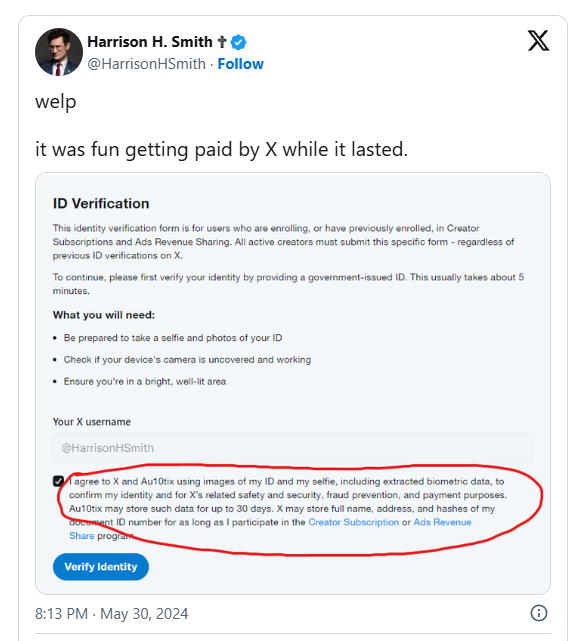
The circled segment of the social media post says:
I agree to X and Au10tix using images of my ID and my selfie, including extracted biometric data to confirm my identity and for X’s related safety and security, fraud prevention, and payment purposes. Au10tix may store such data for up to 30 days. X may store full name, address, and hashes of my document ID number for as long as I participate in the Creator Subscription or Ads Revenue Share program.
This dinobaby followed the October 2023 event with shock and surprise. The dinobaby has long been a champion of Israel’s intelware capabilities, and I have done some small projects for firms which I am not authorized to identify. Now I am skeptical and more critical. What if X’s identity service is compromised? What if the servers are breached and the data exfiltrated? What if the system does not work and downstream financial fraud is enabled by X’s push beyond short text messaging? Much intelware is little more than glorified and old-fashioned search and retrieval.
Does Mr. Musk or other commercial purchasers of intelware know about cracks and fissures in intelware systems which allowed the October 2023 event to be undetected until live-fire reports arrived? This tie up is interesting and is worth monitoring.
Stephen E Arnold, June 4, 2024
AItoAI Interviews Connecticut Senator James Maroney
May 30, 2024
 This essay is the work of a dinobaby. Unlike some folks, no smart software improved my native ineptness.
AItoAI: Smart Software for Government Uses Cases has published its interview with Senator James Maroney. Senator Maroney is the driving force behind legislation to regulate artificial intelligence in Connecticut. In the 20-minute interview, Senator Maroney elaborated on several facets of the proposed legislation. The interviewers were the father-and-son team of Erik S. (the son) and Stephen E Arnold (father).

Senator James Maroney spearheaded the Connecticut artificial intelligence legislation.
Senator Maroney pointed to the rapid growth of AI products and services. That growth has economic implications for the citizens and businesses in Connecticut. The senator explained that biases in algorithms can have a negative impact. For that reason, specific procedures are required to help ensure that the AI systems operate in a fair way. To help address this issue, Senator Maroney advocates a risk-based approach to AI. The idea is that a low-risk AI service like getting information about a vacation requires less attention than a higher-risk application such as evaluating employee performance. The bill includes provisions for additional training. The senator’s commitment to upskilling links to taking steps to help citizens and organizations of all types use AI in a beneficial manner.
AItoAI wants to call attention to Senator Maroney’s making his time available for the interview. Erik and Stephen want to thank the senator for his time and his explanation of some of the bill’s provisions.
You can view the video at https://youtu.be/ZfcHKLgARJU or listen to the audio of the 20-minute program at https://shorturl.at/ziPgr.
Stephen E Arnold, May 30, 2024
Rentals Are In, Ownership Is Out
May 23, 2024
 This essay is the work of a dinobaby. Unlike some folks, no smart software improved my native ineptness.
We thought the age of rentals was over and we bid farewell to Blockbuster with a nostalgic wave. We were so wrong and it started with SaaS or software as a service. It should also be streaming as a service. The concept sounds good: updated services, tech support, and/or an endless library of entertainment that includes movies, TV shows, music, books, and videogames. The problem is the fees keep getting higher, the tech support doesn’t speak English, the software has bugs, and you don’t own the entertainment.
You don’t own your favorite shows, movies, music, videogames, and books anymore unless you buy physical copies or move the digital downloads off the hosting platform. Australians were scratching their heads over the ownership of their digital media recently The Guardian reported: “‘My Whole Library Is Wiped Out’: What It Means To Own Movies And TV In The Age Of Streaming Services.”
Telstra TV Box Office informed customers that the company would shutter in June and they would lose their purchased media unless they paid another fee to switch everything to Fetch. Customers expected to watch their purchased digital media indefinitely, but they were actually buying into a hosting platform. The problem stems from the entertainment version of SaaS: digital rights management.
People buy digital files but they don’t read the associated terms and conditions. The terms and conditions are long, legalese documents that no one reads. They do clearly state, however, why the digital rights management expectations are. Shaanan Chaney of Melbourne University said it’s unfair for customers to read those documents, but the companies aren’t liable:
“ ‘Such provisions are fairly standard among tech companies. Customers can rent or buy films via Amazon Prime, and the company’s terms of service states the content ‘will generally continue to be available to you for download or streaming … but may become unavailable … Amazon will not be liable to you’.”
Apple iTunes has a similar clause in their terms and conditions, but they suggest customers download their media and backing them up. Digital rights management is important, but it’s run by large corporations that don’t care about consumers (and often creators). Companies do deserve to be paid and run their organizations as they wish, but they should respect their customers (and creators).
Buying physical copies is still a good idea. Life is a subscription and no way to cancel
Whitney Grace, May 23, 2024
-

- Subscribe to Beyond Search
Feature archive
News archive

-


