

Google: Making Users Cross Their Eyes in Confusion
May 9, 2025
 No AI, just a dinobaby watching the world respond to the tech bros.
I read “Don’t Make It Like Google.” The article points out that Google’s “control” extends globally. The company’s approach to software and design are ubiquitous. People just make software like Google because it seems “right.”
The author of the essay says:
Developers frequently aim to make things “like Google” because it feels familiar and, seemingly, the right way to do things. In the past, this was an implicit influence, but now it’s direct: Google became the platform for web applications (Chrome) and mobile applications (Android). It also created a framework for human-machine interaction: Material Design. Now, “doing it like Google” isn’t just desirable; it’s necessary.
Regulators in the European Union have not figured out how to respond to this type of alleged “monopoly.”
The author points out:
Most tech products now look indistinguishable, just a blobby primordial mess of colors.
Why? The author provides an answer:
Google’s actual UI & UX design is terrible. Whether mass-market or enterprise, web or mobile, its interfaces are chaotic and confusing. Every time I use Google Drive or the G Suite admin console, I feel lost. Neither experience nor intuition helps—I feel like an old man seeing a computer for the first time.
I quite like the reference to the author’s feeling like an “old man seeing a computer for the first time.” As a dinobaby, I find Google’s approach to making functions available — note, I am going to use a dinobaby term — stupid. Simple functions to me are sorting emails by sender and a keyword. I have not figured out how to do this in Gmail. I have given up on Google Maps. I have zero clue how to access the “old” street view with a basic map on a mobile device. Hey, am I the only person in an unfamiliar town trying to locate a San Jose-type office building in a tan office park? I assume I am.
The author points out:
Instead of prioritizing objectively good user experiences, the more profitable choice is often to mimic Google’s design. Not because developers are bad or lazy. Not because users enjoy clunky interfaces. But because it “makes sense” from the perspective of development costs and marketing. It’s tricky to praise Apple while criticizing Google because where Google has clumsy interfaces, Apple has bugs and arbitrary restrictions. But if we focus purely on interface design, Apple demonstrates how influence over users and developers can foster generations of well-designed products. On average, an app in Apple’s ecosystem is more polished and user-friendly than one in Google’s.
I am not sure that Apple is that much better than Google, but for me, the essay makes clear that giant US technology companies shape the user’s reality. The way information is presented and what expert users learn may not be appropriate for most people. I understand that these companies have to have a design motif or template. I understand that big companies have “experts” who determine what users do and want.
The author of the essay says:
We’ve become accustomed to the unintuitive interfaces of washing machines and microwaves. A new washing machine may be quieter, more efficient, and more aesthetically pleasing, yet its dials and icons still feel alien; or your washing machine now requires an app. Manufacturers have no incentive to improve this aspect—they just do it “like the Google of their industry.” And the “Google” of any industry inevitably gets worse over time.
I disagree. I think that making interfaces impossible is a great thing. Now here’s my reasoning: Who wants to expend energy figuring out a “better way.” The name of the game is to get eyeballs. Looking like Google or any of the big technology companies means that one just rolls over and takes what these firms offer as a default. Mind control and behavior conditioning is much easier and ultimately more profitable than approaching a problem from the user’s point of view. Why not define what a user gets, make it difficult or impossible to achieve a particular outcome, and force the individual to take what is presented as the one true way.
That makes business sense.
Stephen E Arnold, May 9, 2025
Microsoft and Its Customers: Out of Phase, Orthogonal, and Confused
May 9, 2024
 This essay is the work of a dinobaby. Unlike some folks, no smart software improved my native ineptness.
I am writing this post using something called Open LiveWriter. I switched when Microsoft updated our Windows machines and killed printing, a mouse linked via a KVM, and the 2012 version of its blog word processing software. I use a number of software products, and I keep old programs in order to compare them to modern options available to a user. The operative point is that a Windows update rendered the 2012 version of LiveWriter lost in the wonderland of Windows’ Byzantine code.

A young leader of an important project does not want to hear too much from her followers. In fact, she wishes they would shut up and get with the program. Thank, MSFT Copilot. How’s the Job One of security coming today?
There are reports, which I am not sure I believe, that Windows 11 is a modern version of Windows Vista. The idea is that users are switching to Windows 10. Well, maybe. But the point is that users are not happy with Microsoft’s alleged changes to Windows; for instance:
- Notifications (advertising) in the Windows 11 start menu
- Alleged telemetry which provides a stream of user action and activity data to Microsoft for analysis (maybe marketing purposes?)
- Gratuitous interface changes which range from moving control items from a control panel to a settings panel to fiddling with task manager
- Wonky updates like the printer issue, driver wonkiness, and smart help which usually returns nothing of much help.
I read “This Third-Party App Blocks Integrated Windows 11 Advertising.” You can read the original article to track down this customization tool. My hunch is that its functions will be intentionally blocked by some bonus centric Softie or a change to the basic Windows 11 control panel will cause the software to perform like LiveWriter 2012.
I want to focus on a comment to the cited article written by seeprime:
Microsoft has seriously degraded File Explorer over the years. They should stop prolonging the Gates culture of rewarding software development, of new and shiny things, at the expense of fixing what’s not working optimally.
Now that security, not AI and not Windows 11, are the top priority at Microsoft, will the company remediate the grouses users have about the product? My answer is, “No.” Here’s why:
- Fixing, as seeprime, suggests is less important that coming up with some that seems “new.” The approach is dangerous because the “new” thing may be developed by someone uninformed about the hidden dependencies within what is code as convoluted as Google’s search plumbing. “New” just breaks the old or the change is something that seems “new” to an intern or an older Softie who just does not care. Good enough is the high bar to clear.
- Details are not Microsoft’s core competency. Indeed, unlike Google, Microsoft has many revenue streams, and the attention goes to cooking up new big-money services like a version of Copilot which is not exposed to the Internet for its government customers. The cloud, not Windows, is the future.
- Microsoft whether it knows it or not is on the path to virtualize desktop and mobile software. The idea means that Microsoft does not have to put up with developers who make changes Microsoft does not want to work. Putting Windows in the cloud might give Microsoft the total control it desires.
- Windows is a security challenge. The thinking may be: “Let’s put Windows in the cloud and lock down security, updates, domain look ups, etc. I would suggest that creating one giant target might introduce some new challenges to the Softie vision.
Speculation aside, Microsoft may be at a point when users become increasingly unhappy. The mobile model, virtualization, and smart interfaces might create tasty options for users in the near future. Microsoft cannot make up its mind about AI. It has the OpenAI deal; it has the Mistral deal; it has its own internal development; and it has Inflection and probably others I don’t know about.
Microsoft cannot make up its mind. Now Microsoft is doing an about face and saying, “Security is Job One.” But there’s the need to make the Azure Cloud grow. Okay, okay, which is it? The answer, I think, is, “We want to do it all. We want everything.”
This might be difficult. Users might just pile up and remain out of phase, orthogonal, and confused. Perhaps I could add angry? Just like LiveWriter: Tossed into the bit trash can.
Stephen E Arnold, May 9. 2024
Are AI UIs Really Better?
June 27, 2023
User experience design firm Nielsen Norman Group believes advances in AI define an entirely new way of interacting with computers. Writer and company cofounder Jakob Nielsen asserts, “AI: First New UI Paradigm in 60 Years.” We would like to point out natural language is not new, but we acknowledge there are now machine resources and software that make methods more useful. Do they rise to the level of a shiny new paradigm?
Neilsen begins with a little history lesson. First came batch processing in 1945 — think stacks of punch cards and reams of folded printouts. It was an unwieldy and inconvenient system to say the least. Then around 1964 command-based interaction took over, evolving through the years from command-line programming to graphical user interfaces. Nielsen describes why AI represents a departure from these methods:
“With the new AI systems, the user no longer tells the computer what to do. Rather, the user tells the computer what outcome they want. Thus, the third UI paradigm, represented by current generative Auk is intent-based outcome specification.”
Defining outcomes instead of steps — sounds great until one asks who’s in control. Not the user. The article continues:
“Do what I mean, not what I say is a seductive UI paradigm — as mentioned, users often order the computer to do the wrong thing. On the other hand, assigning the locus of control entirely to the computer does have downsides, especially with current AI, which is prone to including erroneous information in its results. When users don’t know how something was done, it can be harder for them to identify or correct the problem.”
Yes! Nielsen cites this flaw as a reason he will stick with graphic user interfaces, thank you very much. (Besides, he feels, visual information is easier to understand and interact with than text.) We would add a more sinister consideration: Is the system weaponized or delivering shaped information? Developers’ lack of transparency can hide not only honest mistakes but also biases and even intentional misinformation. We agree with Nielsen: We will stick with GUIs for a bit longer.
Cynthia Murrell, June 27, 2023
A Balloon Fetish?
June 2, 2022
Years ago as I drove down and up the 101 I noted the big hanger. I thought, “Hindenberg?” A couple of years later, the Google inflated the Loon balloons. I loved the name and the idea that balloons could remain in a semi stationary location providing Internet access to those in need. Maybe Sri Lanka or a storm-devastated island? Yeah.
I was interested in “Largest Airship Built in United States Since 1930s to Take Shape Soon Inside Akron Airdock.” The write up reported:
“LTA is standing on the shoulders of its predecessors here at the airdock,” said Alan Weston, the company’s chief executive officer. LTA – as in Lighter Than Air – was founded in California by billionaire Google co-founder Sergey Brin. “Because of their efforts, we are going to be able to build airships that are faster, that are safer, more environmentally friendly and have greater capabilities than any airship built before.”
Yep, another balloon and a big one.
The dollar stores in the rust belt are reporting shortages of helium. Is there a connection? Who knows.
What I do know:
- A certain Xoogler has an interest in balloons
- Previous balloon projects did not remain aloft
- A display of dozens of these big balloons would make a heck of a kids’ birthday party unicorn display just on a Google-like scale.
The big floater is an ideal advertising platform, right?
Stephen E Arnold, June 2, 2022
Tim Apple and Unintended Consequences: AirPods?
April 19, 2022
Apple in my opinion emphasizes privacy. (How about the iPhone and the alleged NSO Group Pegasus functionality?) “Ukrainians Are Tracking the Movement of Russian Troops Thanks to One Occupier Looter with AirPods.” I am not sure if the write up is accurate. The source says “truth.” But…
The tracking thing is interesting; for example, Phone home malware on an iPhone, an AirTag hidden on a Russian T-14 Armata, or AirPods. Head phones? Yep.
The cited article reports:
A Russian soldier stole [a Ukrainian’s] AirPods (wireless headphones) when looting [the Ukrainian’s] apartment while Russian occupying forces were in Gostomel. Russian soldiers withdrew, but thanks to the technology on Apple devices, Ukrainians can keep track of where their headphones are. Find My technology on Apple devices lets you find the location of a lost device on the map if it’s near Bluetooth smartphones or connected to Wi-Fi.
What can one do with the help geo-location functions? One idea is to use the coordinates as a target for a semi-smart missile. (This is not a criticism of smart software. It is part of the close enough for horseshoes methods which can often deliver the payload somewhere unintended.)
Now about that Tim Apple privacy thing? Pravda or falsehood?
Stephen E Arnold, April 19, 2022
Ad-Rich User Tracking GPS Maps: Can You Be Guided Off a Cliff?
September 3, 2021
It is easy to go on autopilot when using a GPS device like Waze or Google Maps, but never Apple Maps because it is never accurate. Unfortunately even trusted apps are not error free and Auto Evolution explains why in: “Don’t Trust Google Maps And Waze, Colorado Officials Say.” While many GPS apps are reliable, they are notorious for containing inaccurate data, especially in rural or foreign countries.
GPS horror stories haunt the Internet like old MySpace accounts. Two Russians blindly followed Google Maps to a location, where they lost their signal. They spent the night in frigid temperatures, one of them died. Other drivers use roads that are only meant for off-road vehicles or tractors. Local authorities end up rescuing these drivers, because they are often stranded.
In Colorado, drivers are trusting Waze, Google Maps, and other GPS apps way too much. The Colorado Department of Transportation even issued a statement telling drivers not to use these apps, because it could take them down dangerous or dead end roads.
“‘Don’t trust your cell phones, they are really getting people into trouble,’ Amber Barrett, the Eagle County Sheriff’s Office Public Information Officer, has been quoted as saying.
Trusting apps like Google Maps and Waze is a big issue, she said, though, in theory, all these solutions should be updated by map editors or volunteers with accurate data. But of course, no app is bulletproof, yet we wouldn’t go as far as not using these apps at all.”
The department advises people to not take GPS directions as set in stone. If a road appears that it is not meant for regular travel, then do not follow it. The GPS will persuade drivers to make a U-turn or turn around at the next possible place.
Ad supported map makers have an incentive to keep their users from killing themselves by following incorrect directions. Dead people cannot buy advertisers’ products nor can they deliver useful real time data to the map providers.
Whitney Grace, August xx, 2021
Clear Signals of Deeper, Less Visible Flaws, Carelessness, and Corner Cuts
June 21, 2021
I read “State of the Windows: How Many Layers of UI Inconsistencies Are in Windows 10?” I found the listing of visual anomalies interesting. I don’t care much about Windows. We run a couple of applications and upgrade to new versions once the point releases and bugs have been identified and mostly driven into dark holes.
The write up points out:
As you may know, Microsoft is planning on overhauling the UI of Windows with their “Sun Valley” update, which aims to unify the design of the OS. However, as we can see, Windows is one behemoth of an operating system. Will their efforts to finally make a cohesive user experience succeed?
My answer to this question is that Microsoft has embraced processes which tolerate inconsistencies. I see this as a strategic or embedded function of the company’s management attitude: Good enough. If a company cannot make interfaces consistent, what about getting security issues, software update processes, and code quality under control.
I want to mention the allegation that Microsoft may have been signing malicious drivers. For more on this interesting assertion, navigate to Gossi The Dog at this link. One hopes the information in this sequence of messages and screenshots is fabricated. But if there are on the money, well …
If you can’t see it, perhaps “good enough” becomes “who cares.” Obviously some at Microsoft hold both of these strategic principles dear.
Stephen E Arnold, June 21, 2021
College Book Popularity: Thumbtyper Research
January 14, 2021
I am not sure how to interpret the information in “The Most Popular College Books.” First, there is a difference between reading a book and including the book on a list. How many thumbtypers have read De La Démocratie en Amérique? I remember seeing most of the students in my class in American history with those cheerful summaries available at the bookstore near the campus. There were a couple of people with the one volume abridged edition. Should I name the student who had the two volume edition in French? Nope, not making this write up about me.
A list is something easy to digest; for example, a list of Tesla models. The approach in the write up is to convert lists into wonky panels of thumbnails and narrative passages. If you have the time and thumbtypers’ skill at navigating most illegible icons, you will love this write up.
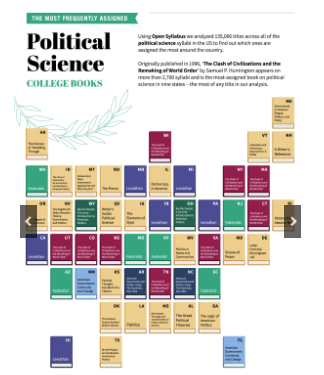
Some of the data in the list is downright amazing. The potboiler “Story of an Hour” is “the most assigned work of literature.” Okay. A spin on an O. Henry story call “The Gift of the Magi.” But American literature’s best? Sure.
I worked on an advanced degree at a Jesuit college. Let me tell you that most of the graduate students I encountered had never read Nicomachean Ethics in any form. Today it’s moving up the popularity list. Believe it or not. Ethics: Definitely a hot topic today. Gee, I wonder why? Maybe the answer is in De La Démocratie en Amérique or “Story of an Hour.”
Stephen E Arnold, January 14, 2021
Microsoft: What Is the Inspiration for Google Action Blocks?
May 22, 2020
Years ago, an outfit connected to the Microsofties invited me to a meeting. The meeting took place before the zippy Windows phone tile interface took the world like a mild mist on a spring morning. The big colorful tiles appeared in the Windows desktop interface. One thing for sure: Flashing tiles catch the eye and suck up bandwidth and CPU cycles like a fast growing dandelion.
I thought of this Windows tile thing when I read “Google Action Blocks Would Make iPhone Simple Again.” The title makes it clear that hurling digital tiles in an action filled way will klonk the iPhone and nick the Redmond empire.
The article reported:
Google Action Blocks can turn several steps into a single step – one button tap.
Tap on what?
Good question. The action block thing converts an iPhone into a semi Windows phone. Android phones are just so easy to use the way the Google intended.
The article is definitely excited about this latest me too from the Googlers:
But why, you might ask, would I need a button to open an app? Can’t I just tap the app icon? Yes, you can, but Action Block buttons can be made large. Action Blocks creates Widgets, Widgets that are resizable – as resizable as you desire. You could open a specific app with a button that’s as large as your display – it could be massive!
Innovation is alive and well at Alphabet. Users of the iPhone who work at Microsoft will experience a moment of nostalgia when Action Blocks are tackled.
Stephen E Arnold, May 22, 2020
Dark Patterns: A Partial Explanation
May 21, 2020
Manipulation is a rich, multi-layered concept. DarkCyber noted “Dark Patterns: Past, Present, and Future: The Evolution of Tricky User Interfaces” is a slice of a manipulative pie, but the bakery has not been fully sampled. (Note: You may have to pay to read the article.) That poorly lit patisserie can be explored by future computer, scholar, analyst philosophers.
The pie slice at hand look good and seems tasty.
The article is the work of a number of computer, scholar, analyst philosophers. The main point is:
Dark patterns are user interfaces that benefit an online service by coercing users into making decisions they might not otherwise make.
The authors have ingested the thinking of the economist, scholar, and analysts Richard H. Thaler and Cass R. Sunstein. The idea is that “helpful” suggestions, facts, comments, opinions, or other message payloads can cause a person to react. This is the Newtonian approach to manipulation. Like the pie, there is a quantum world of manipulation waiting to be documented; for example, a shaped experience slightly more subtle that a nun’s whacking an inattentive choir boy on the head with a hymnal.
The write up includes diagrams, an origin story, and a nod to the Google. Like many aspiring experts, the authors offer suggestions or recommendations presented in adulting language; for instance:
Let’s urge the design community to set standards for itself, both to avoid onerous regulation and because it’s the right thing to do.
Yep, that will work. The datasphere may be slightly more intractable for users unable to figure out a log scale.
Stephen E Arnold, May 21, 2020
-

- Subscribe to Beyond Search
Feature archive
News archive

-


