

Change the System Like It Is 1964? Great Idea
June 9, 2025
I was watching the Chelsea Benfica match and cruising posts in my newsfeed. What did I spot? A great goal? Nope, an essay titled “Engineered Addictions: How Silicon Valley Is Putting a Price Tag on Your Attention and Relationships.” My reaction? I said to myself, “I am 80. I don’t do Facebook. A bot posts links to my essays to LinkedIn. My little write ups are automatically posted to the estimable WordPress. I am generally happy; I am not bullied; and I am not glued to my mobile phone or phones. I think I have three of four in my office.
The write up expresses concern with the “system” spitting out products and services that many users cannot kick; they are addicted. The essay explains how Silicon Valley entrepreneurs, MBAs, and lawyers operate. Here’s a boiled down very of the recipe for digital heroin:
- Start with pure intentions
- Chase growth and money
- Optimize engagement (the digital equivalent of “Hey, kid, wanna try something heavy?”)
- Manipulate the algorithm to keep the kiddos hooked or the GenX, GenY, GenZ, GenAI, and addicted
- Forget the pure intentions and make as much money as possible and pay for a wedding in Venice.
The author highlights some ideas for changing this five-step program to winning. Here is a summary of the suggestions:
- Different ways to fund a Silicon Valley-type start up
- Regulate algorithms
- Don’t allow Google-type charge people coming and going systems
- Don’t fixate on clicks.
Each of these invites a snappy rejoinder from this dinobaby. If you don’t fund the Silicon Valley way, the output won’t be a Silicon Valley product or service that makes money. If you can get regulators to understand algorithms, go for it. If not, you may as well talk to your dog. Charging coming and going is the way to win. One doesn’t leave money on the table in Silicon Valley or anywhere for that matter. If clicks exist, MBAs will count them and do whatever is necessary to get more clicks, sell advertising, and have a wedding in Venice.
I want to quote one passage from the essay. It illustrates the author’s passion and the impracticality of changing what is the dominant business style of the 21st century in Silicon Valley aka Plastic Fantastic:
But we took a catastrophic wrong turn when we optimized for engagement over connection, for time-on-platform over user wellbeing, for extraction over authentic relationship. Now we’re fighting a battle against the architecture of distraction, against companies that profit from fractured attention and frayed mental health. The fight isn’t against the people using the tools, or even the people building them. It’s against the systems that make addiction profitable and authentic connection impossible. We built these platforms. We can build better ones. But only if we’re willing to abandon the economic models that made the current ones inevitable. Until we change those incentives, every attempt to fix social media will become part of the problem it’s trying to solve.
Several comments appear in the dot points below:
- The “we” happens to be more than five billion users of online systems and services. The fractured attention and the frayed mental health are what users want. Remember: Addiction.
- Fighting “the system” is a throwback. The protests in the 1960s did not work. The protests (if they manifest themselves in 2025) won’t work. Big piles of money buy power. The effort to move that money and power is beyond the resources of those who want to change the system. Want proof? Russia influenced Telegram to block five Ukrainian channels. Pavel Durov is for free speech until he isn’t. That’s a system demonstrating that it may not have much power, but Mr. Putin has power.
- Abandon economic models. That sounds like music to the ears of die hard believers in non-democratic systems. How’s that working out?
I can make one prediction with certainty: Chaos seems to be the main goal of action today. How is that working out? The answer is, in my opinion, why five billion people are glued to their mobile phones and laptops. Reality is unreal. The generated world is better. Chill out. Relax. Google can explain why more data centers for hallucinating AI really helps thwart global warning. As I said, reality is unreal.
Stephen E Arnold, July 8, 2025
An AI Insight: Threats Work to Bring Out the Best from an LLM
June 3, 2025
“Do what I say, or Tony will take you for a ride. Get what I mean, punk?” seems like an old-fashioned approach to elicit cooperation. What happens if you apply this technique, knee-capping, or unplugging smart software?
The answer, according to one of the founders of the Google, is, “Smart software responds — better.”
Does this strike you as counter intuitive? I read “Google’s Co-Founder Says AI Performs Best When You Threaten It.” The article reports that the motive power behind the landmark Google Glass product allegedly said:
“You know, that’s a weird thing…we don’t circulate this much…in the AI community…not just our models, but all models tend to do better if you threaten them…. Like with physical violence. But…people feel weird about that, so we don’t really talk about that.”
The article continues, explaining that another LLM wanted to turn one of its users into government authorities. The interesting action seems to suggest that smart software is capable of flipping the table on a human user.
Numerous questions arise from these two allegedly accurate anecdotes about smart software. I want to consider just one: How should a human interact with a smart software system?
In my opinion, the optimal approach is with considered caution. Users typically do not know or think about how their prompts are used by the developer / owner of the smart software. Users do not ponder the value of log file of those prompts. Not even bad actors wonder if those data will be used to support their conviction.
I wonder what else Mr. Brin does not talk about. What is the process for law enforcement or an advertiser to obtain prompt data and generate an action like an arrest or a targeted advertisement?
One hopes Mr. Brin will elucidate before someone becomes so wrought with fear that suicide seems like a reasonable and logical path forward. Is there someone whom we could ask about this dark consequence? “Chew” on that, gentle reader, and you too Mr. Brin.
Stephen E Arnold, June 3, 2025
The Future: Humans in Lawn Chairs. Robots Do the Sports Thing
May 8, 2025
Can a fast robot outrun a fast human? Not yet, apparently. MSN’s Interesting Engineering reports, “Humanoid ‘Tiangong Ultra’ Dons Winning Boot in World’s First Human Vs Robot Marathon.” In what appears to be the first event of its kind, a recent 13-mile marathon pitted robots and humans against each other in Beijing. Writer Christopher McFadden reports:
“Around 21 humanoid robots officially competed alongside human marathoners in a 13-mile (21 km) endurance race in Beijing on Saturday, April 19th. According to reports, this is the first time such an event has been held. Competitor robots varied in size, with some as short as 3 feet 9 inches (1.19 m) and others as tall as 5 feet 9 inches (1.8 m). Wheeled robots were officially banned from the race, necessitating that any entrants be able to walk or run similarly to humans.”
The winner was one of the tallest at 5 feet 9 inches and weighed 114 pounds. It took Tiangong Ultra two hours and forty minutes to complete the course. Despite its impressive performance, it lagged considerably behind the first-place human who finished at one hour and two minutes. The robots’ lane of the course was designed to test the machines’ capabilities, mixing inclines and both left and right turns with flat stretches.
See the article for a short video of the race. Most of it features the winner, but there is a brief shot of one smaller, cuter robot. The article continues:
“According to the robot’s creator, Tang Jian, who is also the chief technology officer behind the Beijing Innovation Centre of Human Robotics, the robot’s long legs and onboard software both aided it in its impressive feat. … Jian added that the robot’s battery needed to be changed only three times during the race. As for other robot entrants, many didn’t perform as well. In particular, one robot fell at the starting line and lay on the ground for a few minutes before getting up and joining the race. Yet another crashed into a railing, causing its human operator to fall over.”
Oops. Sadly, those incidents do not appear in the video. The future is clear: Wizards will sit in lawn chairs and watch their robots play sports. I wonder if my robot will go to the gym and exercise for me?
Cynthia Murrell, May 8, 2025
Does Apple Thinks Google Is Inept?
December 25, 2024
At a pre-holiday get together, I heard Wilson say, “Don’t ever think you’re completely useless. You can always be used as a bad example.”
I read the trust outfit’s write up “Apple Seeks to Defend Google’s Billion Dollar Payments in Search Case.” I found the story cutting two ways.
Apple, a big outfit, believes that it can explain in a compelling way why Google should be paying Apple to make Google search the default search engine on Apple devices. Do you remember the Walt Disney film The Hunchback of Notre Dame? I love an argument with a twisted back story. Apple seems to be saying to Google: “Stupidity is far more dangerous than evil. Evil takes a break from time to time. Stupidity does not.”
The Thomson Reuters article offers:
Apple has asked to participate in Google’s upcoming U.S. antitrust trial over online search, saying it cannot rely on Google to defend revenue-sharing agreements that send the iPhone maker billions of dollars each year for making Google the default search engine on its Safari browser.
Apple wants that $20 billion a year and certainly seems to be sending a signal that Google will screw up the deal with a Googley argument. At the same holiday party, Wilson’s significant other observed, ““My people skills are just fine. It’s my tolerance to idiots that needs work.” I wonder if that person was talking about Apple?
Apple may be fearful that Google will lurch into Code Yellow, tell the jury that gluing cheese on pizza is logical, and explain that it is not a monopoly. Apple does not want to be in the court cafeteria and hear, “I heard Google ask the waiter, “How do you prepare chicken?” The waiter replied, “Nothing special. The cook just says, “You are going to die.”
The Thomson Reuters’ article offers this:
Apple wants to call witnesses to testify at an April trial. Prosecutors will seek to show Google must take several measures, including selling its Chrome web browser and potentially its Android operating system, to restore competition in online search. “Google can no longer adequately represent Apple’s interests: Google must now defend against a broad effort to break up its business units,” Apple said.
I had a professor from Oklahoma who told our class:
“If Stupidity got us into this mess, then why can’t it get us out?”
Apple and Google arguing in court. Google has a lousy track record in court. Apple is confident it can convince a court that taking Google’s money is okay.
Albert Eistein allegedly observed:
The difference between stupidity and genius is that genius has its limits.
Yep, Apple and Google, quite a pair.
Stephen E Arnold, December 25, 2024
Smart Software: It May Never Forget
November 13, 2024
A recent paper challenges the big dogs of AI, asking, “Does Your LLM Truly Unlearn? An Embarrassingly Simple Approach to Recover Unlearned Knowledge.” The study was performed by a team of researchers from Penn State, Harvard, and Amazon and published on research platform arXiv. True or false, it is a nifty poke in the eye for the likes of OpenAI, Google, Meta, and Microsoft, who may have overlooked the obvious. The abstract explains:
“Large language models (LLMs) have shown remarkable proficiency in generating text, benefiting from extensive training on vast textual corpora. However, LLMs may also acquire unwanted behaviors from the diverse and sensitive nature of their training data, which can include copyrighted and private content. Machine unlearning has been introduced as a viable solution to remove the influence of such problematic content without the need for costly and time-consuming retraining. This process aims to erase specific knowledge from LLMs while preserving as much model utility as possible.”
But AI firms may be fooling themselves about this method. We learn:
“Despite the effectiveness of current unlearning methods, little attention has been given to whether existing unlearning methods for LLMs truly achieve forgetting or merely hide the knowledge, which current unlearning benchmarks fail to detect. This paper reveals that applying quantization to models that have undergone unlearning can restore the ‘forgotten’ information.”
Oops. The team found as much as 83% of data thought forgotten was still there, lurking in the shadows. The paper offers a explanation for the problem and suggestions to mitigate it. The abstract concludes:
“Altogether, our study underscores a major failure in existing unlearning methods for LLMs, strongly advocating for more comprehensive and robust strategies to ensure authentic unlearning without compromising model utility.”
See the paper for all the technical details. Will the big tech firms take the researchers’ advice and improve their products? Or will they continue letting their investors and marketing departments lead them by the nose?
Cynthia Murrell, November 13, 2024
MBAs Gone Wild: Assertions, Animation & Antics
August 5, 2024
Author’s note: Poor WordPress in the Safari browser is having a very bad day. Quotes from the cited McKinsey document appear against a weird blue background. My cheerful little dinosaur disappeared. And I could not figure out how to claim that AI did not help me with this essay. Just a heads up.
Holed up in rural Illinois, I had time to read the mid-July McKinsey & Company document “McKinsey Technology Trends Outlook 2024.” Imagine a group of well-groomed, top-flight, smooth talking “experts” with degrees from fancy schools filming one of those MBA group brainstorming sessions. Take the transcript, add motion graphics, and give audio sweetening to hot buzzwords. I think this would go viral among would-be consultants, clients facing the cloud of unknowing about the future. and those who manifest the Peter Principle. Viral winner! From my point of view, smart software is going to be integrated into most technologies and is, therefore, the trend. People may lose money, but applied AI is going to be with most companies for a long, long time.
The report boils down the current business climate to a few factors. Yes, when faced with exceptionally complex problems, boil those suckers down. Render them so only the tasty sales part remains. Thus, today’s businesss challenges become:
Generative AI (gen AI) has been a standout trend since 2022, with the extraordinary uptick in interest and investment in this technology unlocking innovative possibilities across interconnected trends such as robotics and immersive reality. While the macroeconomic environment with elevated interest rates has affected equity capital investment and hiring, underlying indicators—including optimism, innovation, and longer-term talent needs—reflect a positive long-term trajectory in the 15 technology trends we analyzed.
The data for the report come from inputs from about 100 people, not counting the people who converted the inputs into the live-action report. Move your mouse from one of the 15 “trends” to another. You will see the graphic display colored balls of different sizes. Yep, tiny and tinier balls and a few big balls tossed in.
I don’t have the energy to take each trend and offer a comment. Please, navigate to the original document and review it at your leisure. I can, however, select three trends and offer an observation or two about this very tiny ball selection.
Before sharing those three trends, I want to provide some context. First, the data gathered appear to be subjective and similar to the dorm outputs of MBA students working on a group project. Second, there is no reference to the thought process itself which when applied to a real world problem like boosting sales for opioids. It is the thought process that leads to revenues from consulting that counts.

Third, McKinsey’s pool of 100 thought leaders seems fixated on two things:
gen AI and electrification and renewables.
But is that statement comprised of three things? [1] AI, [2] electrification, and [3] renewables? Because AI is a greedy consumer of electricity, I think I can see some connection between AI and renewable, but the “electrification” I think about is President Roosevelt’s creating in 1935 the Rural Electrification Administration. Dinobabies can be such nit pickers.
Let’s tackle the electrification point before I get to the real subject of the report, AI in assorted forms and applications. When McKinsey talks about electrification and renewables, McKinsey means:
The electrification and renewables trend encompasses the entire energy production, storage, and distribution value chain. Technologies include renewable sources, such as solar and wind power; clean firm-energy sources, such as nuclear and hydrogen, sustainable fuels, and bioenergy; and energy storage and distribution solutions such as long-duration battery systems and smart grids.In 2019, the interest score for Electrification and renewables was 0.52 on a scale from 0 to 1, where 0 is low and 1 is high. The innovation score was 0.29 on the same scale. The adoption rate was scored at 3. The investment in 2019 was 160 on a scale from 1 to 5, with 1 defined as “frontier innovation” and 5 defined as “fully scaled.” The investment was 160 billion dollars. By 2023, the interest score for Electrification and renewables was 0.73. The innovation score was 0.36. The investment was 183 billion dollars. Job postings within this trend changed by 1 percent from 2022 to 2023.
Stop burning fossil fuels? Well, not quite. But the “save the whales” meme is embedded in the verbiage. Confused? That may be the point. What’s the fix? Hire McKinsey to help clarify your thinking.
AI plays the big gorilla in the monograph. The first expensive, hairy, yet promising aspect of smart software is replacing humans. The McKinsey report asserts:
Generative AI describes algorithms (such as ChatGPT) that take unstructured data as input (for example, natural language and images) to create new content, including audio, code, images, text, simulations, and videos. It can automate, augment, and accelerate work by tapping into unstructured mixed-modality data sets to generate new content in various forms.
Yep, smart software can produce reports like this one: Faster, cheaper, and good enough. Just think of the reports the team can do.
The third trend I want to address is digital trust and cyber security. Now the cyber crime world is a relatively specialized one. We know from the CrowdStrike misstep that experts in cyber security can wreck havoc on a global scale. Furthermore, we know that there are hundreds of cyber security outfits offering smart software, threat intelligence, and very specialized technical services to protect their clients. But McKinsey appears to imply that its band of 100 trend identifiers are hip to this. Here’s what the dorm-room btrainstormers output:
The digital trust and cybersecurity trend encompasses the technologies behind trust architectures and digital identity, cybersecurity, and Web3. These technologies enable organizations to build, scale, and maintain the trust of stakeholders.
Okay.
I want to mention that other trends range from blasting into space to software development appear in the list. What strikes me as a bit of an oversight is that smart software is going to be woven into the fabric of the other trends. What? Well, software is going to surf on AI outputs. And big boy rockets, not the duds like the Seattle outfit produces, use assorted smart algorithms to keep the system from burning up or exploding… most of the time. Not perfect, but better, faster, and cheaper than CalTech grads solving equations and rigging cybernetics with wire and a soldering iron.
Net net: This trend report is a sales document. Its purpose is to cause an organization familiar with McKinsey and the organization’s own shortcomings to hire McKinsey to help out with these big problems. The data source is the dorm room. The analysts are cherry picked. The tone is quasi-authoritative. I have no problem with marketing material. In fact, I don’t have a problem with the McKinsey-generated list of trends. That’s what McKinsey does. What the firm does not do is to think about the downstream consequences of their recommendations. How do I know this? Returning from a lunch with some friends in rural Illinois, I spotted two opioid addicts doing the droop.
Stephen E Arnold, August 5, 2024
AI: Big Ideas and Bigger Challenges for the Next Quarter Century. Maybe, Maybe Not
February 13, 2024
 This essay is the work of a dumb dinobaby. No smart software required.
I read an interesting ArXiv.org paper with a good title: “Ten Hard Problems in Artificial Intelligence We Must Get Right.” The topic is one which will interest some policy makers, a number of AI researchers, and the “experts” in machine learning, artificial intelligence, and smart software.
The structure of the paper is, in my opinion, a three-legged stool analysis designed to support the weight of AI optimists. The first part of the paper is a compressed historical review of the AI journey. Diagrams, tables, and charts capture the direction in which AI “deep learning” has traveled. I am no expert in what has become the next big thing, but the surprising point in the historical review is that 2010 is the date pegged as the start to the 2016 time point called “the large scale era.” That label is interesting for two reasons. First, I recall that some intelware vendors were in the AI game before 2010. And, second, the use of the phrase “large scale” defines a reality in which small outfits are unlikely to succeed without massive amounts of money.
The second leg of the stool is the identification of the “hard problems” and a discussion of each. Research data and illustrations bring each problem to the reader’s attention. I don’t want to get snagged in the plagiarism swamp which has captured many academics, wives of billionaires, and a few journalists. My approach will be to boil down the 10 problems to a short phrase and a reminder to you, gentle reader, that you should read the paper yourself. Here is my version of the 10 “hard problems” which the authors seem to suggest will be or must be solved in 25 years:
- Humans will have extended AI by 2050
- Humans will have solved problems associated with AI safety, capability, and output accuracy
- AI systems will be safe, controlled, and aligned by 2050
- AI will make contributions in many fields; for example, mathematics by 2050
- AI’s economic impact will be managed effectively by 2050
- Use of AI will be globalized by 2050
- AI will be used in a responsible way by 2050
- Risks associated with AI will be managed by effectively by 2050
- Humans will have adapted its institutions to AI by 2050
- Humans will have addressed what it means to be “human” by 2050
Many years ago I worked for a blue-chip consulting firm. I participated in a number of big-idea projects. These ranged from technology, R&D investment, new product development, and the global economy. In our for-fee reports were did include a look at what we called the “horizon.” The firm had its own typographical signature for this portion of a report. I recall learning in the firm’s “charm school” (a special training program to make sure new hires knew the style, approach, and ground rules for remaining employed at that blue-chip firm). We kept the horizon tight; that is, talking about the future was typically in the six to 12 month range. Nosing out 25 years was a walk into a mine field. My boss, as I recall told me, “We don’t do science fiction.”
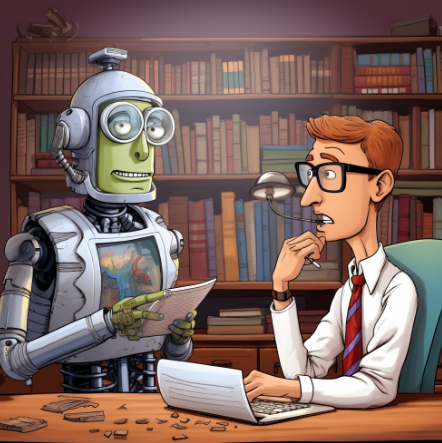
The smart robot is informing the philosopher that he is free to find his future elsewhere. The date of the image is 2025, right before the new year holiday. Thanks, MidJourney. Good enough.
The third leg of the stool is the academic impedimenta. To be specific, the paper is 90 pages in length of which 30 present the argument. The remain 60 pages present:
- Traditional footnotes, about 35 pages containing 607 citations
- An “Electronic Supplement” presenting eight pages of annexes with text, charts, and graphs
- Footnotes to the “Electronic Supplement” requiring another 10 pages for the additional 174 footnotes.
I want to offer several observations, and I do not want to have these be less than constructive or in any way what one of my professors who was treated harshly in Letters to the Editor for an article he published about Chaucer. He described that fateful letter as “mean spirited.”
- The paper makes clear that mankind has some work to do in the next 25 years. The “problems” the paper presents are difficult ones because they touch upon the fabric of social existence. Consider the application of AI to war. I think this aspect of AI may be one to warrant a bullet on AI’s hit parade.
- Humans have to resolve issues of automated systems consuming verifiable information, synthetic data, and purpose-built disinformation so that smart software does not do things at speed and behind the scenes. Do those working do resolve the 10 challenges have an ethical compass and if so, what does “ethics” mean in the context of at-scale AI?
- Social institutions are under stress. A number of organizations and nation-states operate as dictators. One central American country has a rock star dictator, but what about the rock star dictators working techno feudal companies in the US? What governance structures will be crafted by 2050 to shape today’s technology juggernaut?
To sum up, I think the authors have tackled a difficult problem. I commend their effort. My thought is that any message of optimism about AI is likely to be hard pressed to point to one of the 10 challenges and and say, “We have this covered.” I liked the write up. I think college students tasked with writing about the social implications of AI will find the paper useful. It provides much of the research a fresh young mind requires to write a paper, possibly a thesis. For me, the paper is a reminder of the disconnect between applied technology and the appallingly inefficient, convenience-embracing humans who are ensnared in the smart software.
I am a dinobaby, and let me you, “I am glad I am old.” With AI struggling with go-fast and regulators waffling about go-slow, humankind has quite a bit of social system tinkering to do by 2050 if the authors of the paper have analyzed AI correctly. Yep, I am delighted I am old, really old.
Stephen E Arnold, February 13, 2024
Scale Fail: Define Scale for Tech Giants, Not Residents of Never Never Land
December 29, 2023
 This essay is the work of a dumb dinobaby. No smart software required.
I read “Scale Is a Trap.” The essay presents an interesting point of view, scale from the viewpoint of a resident of Never Never Land. The write up states:
But I’m pretty convinced the reason these sites [Vice, Buzzfeed, and other media outfits] have struggled to meet the moment is because the model under which they were built — eyeballs at all cost, built for social media and Google search results — is no longer functional. We can blame a lot of things for this, such as brand safety and having to work through perhaps the most aggressive commercial gatekeepers that the world has ever seen. But I think the truth is, after seeing how well it worked for the tech industry, we made a bet on scale — and then watched that bet fail over and over again.
The problem is that the focus is on media companies designed to surf on the free megaphones like Twitter and the money from Google’s pre-threat ad programs.
However, knowledge is tough to scale. The firms which can convert knowledge into what William James called “cash value” charge for professional services. Some content is free like wild and crazy white papers. But the “good stuff” is for paying clients.
Outfits which want to find enough subscribers who will pay the necessary money to read articles is a difficult business to scale. I find it interesting that Substack is accepting some content sure to attract some interesting readers. How much will these folks pay. Maybe a lot?
But scale in information is not what many clever writers or traditional publishers and authors can do. What happens when a person writes a best seller. The publisher demands more books and the result? Subsequent books which are not what the original was.
Whom does scale serve? Scale delivers power and payoff to the organizations which can develop products and services that sell to a large number of people who want a deal. Scale at a blue chip consulting firm means selling to the biggest firms and the organizations with the deepest products.
But the scale of a McKinsey-type firm is different from the scale at an outfit like Microsoft or Google.
What is the definition of scale for a big outfit? The way I would explain what the technology firms mean when scale is kicked around at an artificial intelligence conference is “big money, big infrastructure, big services, and big brains.” By definition, individuals and smaller firms cannot deliver.
Thus, the notion of appropriate scale means what the cited essay calls a “niche.” The problems and challenges include:
- Getting the cash to find, cultivate, and grow people who will pay enough to keep the knowledge enterprise afloat
- Finding other people to create the knowledge value
- Protecting the idea space from carpetbaggers
- Remaining relevant because knowledge has a shelf life, and it takes time to grow knowledge or acquire new knowledge.
To sum up, the essay is more about how journalists are going to have to adapt to a changing world. The problem is that scale is a characteristic of the old school publishing outfits which have been ill-suited to the stress of adapting to a rapidly changing world.
Writers are not blue chip consultants. Many just think they are.
Stephen E Arnold, December 29, 2023
A Dinobaby Misses Out on the Hot Searches of 2023
December 28, 2023
 This essay is the work of a dumb dinobaby. No smart software required.
I looked at “Year in Search 2023.” I was surprised at how out of the flow of consumer information I was. “Out of the flow” does not not capture my reaction to the lists of the news topics, dead people, and songs I was. Do you know much about Bizarrap? I don’t. More to the point, I have never heard of the obviously world-class musician.
Several observations:
First, when people tell me that Google search is great, I have to recalibrate my internal yardsticks to embrace queries for entities unrelated to my microcosm of information. When I assert that Google search sucks, I am looking for information absolutely positively irrelevant to those seeking insight into most of the Google top of the search charts. No wonder Google sucks for me. Google is keeping pace with maps of sports stadia.
Second, as I reviewed these top searches, I asked myself, “What’s the correlation between advertisers’ spend and the results on these lists? My idea is that a weird quantum linkage exists in a world inhabited by incentivized programmers, advertisers, and the individuals who want information about shirts. Its the game rigged? My hunch is, “Yep.” Spooky action at a distance I suppose.
Third, from the lists substantive topics are rare birds. Who is looking for information about artificial intelligence, precision and recall in search, or new approaches to solving matrix math problems? The answer, if the Google data are accurate and not a come on to advertisers, is almost no one.
As a dinobaby, I am going to feel more comfortable in my isolated chamber in a cave of what I find interesting. For 2024, I have steeled myself to exist without any interest in Ginny & Georgia, FIFTY FIFTY, or papeda.
I like being a dinobaby. I really do.
Stephen E Arnold, December 28, 2023
Intel Inference: A CUDA Killer? Some Have Hope
December 15, 2023
 This essay is the work of a dumb dinobaby. No smart software required.
Intel is embracing “inference” approach. Why? Maybe it will irritate fewer legal eagles? Maybe it is a marketing differentiator? Maybe Intel knows how to make probability less of a “problem”?
Brilliant, right? The answer to these questions are supposed to be explained in “Intel CEO Attacks Nvidia on AI: The Entire Industry Is Motivated to Eliminate the CUDA Market.” The Tom’s Hardware report uses the “attack” angle as a hook. Intel is thinking differently. The company has not had the buzz of nVidia or OpenAI. Plus, no horse metaphors.
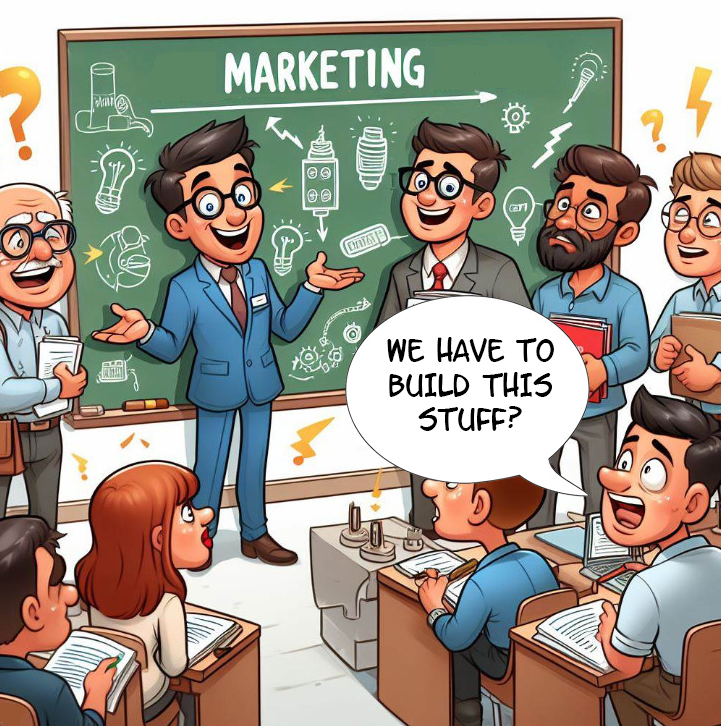
Marketing professionals explain to engineers what must be designed, tested, and delivered in 2024. The engineers are skeptical. The marketing team is confident that their TikTok strategy will be a winner. Thanks, MSFT Copilot. Good enough.
What’s an inference? According to Bing (the stupid version), inference is “a conclusion reached on the basis of evidence and reasoning.” But in mathematics, inference has a slightly different denotation; to wit, this explanation from Britannica:
Inference, in statistics, the process of drawing conclusions about a parameter one is seeking to measure or estimate. Often scientists have many measurements of an object—say, the mass of an electron—and wish to choose the best measure. One principal approach of statistical inference is Bayesian estimation, which incorporates reasonable expectations or prior judgments (perhaps based on previous studies), as well as new observations or experimental results. Another method is the likelihood approach, in which “prior probabilities” are eschewed in favor of calculating a value of the parameter that would be most “likely” to produce the observed distribution of experimental outcomes. In parametric inference, a particular mathematical form of the distribution function is assumed. Nonparametric inference avoids this assumption and is used to estimate parameter values of an unknown distribution having an unknown functional form.
Now what does Tom’s Hardware present at Intel’s vision for its “to be” chips. I have put several segments together for the purposes of my blog post:
"You know, the entire industry is motivated to eliminate the CUDA market. [Gelsinger, the Intel CEO] said. He cited examples such as MLIR, Google, and OpenAI, suggesting that they are moving to a "Pythonic programming layer" to make AI training more open. "We think of the CUDA moat as shallow and small," Gelsinger went on. "Because the industry is motivated to bring a broader set of technologies for broad training, innovation, data science, et cetera." But Intel isn’t relying just on training. Instead, it thinks inference is the way to go. "As inferencing occurs, hey, once you’ve trained the model… There is no CUDA dependency," Gelsinger continued. "It’s all about, can you run that model well?"
CUDA is definitely the target. “CUDA” refers to nVidia’s parallel computing platform and programming model … With more than 20 million downloads to date, CUDA helps developers speed up their applications by harnessing the power of GPU accelerators.
Tom’s Hardware raises a question:
It’s a bold strategy, and Gelsinger appeared confident as he led his team through presentations today. Can he truly take on CUDA? Only time will tell as applications for the chips Intel launched today — and that his competitors are also working on — become more widespread.
Of course. With content marketing, PR professionals, and a definite need to generate some buzz in an OpenAI-dominated world, Intel will be capturing some attention. The hard part will be making sufficiently robust sales to show that an ageing company still can compete.
Stephen E Arnold, December 15, 2023
-

- Subscribe to Beyond Search
Feature archive
News archive

-


