

SEO Dead? Nope, Just Wounded But Will Survive Unfortunately
May 27, 2025
SEO or search engine optimization is one of the forces that killed old fashioned precision and recall. Precision morphed from presenting on point sources to smashing a client’s baloney content into a searcher’s face. Recall went from a metric indicating that a query was passed across available processed content. Now it means, “Buy, believe, and baloney information.”
The write up “The Future of SEO As the Future Google Search Rolls Out” explains:
“Google isn’t going to keep its search engine the way it was for the past two decades. Google knows it has to change, despite them making an absolute fortune from search ads. Google is worried about TikTok, worried about, ChatGPT, worried about searchers going to something new and better.”
These paragraphs make clear that SEO is not going to its grave without causing some harm to the grave diggers:
“There are a lot of concerned people in the search marketing industry right now. The bottom line is while many of us like to complain and we honestly have good reason to be upset, complaining won’t help. We need to adapt and change and experiment. Experiment with these new experiences, keep on top of these changes happening in Google and at other AI and search companies. Then try new things and keep testing. If you do not adapt, you will die. SEO won’t die, but you will become irrelevant. The good news, SEOs are some of the best at adapting, embracing change and testing new strategies out. So you are all ready and equipped for the future of search.”
Let me share some observations about this statement from the cited write up:
First, the SEO professionals are concerned. About relevance and returning precise on point information to the user? Are you kidding me? SEO professionals are worried about their making money. Google, after using SEOs as part of their push to sell ads, the SEO crowd is wracked with uncertainty.
Second, adaptation is important. A failure to adapt means no money. Now the SEO professionals must embrace anxiety. Is stress good for SEO professionals? Probably not.
Third, SEO professionals with 20 years of experience must experiment. Are these individuals equipped to head to the innovation space and crank out new ways to generate money? A few will be able to be the old that that learns to roll over on late night television. Most — well — will struggle to get up or die trying.
What’s my prediction for the future of SEO? Snake oil vendors are part of the data carnival. Ladies and gentlemen, get your cure for no traffic here. Step right up.”
Stephen E Arnold, May xx, 2-25
Google AI Search: A Wrench in SEO Methods
April 17, 2025
Does AI finally spell the end of SEO? Or will it supercharge the practice? Pymnts declares, “Google’s AI Search Switch Leaves Indie Websites Unmoored.” The brief write-up states:
“Google’s AI-generated search answers have reportedly not been good for independent websites. Those answers, along with Google’s alterations to its search algorithm in support of them, have caused traffic to those websites to plunge, Bloomberg News reported Monday (April 7), citing interviews with 25 publishers and people working with them. The changes, Bloomberg said, threaten a ‘delicate symbiotic relationship’ between businesses and Google: they generate good content, and the tech giant sends them traffic. According to the report, many publishers said they either need to shut down or revamp their distribution strategy. Experts this effort could ultimately reduce the quality of information Google can access for its search results and AI answers.”
To add insult to injury, we are reminded, AI Search’s answers are often inaccurate. SEO pros are scrambling to adapt to this new reality. We learn:
“‘It’s important for businesses to think of more than just pure on-page SEO optimization,’ Ben Poulton, founder of the SEO agency Intellar, told PYMNTS. ‘AI overviews tend to try and showcase the whole experience. That means additional content, more FAQs answered, customer feedback addressed on the page, details about walking distance and return policies for brands with a brick-and-mortar, all need to be readily available, as that will give you the best shot of being featured,’ Poulton said.”
So it sounds like one thing has not changed: Second to buying Google ads, posting thoroughly good content is the best way to surface in search results. Or, now, to donate knowledge for the algorithm to spit out. Possibly with hallucinations mixed in.
Cynthia Murrell, April 17, 2025
Does Google Have a Monopoly? Does AI Search Make a Difference?
July 9, 2024
I read “2024 Zero-Click Search Study: For Every 1,000 EU Google Searches, Only 374 Clicks Go to the Open Web. In the US, It’s 360.” The write up begins with caveats — many caveats. But I think I am not into the search engine optimization and online advertising mindset. As a dinobaby, I find the pursuit of clicks in a game controlled by one outfit of little interest.

Is it possible that what looks like a nice family vacation place is a digital roach motel? Of course not! Thanks, MSFT Copilot. Good enough.
Let’s answer the two questions the information in the report from the admirably named SparkToro presents. In my take on the article, the charts, the buzzy jargon, the answer to the question, “Does Google Have a Monopoly?” the answer is, “Wow, do they.”
The second question I posed is, “Does AI Search Make a Difference in Google Traffic?’ the answer is, “A snowball’s chance in hell is better.”
The report and analysis takes me to close enough for horse shoes factoids. But that’s okay because the lack of detailed, reliable data is part of the way online operates. No one really knows if the clicks from a mobile device are generated by a nepo baby with money to burn or a bank of 1,000 mobile devices mindlessly clicking on Web destinations. Factoids about online activity are, at best, fuzzy. I think SEO experts should wear T shirts and hats with this slogan, “Heisenberg rocks. I am uncertain.
I urge you to read and study the SparkToro analysis. (I love that name. An electric bull!)
The article points out that Google gets a lot of clicks. Here’s a passage which knits together several facts from the study:
Google gets 1/3 of the clicks. Imagine a burger joint selling 33 percent of the burgers worldwide. Could they get more? Yep. How much more:
Equally concerning, especially for those worried about Google’s monopoly power to self-preference their own properties in the results, is that almost 30% of all clicks go to platforms Google owns. YouTube, Google Images, Google Maps, Google Flights, Google Hotels, the Google App Store, and dozens more means that Google gets even more monetization and sector-dominating power from their search engine. Most interesting to web publishers, entrepreneurs, creators, and (hopefully) regulators is the final number: for every 1,000 searches on Google in the United States, 360 clicks make it to a non-Google-owned, non-Google-ad-paying property. Nearly 2/3rds of all searches stay inside the Google ecosystem after making a query.
The write up also presents information which suggests that the European Union’s regulations don’t make much difference in the click flow. Sorry, EU. You need another approach, perhaps?
In the US, users of Google have a tough time escaping what might be colorfully named the “digital roach motel.”
Search behavior in both regions is quite similar with the exception of paid ads (EU mobile searchers are almost 50% more likely to click a Google paid search ad) and clicks to Google properties (where US searchers are considerably more likely to find themselves back in Google’s ecosystem after a query).
The write up presented by SparkToro (Is it like the energizer bunny?) answers a question many investors and venture firms with stakes in smart software are asking: “Is Google losing search traffic? The answer is, “Nope. Not a chance.”
According to Datos’ panel, Google’s in no risk of losing market share, total searches, or searches per searcher. On all of these metrics they are, in fact, stronger than ever. In both the US and EU, searches per searcher are rising and, in the Spring of 2024, were at historic highs. That data doesn’t fit well with the narrative that Google’s cost themselves credibility or that Internet users are giving up on Google and seeking out alternatives. … Google continues to send less and less of its ever-growing search pie to the open web…. After a decline in 2022 and early 2023, Google’s back to referring a historically high amount of its search clicks to its own properties.
AI search has not been the game changer for which some hoped.
Net net: I find it interesting that data about what appears to be a monopoly is so darned sketchy after more than two decades of operation. For Web search start ups, it may be time to rethink some of those assertions in those PowerPoint decks.
Stephen E Arnold, July 9, 2024
Publication Founded by a Googler Cheers for Google AI Search
June 5, 2024
 This essay is the work of a dinobaby. Unlike some folks, no smart software improved my native ineptness.
To understand the “rah rah” portion of this article, you need to know the backstory behind Search Engine Land, a news site about search and other technology. It was founded by Danny Sullivan, who pushed the SEO bandwagon. He did this because he was angling for a job at Google, he succeeded, and now he’s the point person for SEO.
Another press release touting the popularity of Google search dropped: “Google SEO Says AI Overviews Are Increasing Search Usage.” The author Danny Goodwin remains skeptical about Google’s spiked popularity due to AI and despite the bias of Search Engine Land’s founder.
During the QI 2024 Alphabet earnings call, Google/Alphabet CEO Sundar Pichai said that the search engine’s generative AI has been used for billions of queries and there are plans to develop the feature further. Pichai said positive things about AI, including that it increased user engagement, could answer more complex questions, and how there will be opportunities for monetization.
Goodwin wrote:
“All signs continue to indicate that Google is continuing its slow evolution toward a Search Generative Experience. I’m skeptical about user satisfaction increasing, considering what an unimpressive product AI overviews and SGE continues to be. But I’m not the average Google user – and this was an earnings call, where Pichai has mastered the art of using a lot of words to say a whole lot of nothing.”
AI is the next evolution of search and Google is heading the parade, but the technology still has tons of bugs. Who founded the publication? A Googler. Of course there is no interaction between the online ad outfit and an SEO mouthpiece. Un-uh. No way.
Whitney Grace, June 5, 2024
Search Metrics: One Cannot Do Anything Unless One Finds the Info
May 2, 2024
 This essay is the work of a dumb dinobaby. No smart software required.
The search engine optimization crowd bamboozled people with tales of getting to be number one on Google. The SEO experts themselves were tricked. The only way to appear on the first page of search results is to buy an ad. This is the pay-to-play approach to being found online. Now a person cannot do anything, including getting in the building to start one’s first job without searching. The company sent the future wizard an email with the access code. If the new hire cannot locate the access code, she cannot work without going through hoops. Most work or fun is similar. Without an ability to locate specific information online, a person is going to be locked out or just lost in space.

The new employee cannot search her email to locate the access code. No job for her. Thanks, MSFT Copilot, a so-so image without the crazy Grandma says, “You can’t get that image, fatso.”
I read a chunk of content marketing called “Predicted 25% Drop In Search Volume Remains Unclear.” The main idea (I think) is that with generative smart software, a person no longer has to check with Googzilla to get information. In some magical world, a person with a mobile phone will listen as the smart software tells a user what information is needed. Will Apple embrace Microsoft AI or Google AI? Will it matter to the user? Will the number of online queries decrease for Google if Apple decides it loves Redmond types more than Googley types? Nope.
The total number of online queries will continue to go up until the giant search purveyors collapse due to overburdened code, regulatory hassles, or their own ineptitude. But what about the estimates of mid tier consulting firms like Gartner? Hello, do you know that Gartner is essentially a collection of individuals who do the bidding of some work-from-home, self-anointed experts?
Face facts. There is one alleged monopoly controlling search. That is Google. It will take time for an upstart to siphon significant traffic from the constellation of Google services. Even Google’s own incredibly weird approach to managing the company will not be able to prevent people from using the service. Every email search is a search. Every direction in Waze is a search. Every click on a suggested YouTube TikTok knock off is a search. Every click on anything Google is a search. To tidy up the operation, assorted mechanisms for analyzing user behavior provide a fingerprint of users. Advertisers, even if they know they are being given a bit of a casino frippery, have to decide among Amazon, Meta, or, or … Sorry. I can’t think of another non-Google option.
If you want traffic, you can try to pull off a Black Swan event as OpenAI did. But for most organizations, if you want traffic, you pay Google. What about SEO? If the SEO outfit is a Google partner, you are on the Information Highway to Google’s version of Madison Avenue.
But what about the fancy charts and graphs which show Google’s vulnerability? Google’s biggest enemy is Google’s approach to managing its staff, its finances, and its technology. Bing or any other search competitor is going to find itself struggling to survive. Don’t believe me? Just ask the founder of Search2, Neeva, or any other search vendor crushed under Googzilla’s big paw. Unclear? Are you kidding me? Search volume is going to go up until something catastrophic happens. For now, buy Google advertising for traffic. Spend some money with Meta. Use Amazon if you sell fungible things. Google owns most of the traffic. Adjust and quit yapping about some fantasy cooked up by so-called experts.
Stephen E Arnold, May 2, 2024
Want Clicks: Do Sad, Really, Really Sorrowful
March 13, 2024
 This essay is the work of a dumb dinobaby. No smart software required.
The US is a hotbed of negative news. It’s what drives the media and perpetuates the culture of fear that (arguably) has plagued the country since colonial times. US citizens and now the rest of the world are so addicted to bad news that a research team got the brilliant idea to study what words people click. Nieman Lab wrote about the study in, “Negative Words In News Headlines Generate More Clicks-But Sad Words Are More Effective Than Angry Or Scary Ones.”

Thanks, MSFT Copilot. One of Redmond’s security professionals I surmise?
Negative words are prevalent in headlines because they sell clicks. The Nature Human Behavior(u)r journal published a study called “Negativity Drives Online News Consumption.” The study analyzed the effect of negative and emotional words on news consumption and the research team discovered that negativity increased clickability. These findings also confirm the well-documented behavior of humans seeking negativity in all information-seeking.
It coincides with humanity’s instinct to be vigilant of any danger and avoid it. While humans instinctually gravitate towards negative headlines, certain negative words are more popular than others. Humans apparently are driven to click on sad-related synonyms, avoid anything resembling joy or fear, and angry words don’t have any effect. It all goes back to survival:
“And if we are to believe “Bad is stronger than good” derives from evolutionary psychology — that it arose as a useful heuristic to detect threats in our environment — why would fear-related words reduce likelihood to click? (The authors hypothesize that fear and anger might be more important in generating sharing behavior — which is public-facing — than clicks, which are private.)
In any event, this study puts some hard numbers to what, in most newsrooms, has been more of an editorial hunch: Readers are more drawn to negativity than to positivity. But thankfully, the effect size is small — and I’d wager that it’d be even smaller for any outlet that decided to lean too far in one direction or the other.”
It could also be a strict diet of danger-filled media too.
Whitney Grace, March 13, 2024
It Works for SEO and Narcotics… and Academics
February 14, 2024
 This essay is the work of a dumb dinobaby. No smart software required.
Academic research papers that have been cited often are probably credible, right? These days, not so much. Science reports, “Citation Cartels Help Some Mathematicians – and their Universities – Climb the Rankings.” Referring to an analysis by University of Vigo’s Domingo Docampo, writer Michele Catanzaro tells us:
“Cliques of mathematicians at institutions in China, Saudi Arabia, and elsewhere have been artificially boosting their colleagues’ citation counts by churning out low-quality papers that repeatedly reference their work, according to an unpublished analysis seen by Science. As a result, their universities—some of which do not appear to have math departments—now produce a greater number of highly cited math papers each year than schools with a strong track record in the field, such as Stanford and Princeton universities. These so-called ‘citation cartels’ appear to be trying to improve their universities’ rankings, according to experts in publication practices. ‘The stakes are high—movements in the rankings can cost or make universities tens of millions of dollars,’ says Cameron Neylon, a professor of research communication at Curtin University. ‘It is inevitable that people will bend and break the rules to improve their standing.’ In response to such practices, the publishing analytics company Clarivate has excluded the entire field of math from the most recent edition of its influential list of authors of highly cited papers, released in November 2023.”
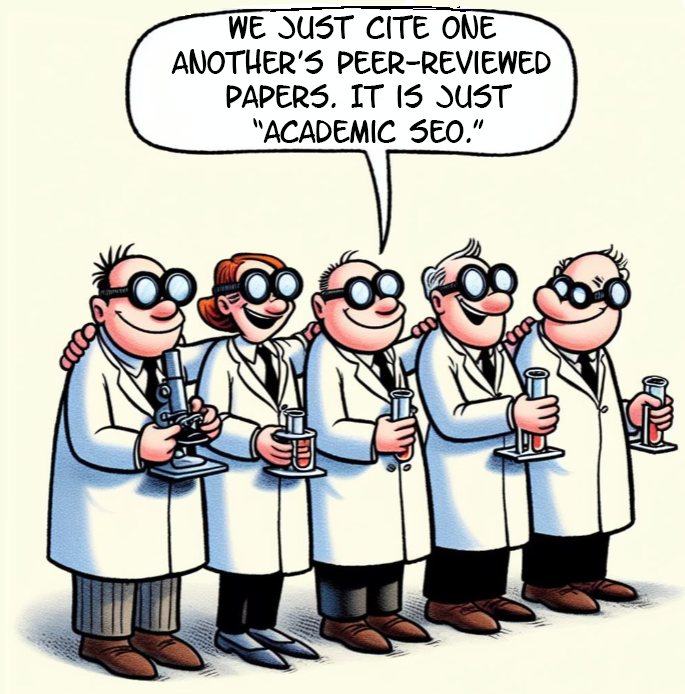
Thanks MSFT Copilot Bing thing. You are mostly working today. Actually well enough for good enough art.
Researchers say this manipulation occurs across disciplines, but the relatively low number of published math papers makes it more obvious in that field. When Docampo noticed the trend, the mathematician analyzed 15 years’ worth of Clarivate’s data to determine which universities were publishing highly cited math papers and who was citing them. Back in 2008 – 2010, legitimately heavy-hitters like UCLA and Princeton were at the top of the cited list. But in the last few years those were surpassed by institutions not exactly known for their mathematics prowess. Many were based in China, Saudi Arabia, and Egypt. And, yes, those citations were coming from inside the writers’ own schools. Sneaky. But not sneaky enough.
There may again come a time when citations can be used as a metric for reliability. Docampo is working on a system to weigh citations according to the quality of the citing journals and institutions. Until then, everyone should take citation counts with a grain of salt.
Cynthia Murrell, February 14, 2024
AI and SEO: If This Does Not Kill Relevance, Nothing Will
February 1, 2024
 This essay is the work of a dumb dinobaby. No smart software required.
The integration of AI into search engines may help consumers better find what they are looking for and reduce or eliminate creepy intrusive ads. More importantly, for readers of Adweek anyway, that dynamic is an opportunity for advertisers. Now they can more finely target ads while charming potential customers with friendly algorithmic rapport. That is the gist of write-up, “3 Major Ways Generative AI Is Redefining Search.” Under the subheadings “Dialogue over monologue,” “Offers not ads,” and “Subjective data over objective data,” writer Christian J. Ward details how marketers can leverage the human-esque qualities of AI interactions to entice consumers. For example, under the first of these “pivotal shifts,” Ward writes:
“With conversational AI as the interface, consumers can share exactly what they want to share, and brands can focus on great responses instead of suboptimal guesses. … When a consumer freely offers details on what they seek and why, the brand can leverage that zero-party data to personalize their experience. Trust is built through dialogues, not infinite monologues algorithmically ranked in search engine results. Most importantly, these AI-driven dialogues open unprecedented opportunities for brands to engage each person individually.”
Yes, trust is built through dialogues. But is that still the case when one party is a fake person? Probably, for many consumers. Ward goes on to describe ways companies can capitalize on these “conversations:”
“Conversations like these build trust and enable the brand to customize an offer that meets the needs of that individual customer. This is the future of offer-based interactions, directly controlled by a dialogue with the customer. Moving from privacy-invasive ad models to trust-centric dialogue models will take time. But for objective questions—which often directly precede conversion and purchase decisions—brands will utilize gen AI aggressively to take back the consumer dialogue from centralized search systems that seek to monetize ad spend.”
Reduce one’s ad budget while using salary-free AI to build lucrative customer rapport? Sounds great. Unless one’s interest is in truly relevant search results, not marketing ploys. Welcome to the next iteration of SEO.
Cynthia Murrell, February 1, 2024
SEO for 2022: Why Not Buy Google Ads and Skip the Baloney
December 17, 2021
There is one game in the US for search. Yeah, I know DuckDuckGo is wonderful. There’s even Bing. And you can still navigate to AOL.com and enter a search. Same for Dogpile.com. I am not going to repeat what I have been saying for decades. Primary search does the crawl, the indexing, the query processing, and the results serving. There are a few outfits in this business, but none is known; for example, Swisscows.ch, Yandex.ru, Baidu.com, and a few others.
This article “Why Your Website Must Have an SEO Strategy for 2022” strikes me as pretty darned crazy. If someone repeats a process over and over again and fails, what’s that say about the approach or the person? In my view, crazy seems close to the mark.
The write up says:
The aim of SEO is simple: high SEO ranking brings more traffic and more revenue.
More accurately, SEO produces work for search engine optimization experts. Many of the certified outfits are Google partners. When a temporary boost expires, these professionals will sell Google ads.
There you go.
Why not just buy Google ads and forget the futility of trying to outwit the Google. In case you haven’t notice, the Google along with Facebook are in a prime position to determine who and what gets eyeballs.
Buy ads. Simpler, faster, and cheaper. People with degrees in art history and business communications are no match for Googzilla’s decades of “refinement”.
Stephen E Arnold, December 17, 2021
SEO Tips and Tricks Persist
December 10, 2021
SEO pros are working hard to keep the field relevant, despite the reality that buying Google ads is becoming the only productive solution. Search Engine Journal airily proscribes “5 Essential Enterprise SEO Trends to Watch in 2022.” Oddly, purchasing Google ads is not among the recommendations. Writer Lemuel Park explains:
“In 2022, [enterprise SEO strategy] will involve:
* Improving cross-channel and broader departmental collaboration.
* Advancing workflow and reporting processes and systems.
* Utilizing data and insights in real-time.
* Embracing and working with AI technology and automation.
Challenges in enterprise SEO can vary from organization to organization. However, the commonality is found in areas such as executive buy-in, internal collaboration, and wider digital integration (showcasing impact). With last year’s challenge comes next year’s opportunity – and with that in mind, let’s dig into the 5 key areas of focus to consider as you plan your enterprise SEO strategy for the year ahead.”
Here are the five suggestions: keep pace with search updates/ algorithms and best practices; take advantage of automation; squeeze insights from data; align SEO and Pay Per Click teams; and integrate SEO into all departments. Curious readers can see the write-up for details on each consideration. Some of these, especially the last point, seem like a lot of work. It would be much easier to give in to the Googlers’ machinations. Google Search is their platform, after all; it is no surprise when they tilt it toward their own pockets.
Cynthia Murrell December 10, 2021
-

- Subscribe to Beyond Search
Feature archive
News archive

-


