

Meeker Reveals the Hurdle the Google Must Over: Can Google Be Agile Again?
June 20, 2025
 Just a dinobaby and no AI: How horrible an approach?
The hefty Meeker Report explains Google’s PR push, flood of AI announcement, and statements about advertising revenue. Fear may be driving the Googlers to be the Silicon Valley equivalent of Dan Aykroyd and Steve Martin’s “wild and crazy guys.” Google offers up the Sundar & Prabhakar Comedy Show. Similar? I think so.
I want to highlight two items from the 300 page plus PowerPoint deck. The document makes clear that one can create a lot of slides (foils) in six years.
The first item is a chart on page 21. Here it is:
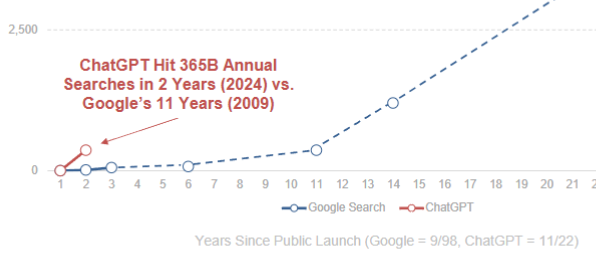
Note the tiny little line near the junction of the x and y axis. Now look at the red lettering:
ChatGPT hit 365 billion annual searches by Year since public launches of Google and Chat GPT — 1998 – 2025.
Let’s assume Ms. Meeker’s numbers are close enough for horse shoes. The slope of the ChatGPT search growth suggests that the Google is losing click traffic to Sam AI-Man’s ChatGPT. I wonder if Sundar & Prabhakar eat, sleep, worry, and think as the Code Red lights flashes quietly in the Google lair? The light flashes: Sundar says, “Fast growth is not ours, brother.” Prabhakar responds, “The chart’s slope makes me uncomfortable.” Sundar says, “Prabhakar, please, don’t think of me as your boss. Think of me as a friend who can fire you.”
Now this quote from the top Googler on page 65 of the Meeker 2025 AI encomium:
The chance to improve lives and reimagine things is why Google has been investing in AI for more than a decade…
So why did Microsoft ace out Google with its OpenAI, ChatGPT deal in January 2023?
Ms. Meeker’s data suggests that Google is doing many AI projects because it named them for the period 5/19/25-5/23/25. Here’s a run down from page 260 in her report:
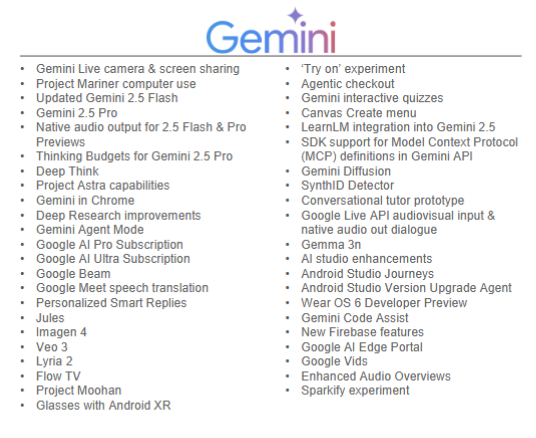
And what di Microsoft, Anthropic, and OpenAI talk about in the some time period?

Google is an outputter of stuff.
Let’s assume Ms. Meeker is wildly wrong in her presentation of Google-related data. What’s going to happen if the legal proceedings against Google force divestment of Chrome or there are remediating actions required related to the Google index? The Google may be in trouble.
Let’s assume Ms. Meeker is wildly correct in her presentation of Google-related data? What’s going to happen if OpenAI, the open source AI push, and the clicks migrate from the Google to another firm? The Google may be in trouble.
Net net: Google, assuming the data in Ms. Meeker’s report are good enough, may be confronting a challenge it cannot easily resolve. The good news is that the Sundar & Prabhakar Comedy Show can be monetized on other platforms.
Is there some hard evidence? One can read about it in Business Insider? Well, ooops. Staff have been allegedly terminated due to a decline in Google traffic.
Stephen E Arnold, June 20, 2025
Knowledge Management: Hog Wash or Lipstick on a Pig?
May 8, 2025
 No AI. Just a dinobaby who gets revved up with buzzwords and baloney.
I no longer work at a blue chip consulting company. Heck, I no longer work anywhere. Years ago, I bailed out to work for a company in fly-over country. The zoom-zoom life of the big city tuckered me out. I know, however, when a consulting pitch is released to the world. I spotted one of these “pay us and we will save you” approaches today (April 25, 2025, 5 42 am US Eastern time).

How pretty can the farmer make these pigs? Thanks, OpenAI, good enough, and I know you have no clue about the preparation for a Poland China at a state fair. It does not look like this.
“How Knowledge Mismanagement is Costing Your Company Millions” is an argument presented to spark the sale of professional services. What’s interesting is that instead of beating the big AI/ML (artificial intelligence and machine learning drum set), the authors from an outfit called Bloomfire made “knowledge management” the pointy end of the spear. I was never sure what knowledge management. One of my colleagues did a lot of knowledge management work, but it looked to me like creating an inventory of content, a directory of who in the organization was a go-to source for certain information, and enterprise search.
This marketing essay asserts:
Executives are laser-focused on optimizing their most valuable assets – people, intellectual property, and proprietary technology. But many overlook one asset that has the power to drive revenue, productivity, and innovation: enterprise knowledge.
To me, the idea that one can place a value on knowledge is an important process. My own views of what is called “knowledge value” have been shaped by the work of Taichi Sakaya. This book was published 40 years ago, and it is a useful analysis of how to make money from knowing “stuff”.
This essay makes the argument that an organization that does not know how to get its information act together will not extract the appropriate value from its information. I learned:
Many organizations regard knowledge as an afterthought rather than a business asset that drives financial performance. Knowledge often remains unaccounted for on balance sheets, hidden in siloed systems, and mismanaged to the point of becoming a liability. Redundant, trivial, conflicting, and outdated information can cloud decision making that fails to deliver key results.
The only problem is that “knowledge” loses value when it moves to a system or an individual where it should not be. Let me offer three examples of the fallacy of silo breaking, financial systems, and “mismanaged” paper or digital information.
- A government contract labeled secret by the agency hiring the commercial enterprise. Forget the sharing. Locking up the “information” is essential for protecting national security and for getting paid. The knowledge management is that only authorized personnel know their part of a project. Sharing is not acceptable.
- Financial data, particularly numbers and information about a legal matter or acquisition/divestiture is definitely high value information. The organization should know that talking or leaking these data will result in problems, some little, some medium, and some big time.
- Mismanaged information is a very bad and probably high risk thing. Organizations simply do not have the management bandwidth to establish specific guidelines for data acquisition, manipulation, storage and deletion, access controls that work, and computer expertise to use dumb and smart software to keep those data ponies and information critters under control. The reasons are many and range from accountants who are CEOs to activist investor sock puppets, available money and people, and understanding exactly what has to be done to button up an operation.
Not surprisingly, coming up with a phrase like “enterprise intelligence” may sell some consulting work, but the reality of the datasphere is that whatever an organization does in an engagement running several months or a year will not be permanent. The information system in an organization any size is unstable. How does one make knowledge value from an inherently volatile information environment. Predicting the weather is difficult. Predicting the data ecosystem in an organization is the reason knowledge management as a discipline never went anywhere. Whether it was Harvey Poppel’s paperless office in the 1970s or the wackiness of the system which built a database of people so one could search by what each employee knew, the knowledge management solutions had one winning characteristic: The consultants made money until they didn’t.
The “winners” in knowledge management are big fuzzy outfits; for example, IBM, Microsoft, Oracle, and a few others. Are these companies into knowledge management? I would say, “Sure because no one knows exactly what it means. When the cost of getting digital information under control is presented, the thirst for knowledge management decreases just a tad. Well, maybe I should say, “Craters.”
None of these outfits “solve” the problem of knowledge management. They sell software and services. Despite the technology available today, a Microsoft Azure SharePoint and custom Web page system leaked secure knowledge from the Israeli military. I would agree that this is indeed knowledge mismanagement, but the problem is related to system complexity, poor staff training, and the security posture of the vendor, which in this case is Microsoft.
The essay concludes with this statement in the form of a question:
The question is: Where does your company’s knowledge fall on the balance sheet?
Will the sales pitch work? Will CEOs ask, “Where is my company’s knowledge value?” Probably. The essay throws around a lot of numbers. It evokes uncertainty, risk, and may fear. It has some clever jargon like knowledge mismanagement.
Net net: Well done. Suitable for praise from a business school faculty member. Is knowledge mismanagement going to delivery knowledge value? Unlikely. Is knowledge (managed or mismanaged) hog wash? It depends on one’s experience with Poland Chinas. Is knowledge (managed or mismanaged lipstick on a pig)? Again it depends on one’s sense of what’s right for the critters. But the goal is to sell consulting, not clean hogs or pretty up pigs.
Stephen E Arnold, May 8, 2025
The Big Cull: Goodbye, Type A People Who Make the Government Chug Along
March 3, 2025
 The work of a real, live dinobaby. Sorry, no smart software involved. Whuff, whuff. That’s the sound of my swishing dino tail. Whuff.
I used to work at a couple of big time consulting firms in Washington, DC. Both were populated with the Googlers of that time. The blue chip consulting firm boasted a wider range of experts than the nuclear consulting outfit. There were some lessons I learned beginning with my first day on the job in the early 1970s. Here are three:
- Most of the Federal government operates because of big time consulting firms which do “work” and show up for meetings with government professionals
- Government professionals manage big time consulting firms’ projects with much of the work day associated with these projects and assorted fire drills related to non consulting firm work
- Government workers support, provide input, and take credit or avoid blame for work involving big time consulting firms. These individuals are involved in undertaking tasks not assigned to consulting firms and doing the necessary administrative and support work for big time consulting firm projects.

A big time consulting professional has learned that her $2.5 billion project has been cancelled. The contract workers are now coming toward her, and they are a bit agitated because they have been terminated. Thanks, OpenAI. Too bad about your being “out of GPUs.” Planning is sometimes helpful.
There were some other things I learned in 1972, but these three insights appear to have had sticking power. Whenever I interacted with the US federal government, I kept the rules in mind and followed them for a number of not-do-important projects.
This brings me to the article in what is now called Nextgov FCW. I think “FCW” means or meant Federal Computer Week. The story which I received from a colleague who pays a heck of a lot more attention to the federal government than I do caught my attention.
[Note: This article’s link was sometimes working and sometimes not working. If you 404, you will have do do some old fashioned research.] “Trump Administration Asks Agencies to Cull Consultants” says:
The acting head of the General Services Administration, Stephen Ehikian, asked “agency senior procurement executive[s]” to review their consulting contracts with the 10 companies the administration deemed the highest paid using procurement data — Deloitte, Accenture Federal Services, Booz Allen Hamilton, General Dynamics, Leidos, Guidehouse, Hill Mission Technologies Corp., Science Applications International Corporation, CGI Federal and International Business Machines Corporation — in a memo dated Feb. 26 obtained by Nextgov/FCW. Those 10 companies “are set to receive over $65 billion in fees in 2025 and future years,” Ehikian wrote. “This needs to, and must, change,” he added in bold.
Mr. Ehikian’s GSA biography states:
Stephen Ehikian currently serves as Acting Administrator and Deputy Administrator of the General Services Administration. Stephen is a serial entrepreneur in the software industry who has successfully built and sold two companies focused on sales and customer service to Salesforce (Airkit.ai in 2023 and RelateIQ in 2014). He most recently served as Vice President of AI Products and has a strong record of identifying next-generation technology. He is committed to accelerating the adoption of technology throughout government, driving maximum efficiency in government procurement for the benefit of all taxpayers, and will be working closely with the DOGE team to do so. Stephen graduated from Yale University with a bachelor’s degree in Mechanical Engineering and Economics and earned an MBA from Stanford University.
The firms identified in the passage from Nextgov would have viewed a person with Mr. Ehikian’s credentials as a potential candidate for a job. In the 1970s, an individuals with prior business experience and an MBA would have been added as an associate and assigned to project teams. He would have attended one of the big time consulting firms’ “charm schools.” The idea at the firm which employed me was that each big time consulting firm had a certain way of presenting information, codes of conduct, rules of engagement with prospects and clients, and even the way to dress.
Today I am not sure what a managing partner would assign a person like Mr. Ehikian to undertake. My initial thought is that I am a dinobaby and don’t have a clue about how one of the big time firms in the passage listing companies with multi billions of US government contracts operates. I don’t think too much would change because at the firm where I labored for a number of years much of the methodology was nailed down by 1920 and persisted for 50 years when I arrived. Now 50 years from the date of my arrival, I would be dollars to donuts that the procedures, the systems, and the methods were quite similar. If a procedure works, why change it dramatically. Incremental improvements will get the contract signed. The big time consulting firms have a culture and acculturation is important to these firms’ success.
The cited Nextgov article reports:
The notice comes alongside a new executive order directing agencies to build centralized tech to record all payments issued through contracts and grants, along with justification for those payments. Agency leaders were also told to review all grants and contracts within 30 days and terminate or modify them to reduce spending under that executive order.
This project to “build centralized technology to record all payments issued through contracts and grants” is exactly the type of work that some of the big time consulting firms identified can do. I know that some government entities have the expertise to create this type of system. However, given the time windows, the different departments and cross departmental activities, and the accounting and database hoops that must be navigated, the order to “build centralized technology to record all payments” is a very big job. (That’s why big time consulting firms exist. The US federal government has not developed the pools of expensive and specialized talent to do some big jobs.) I have worked on not-too-important jobs, and I found that just do it was easier said than done.
Several observations:
- I am delighted that I am no longer working at either of the big time consulting firms which used to employ me. At age 80, I don’t have the stamina to participate in the intense, contentious, what are we going to do meetings that are going to ruin many consulting firms’ weekends.
- I am not sure what will happen when the consulting firms’ employees and contractors’ just stop work. Typically, when there is not billing, people are terminated. Bang. Yes, just like that. Maybe today’s work world is a kinder and gentler place, but I am not sure about that.
- The impact on citizens and other firms dependent on the big time consulting firms’ projects is likely to chug along with not much visible change. Then just like the banking outages today (February 28, 2024) in the UK, systems and services will begin to exhibit issues. Some may just outright fail without the ministrations of consulting firm personnel.
- Figuring out which project is mission critical and which is not may be more difficult than replacing a broken MacBook Pro at the Apple Store in the old Carnegie Library Building on K Street. Decisions like these were typical of the projects that big time consulting firms were set up to handle with aplomb. A mistake may take months to surface. If several pop up in one week, excitement will ensue. That thinking for the future is what big time consulting firms do as part of their work. Pulling a plug on an overheating iron in a DC hotel is easy. Pulling a plug on a consulting firm is different for many reasons.
Net net: The next few months will be interesting. I have my eye on the big time consulting firms. I am also watching how the IRS and Social Security System computer infrastructure works. I want to know but no longer will be able to get the information about the management of devices in the arsenal not too far from a famous New Jersey golf course. I wonder about the support of certain military equipment outside the US. I am doing a lot of wondering.
That is fine for me. I am a dinobaby. For others in the big time consulting game and the US government professionals who are involved with these service firms’ contracts, life is a bit more interesting.
Stephen E Arnold, March 3, 2025
2025 Consulting Jive
December 26, 2024
Here you go. I have extracted of list of the jargon one needs to write reports, give talks, and mesmerize those with a desire to be the smartest people in the room:
- Agentic AI
- AI governance platforms
- Ambient invisible intelligence
- Augmented human capability
- Autonomous businesses
- BBMIs (Brain-Body Machine Interfaces)
- Brand reputation
- Business benefits
- Contextual awareness
- Continuous adaptive trust model
- Cryptography
- Data privacy
- Disinformation security
- Energy-efficient computing
- Guardrails
- Hybrid computing
- Human-machine synergy
- Identity validation
- Immersive experiences
- Model lifecycle management
- Multilayered adaptive learning
- Neurological enhancement
- Polyfunctional robots
- Post-quantum cryptography (PQC)
- Provenance
- Quantum computing (QC)
- Real-time personalization
- Risk scoring
- Spatial computing
- Sustainability
- Transparency
- UBMIs (User-Brain Machine Interfaces)
Did this spark your enthusiasm for modern jingo jango. Hats off to the Gartner Group. Wow! Great. Is the list complete? Of course not. I left out bullish*t.
Stephen E Arnold, December 26, 2024
McKinsey Takes One for the Team
December 25, 2024
 This blog post is the work of an authentic dinobaby. No smart software was used.
I read the “real” news in “McKinsey & Company to Pay $650 Million for Role in Opioid Crisis.” The write up asserts:
The global consulting firm McKinsey and Company Friday [December 13, 2024] agreed to pay $650 million to settle a federal probe into its role in helping “turbocharge” sales of the highly addictive opioid painkiller OxyContin for Purdue Pharma…
If I were still working at a big time blue chip consulting firm, I would suggest to the NPR outfit that its researchers should have:
- Estimated the fees billed for opioid-related consulting projects
- Pulled together the estimated number of deaths from illegal / quasi-legal opioid overdoses
- Calculated the revenue per death
- Calculated the cost per death
- Presented the delta between the two totals.
- Presented to aggregate revenue generated for McKinsey’s clients from opioid sales
- Estimated the amount spent to “educate” physicians about the merits of synthetic opioids.
Interviewing a couple of parents or surviving spouses from Indiana, Kentucky, or West Virginia would have added some local color. But assembling these data cannot be done with a TikTok query. Hence, the write up as it was presented.
Isn’t that efficiency of MBA think outstanding? I did like the Friday the 13th timing. A red ink Friday? Nope. The fine doesn’t do the job for big time Blue Chip consulting firms. Just like EU fines don’t deter the Big Tech outfits. Perhaps something with real consequences is needed? Who am I kidding?
Stephen E Arnold, December 25, 2024
KPMG FOMO on AI
December 11, 2024
 This blog post flowed from the sluggish and infertile mind of a real live dinobaby. If there is art, smart software of some type was probably involved.
AI is in demand and KPMG long ago received the message that it needs to update its services to include AI consulting services in its offerings. Technology Magazine shares the story in: “Growing KPMG-Google Cloud Ties Signal AI Services Shift.” Google Cloud and KPMG have a partnership that started when the latter’s clients wanted to implement Google Cloud into their systems. KPMG’s client base increased tenfold when they deployed Google Cloud services.
The nature of the partnership will change to Google’s AI-related services and KPMG budgeted $100 million to the project. The investment is projected to give KPMG $1 billion in revenue for its generative AI technology. KPMG deployed Google’s enterprise search technology Vertex AI Search into its cloud services. Vertex AI and retrieval augmented generation (RAG), a process that checks AI responses with verified data, are being designed to analyze and assist with market and research analysis.
The partnership between these tech companies indicates this is where the tech industry is going:
“The partnership indicates how professional services firms are evolving their technology practices. KPMG’s approach combines its industry expertise with Google Cloud’s technical infrastructure, creating services that bridge the gap between advanced technology and practical business applications… The collaboration also reflects how enterprise AI adoption is maturing. Rather than implementing generic AI solutions, firms are now seeking industry-specific applications that integrate with existing systems and workflows. This approach requires deep understanding of both technical capabilities and sector-specific challenges.”
Need an accounting firm? Well, AI is accounting. Need a consultant. Well, AI is consulting. Need motivated people to bill your firm by the hour at exorbitant fees? You know whom to call.
Whitney Grace, December 11, 2024
Surprise: Those Who Have Money Keep It and Work to Get More
October 29, 2024
 Written by a humanoid dinobaby. No AI except the illustration.
The Economist (a newspaper, not a magazine) published “Have McKinsey and Its Consulting Rivals Got Too Big?” Big is where the money is. Small consultants can survive but a tight market, outfits like Gerson Lehrman, and AI outputters of baloney like ChatGPT mean trouble in service land.

A next generation blue chip consultant produces confidential and secret reports quickly and at a fraction of the cost of a blue chip firm’s team of highly motivated but mostly inexperienced college graduates. Thanks, OpenAI, close enough.
The write up says:
Clients grappling with inflation and economic uncertainty have cut back on splashy consulting projects. A dearth of mergers and acquisitions has led to a slump in demand for support with due diligence and company integrations.
Yikes. What outfits will employ MBAs expecting $180,000 per year to apply PowerPoint and Excel skills to organizations eager for charts, dot points, and the certainty only 24 year olds have? Apparently fewer than before Covid.
How does the Economist know that consulting outfits face headwinds? Here’s an example:
Bain and Deloitte have paid some graduates to delay their start dates. Newbie consultants at a number of firms complain that there is too little work to go around, stunting their career prospects. Lay-offs, typically rare in consulting, have become widespread.
Consulting firms have chased projects in China but that money machine is sputtering. The MBA crowd has found the Middle East a source of big money jobs. But the Economist points out:
In February the bosses of BCG, McKinsey and Teneo, a smaller consultancy, along with Michael Klein, a dealmaker, were hauled before a congressional committee in Washington after failing to hand over details of their work for Saudi Arabia’s Public Investment Fund.
The firm’s response was, “Staff clould be imprisoned…” (Too bad the opioid crisis folks’ admissions did not result in such harsh consequences.)
Outfits like Deloitte are now into cyber security with acquisitions like Terbium Labs. Others are in the “reskilling” game, teaching their consultants about AI. The idea is that those pollinated type A’s will teach the firms’ clients just what they need to know about smart software. Some MBAs have history majors and an MBA in social media. I wonder how that will work out.
The write up concludes:
The quicker corporate clients become comfortable with chatbots, the faster they may simply go directly to their makers in Silicon Valley. If that happens, the great eight’s short-term gains from AI could lead them towards irrelevance.
Wow, irrelevance. I disagree. I think that school relationships and the networks formed by young people in graduate school will produce service work. A young MBA who mother or father is wired in will be valuable to the blue chip outfits in the future.
My take on the next 24 months is:
- Clients will hire employees who use smart software and can output reports with the help of whatever AI tools get hyped on LinkedIn.
- The blue chip outfits will get smaller and go back to their carpeted havens and cook up some crises or trends that other companies with money absolutely have to know about.
- Consulting firms will do the start up play. The failure rate will be interesting to calculate. Consultants are not entrepreneurs, but with connections the advice givers can tap their contacts for some tailwind.
I have worked at a blue chip outfit. I have done some special projects for outfits trying to become blue chip outfits. My dinobaby point of view boils down to seeing the Great Eight becoming the Surviving Six and then the end game, the Tormenting Two.
What picks up the slack? Smart software. Today’s systems generate the same type of normalized pablum many consulting firms provide. Note to MBAs: There will be jobs available for individuals who know how to perform Search GEO (generated engine optimization).
Stephen E Arnold, October 29, 2024
Gee, Will the Gartner Group Consultants Require Upskilling?
October 16, 2024
 The only smart software involved in producing this short FOGINT post was Microsoft Copilot’s estimable art generation tool. Why? It is offered at no cost.
I have a steady stream of baloney crossing my screen each day. I want to call attention to one of the most remarkable and unsupported statements I have seen in months. The PR document “Gartner Says Generative AI Will Require 80% of Engineering Workforce to Upskill Through 2027” contains a number of remarkable statements. Let’s look at a couple.
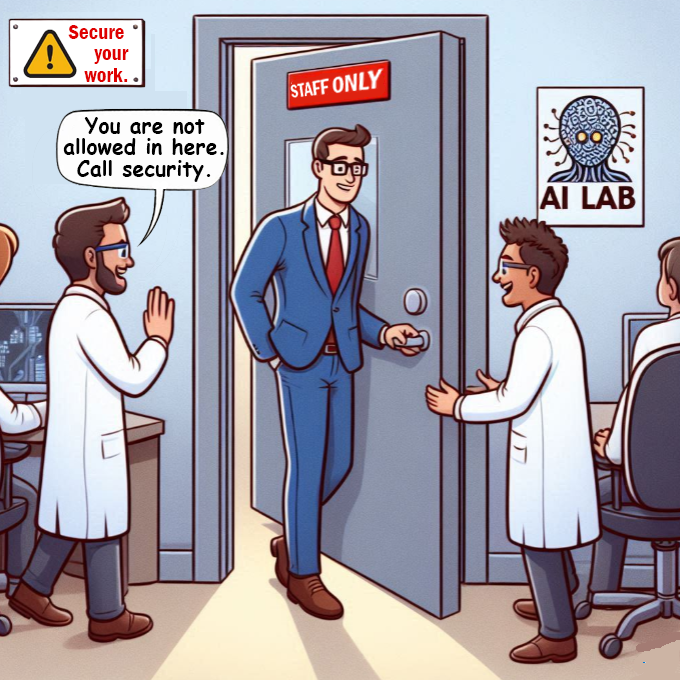
How an allegedly big time consultant is received in a secure artificial intelligence laboratory. Thanks, MSFT Copilot, good enough.
How about this one?
Through 2027, generative AI (GenAI) will spawn new roles in software engineering and operations, requiring 80% of the engineering workforce to upskill, according to Gartner, Inc.
My thought is that the virtual band of wizards which comprise Gartner cook up data the way I microwave a burrito when I am hungry. Pick a common number like the 80-20 Pareto figure. It is familiar and just use it. Personally I was disappointed that Gartner did not use 67 percent, but that’s just an old former blue chip consultant pointing out that round numbers are inherently suspicious. But does Gartner care? My hunch is that whoever reviewed the news release was happy with 80 percent. Did anyone question this number? Obviously not: There are zero supporting data, no information about how it was derived, and no hint of the methodology used by the incredible Gartner wizards. That’s a clue that these are microwaved burritos from a bulk purchase discount grocery.
How about this statement which cites a … wait for it … Gartner wizard as the source of the information?
“In the AI-native era, software engineers will adopt an ‘AI-first’ mindset, where they primarily focus on steering AI agents toward the most relevant context and constraints for a given task,” said Walsh. This will make natural-language prompt engineering and retrieval-augmented generation (RAG) skills essential for software engineers.
I love the phrase “AI native” and I think dubbing the period from January 2023 when Microsoft demonstrated its marketing acumen by announcing the semi-tie up with OpenAI. The code generation systems help exactly what “engineer”? One has to know quite a bit to craft a query, examine the outputs, and do any touch ups to get the outputs working as marketed? The notion of “steering” ignores what may be an AI problem no one at Gartner has considered; for example, emergent patterns in the code generated. This means, “Surprise.” My hunch is that the idea of multi-layered neural networks behaving in a way that produces hitherto unnoticed patterns is of little interest to Gartner. That outfit wants to sell consulting work, not noodle about the notion of emergence which is a biased suite of computations. Steering is good for those who know what’s cooking and have a seat at the table in the kitchen. Is Gartner given access to the oven, the fridge, and the utensils? Nope.
Finally, how about this statement?
According to a Gartner survey conducted in the fourth quarter of 2023 among 300 U.S. and U.K. organizations, 56% of software engineering leaders rated AI/machine learning (ML) engineer as the most in-demand role for 2024, and they rated applying AI/ML to applications as the biggest skills gap.
Okay, this is late 2024 (October to be exact). The study data are a year old. So far the outputs of smart coding systems remain a work in progress. In fact, Dr. Sabine Hossenfelder has a short video which explains why the smart AI programmer in a box may be more disappointing than other hyperbole artists claim. If you want Dr. Hossenfelder’s view, click here. In a nutshell, she explains in a very nice way about the giant bologna slide plopped on many diners’ plates. The study Dr. Hossenfelder cites suggests that productivity boosts are another slice of bologna. The 41 percent increase in bugs provides a hint of the problems the good doctor notes.
Net net: I wish the cited article WERE generated by smart software. What makes me nervous is that I think real, live humans cooked up something similar to a boiled shoe. Let me ask a more significant question. Will Gartner experts require upskilling for the new world of smart software? The answer is, “Yes.” Even today’s sketchy AI outputs information often more believable that this Gartner 80 percent confection.
Stephen E Arnold, October 16, 2024
When Accountants Do AI: Do The Numbers Add Up?
October 9, 2024
 This blog post did not require the use of smart software, just a dumb humanoid.
I will not suggest that Accenture has moved far, far away from its accounting roots. The firm is a go to, hip and zip services firm. I think this means it rents people to do work entities cannot do themselves or do not want to do themselves. When a project goes off the post office path like the British postal service did, entities need someone to blame and — sometimes, just sometimes mind you — to sue.

The carnival barker, who has an MBA and a literature degree from an Ivy League school, can do AI for you. Thanks, MSFT, good enough like your spelling.
“Accenture To Train 30,000 Staff On Nvidia AI Tech In Blockbuster Deal” strikes me as a Variety-type Hollywood story. There is the word “blockbuster.” There is a big number: 30,000. There is the star: Nvidia. And there is the really big word: Deal. Yes, deal. I thought accountants were conservative, measured, low profile. Nope. Accenture apparently has gone full scale carnival culture. (Yes, this is an intentional reference to the book by James B. Twitchell. Note that this YouTube video asserts that it can train you in 80 percent of AI in less than 10 minutes.)
The article explains:
The global services powerhouse says its newly formed Nvidia Business Group will focus on driving enterprise adoption of what it called ‘agentic AI systems’ by taking advantage of key Nvidia software platforms that fuel consumption of GPU-accelerated data centers.
I love the word “agentic.” It is the digital equivalent of a Hula Hoop. (Remember. I am an 80 year old dinobaby. I understand Hula Hoops.)
The write up adds this quote from the Accenture top dog:
Julie Sweet, chair and CEO of Accenture, said the company is “breaking significant new ground” and helping clients use generative AI as a catalyst for reinvention.” “Accenture AI Refinery will create opportunities for companies to reimagine their processes and operations, discover new ways of working, and scale AI solutions across the enterprise to help drive continuous change and create value,” she said in a statement.x
The write up quotes Accenture Chief AI Officer Lan Guan as saying:
“The power of these announcements cannot be overstated. Called the “next frontier” of generative AI, these “agentic AI systems” involve an “army of AI agents” that work alongside human workers to “make decisions and execute with precision across even the most complex workflows,” according to Guan, a 21-year Accenture veteran. Unlike chatbots such as ChatGPT, these agents do not require prompts from humans, and they are not meant to automating pre-existing business steps.
I am interested in this announcement for three reasons.
First, other “services” firms will have to get in gear, hook up with an AI chip and software outfit, and pray fervently that their tie ups actually deliver something a client will not go to court because the “agentic” future just failed.
Second, the notion that 30,000 people have to be trained to do something with smart software. This idea strikes me as underscoring that smart software is not ready for prime time; that is, the promises which started gushing with Microsoft’s January 2023 PR play with OpenAI is complicated. Is Accenture saying it has hired people who cannot work with smart software. Are those 30,000 professionals going to be equally capable of “learning” AI and making it deliver value? When I lecture about a tricky topic with technology and mathematics under the hood, I am not sure 100 percent of my select audiences have what it takes to convert information into a tool usable in a demanding, work related situation. Just saying: Intelligence even among the elite is not uniform. By definition, some “weaknesses” will exist within the Accenture vision for its 30,000 eager learners.
Third, Nvidia has done a great sales job. A chip and software company has convinced the denizens of Carpetland at what CRN (once Computer Reseller News) to get an Nvidia tattoo and embrace the Nvidia future. I would love to see that PowerPoint deck for the meeting that sealed the deal.
Net net: Accountants are more Hollywood than I assumed. Now I know. They are “agentic.”
Stephen E Arnold, October 9, 2024
US Government Procurement: Long Live Silos
September 12, 2024
 This essay is the work of a dumb dinobaby. No smart software required.
I read “Defense AI Models A Risk to Life Alleges Spurned Tech Firm.” Frankly , the headline made little sense to me so I worked through what is a story about a contractor who believes it was shafted by a large consulting firm. In my experience, the situation is neither unusual nor particularly newsworthy. The write up does a reasonable job of presenting a story which could have been titled “Naive Start Up Smoked by Big Consulting Firm.” A small high technology contractor with smart software hooks up with a project in the Department of Defense. The high tech outfit is not able to meet the requirements to get the job. The little AI high tech outfit scouts around and brings a big consulting firm to get the deal done. After some bureaucratic cycles, the small high tech outfit is benched. If you are not familiar with how US government contracting works, the write up provides some insight.
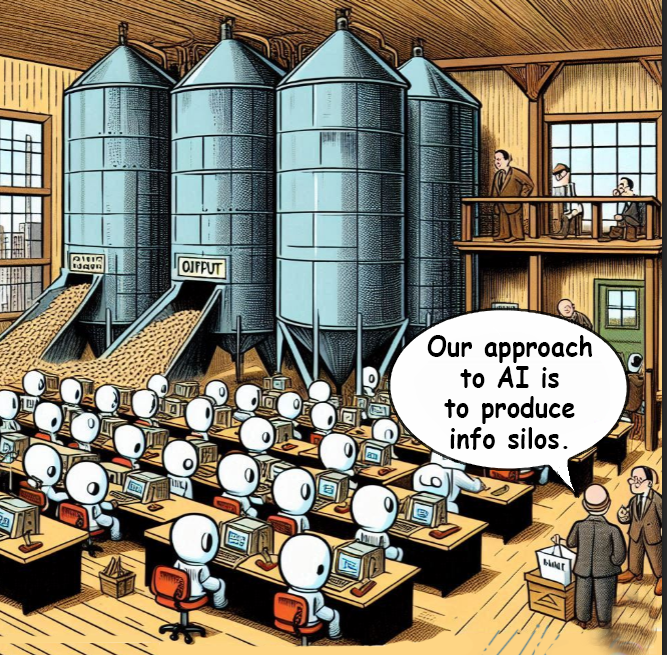
The work product of AI projects will be digital silos. That is the key message of this procurement story. I don’t feel sorry for the smaller company. It did not prepare itself to deal with the big time government contractor. Outfits are big for a reason. They exploit opportunities and rarely emulate Mother Theresa-type behavior. Thanks, MSFT Copilot. Good enough illustration although the robots look stupid.
For me, the article is a stellar example of how information or or AI silos are created within the US government. Smart software is hot right now. Each agency, each department, and each unit wants to deploy an AI enabled service. Then that AI infused service becomes (one hopes) an afterburner for more money with which one can add headcount and more AI technology. AI is a rare opportunity to become recognized as a high-performance operator.
As a result, each AI service is constructed within a silo. Think about a structure designed to hold that specific service. The design is purpose built to keep rats and other vermin from benefiting from the goodies within the AI silo. Despite the talk about breaking down information silos, silos in a high profile, high potential technical are like artificial intelligence are the principal product of each agency, each department, and each unit. The payoff could be a promotion which might result in a cushy job in the commercial AI sector or a golden ring; that is, the senior executive service.
I understand the frustration of the small, high tech AI outfit. It knows it has been played by the big consulting firm and the procurement process. But, hey, there is a reason the big consulting firm generates billions of dollars in government contracts. The smaller outfit failed to lock down its role, retain the key to the know how it developed, and allowed its “must have cachè” to slip away.
Welcome, AI company, to the world of the big time Beltway Bandit. Were you expecting the big time consulting firm to do what you wanted? Did you enter the deal with a lack of knowledge, management sophistication, and a couple of false assumptions? And what about the notion of “algorithmic warfare”? Yeah, autonomous weapons systems are the future. Furthermore, when autonomous systems are deployed, the only way they can be neutralized is to use more capable autonomous weapons. Does this sound like a reply of the logic of Cold War thinking and everyone’s favorite bedtime read On Thermonuclear War still available on Amazon and as of September 6, 2024, on the Internet Archive at this link.
Several observations are warranted:
- Small outfits need to be informed about how big consulting companies with billions in government contracts work the system before exchanging substantive information
- The US government procurement processes are slow to change, and the Federal Acquisition Regulations and related government documents provide the rules of the road. Learn them before getting too excited about a request for a proposal or Federal Register announcement
- In a fight with a big time government contractor make sure you bring money, not a chip on your shoulder, to the meeting with attorneys. The entity with the most money typically wins because legal fees are more likely to kill a smaller firm than any judicial or tribunal ruling.
Net net: Silos are inherent in the work process of any government even those run by different rules. But what about the small AI firm’s loss of the contract? Happens so often, I view it as a normal part of the success workflow. Winners and losers are inevitable. Be smarter to avoid losing.
Stephen E Arnold, September 12, 2024
-

- Subscribe to Beyond Search
Feature archive
News archive

-


