

Telegram Notes: Mama Durova and Her Inner Circle, Part 2
January 20, 2026
 Another dinobaby post. No AI unless it is an image. This dinobaby is not Grandma Moses, just Grandpa Arnold.
This is the second part of my Telegram Notes’ write up about Pavel Durov’s mother. “Mama Albina, Pure Bred Animals, and Some Tricks” gathers thoughts, comments, and hypotheses about what I call a “web of companies.” Imagine. As a professor of “misinformation” and social media, she watched the viral take off of VKontakte. Mama Durova pulled her “cozy group” together. In the circle were her former and second husband, her three sons, and one adopted high-performer whom Nikolai helped. As Pasha rapidly coded VKontakte into a Russian Facebook, his libertarian stance on privacy collided with the Kremlin’s demand for control during the Snow Revolution protests. While Pasha postured as the defiant "GOAT" (the greatest of all time Russian entrepreneur and visionary), she did what mothers do. She orchestrated a "core group" of family insiders—half-brothers and trusted associates—who allegedly routed VK’s revenue through a web of shadow companies like Peering LLC and VKT Rus while using her influence to shield Pasha from Kremlin needs. When the Kremlin moved to silence dissent, Pasha refused to bend, transforming from a golden child into a black sheep. By 2014, he was exiled to run Telegram and create another entrepreneurial winner. Mama’s network remained entrenched in Russia. This briefing uncovers the ultimate family bargain: Did Mama sacrifice her son’s freedom to preserve the lucrative empire she helped build? You can find Part II at this Telegram Notes / Bear Blog page. (Lectures about Telegram are available via Zoom or in person. Write kentmaxwell@proton.me for information. Each lecture attendee receives a free copy of “The Telegram Labyrinth.”
Stephen E Arnold, January 20, 2026
Telegram Notes: Mama Durova and Her Inner Circle
January 14, 2026
 Another dinobaby post. No AI unless it is an image. This dinobaby is not Grandma Moses, just Grandpa Arnold.
We filtered our notes for my new book “The Telegram Labyrinth.” Information about Pavel Durov’s mom was sparse. What we had, however, was interesting. The inner circle boils down to her ex-husbands and her three sons. In Part One of a two-part write up, you can get a snapshot of the individuals who facilitated the technical and business plumbing for VKontakte until its sale to Kremlin-approved buyers and then for the Telegram messaging service. You can find part one of this interesting group on my Telegram Notes online service.
Stephen E Arnold, January 14, 2026
ChatGPT Channels Telegram
January 7, 2026
Just what everyone needs: Telegram type apps on the Sam AI-Man platform. What will bad actors do? Obviously nothing. Apps will be useful, do good, and make the world a better place.k
ChatGPT now connects to apps without leaving the AI interface.? ? According to Mashable, “ChatGPT Launches Apps Beta: 8 Big Apps You Can Now Use In ChatGPT.”? ? ChatGPT wants its users to easily access apps or take suggestions during conversations with the AI.? ? The idea is that ChatGPT will be augmented by apps and extend conversations.
App developers will also be able to use ChatGPT to build chat-native experiences to bring context and action directly into conversations.
The new app integration is described as:
“While some commentators have referred to the new Apps beta as a ChatGPT app store, at this time, it’s more of an app directory. However, in the “Looking Ahead” section of its announcement post, OpenAI does note that this tool could eventually ‘expand the ways developers can reach users and monetize their work.’”
The apps that are integrated into ChatGPT are Zillow, Target, Expedia, Tripadvisor, Instacart, DoorDash, Apple Music, and Spotify.? ? This sounds similar to what Telegram did.? ? Does this mean OpenAI is on the road to Telegram like services?
Just doing good. Bad actors will pay no attention.
Whitney Grace, January 7, 2025
Telegram Notes: Occasional Observations
December 29, 2025
![green-dino_thumb_thumb[3]_thumb](https://www.arnoldit.com/wordpress/wp-content/uploads/2025/12/green-dino_thumb_thumb3_thumb-1.gif "green-dino_thumb_thumb[3]_thumb") Another dinobaby post. No AI unless it is an image. This dinobaby is not Grandma Moses, just Grandpa Arnold.
Another dinobaby post. No AI unless it is an image. This dinobaby is not Grandma Moses, just Grandpa Arnold.
My new Telegram Notes’ service is coming along. Watch Beyond Search for a link to the stories. We will post a short summary of a story in Beyond Search which I have producing since 2008. The longer Telegram Notes’ essays will appear in the new service. We are testing a couple of options. We have a masthead. The art was produced by Google and Venice smart software. If you know nothing about Telegram, its Messenger Service, or its new financial services, the illustration won’t make much sense. If you know a bit about Telegram, you will know about the GOAT. The references to crypto and other content are references to allegations about the content on the platform.

The working version of the Telegram Notes’ masthead. Thanks, AI services. You are good enough.
Beyond Search will continue to host new articles in our traditional format. However, as we figure out how to best use our time, the flow of stories is likely to be uneven. (Personally I love the GOAT picture. But what’s that on the information highway beneath the GOAT? Probably nothing.
Stephen E Arnold, December 29, 2025
Un-Aliving Violates TOS and Some Linguistic Boundaries
December 18, 2025
Ah, lawyers.
Depression is a dark emotionally state and sometimes makes people take their lives. Before people unalive themselves, they usually investigate the act and/or reach out to trusted sources. These days the “trusted sources” are the host of AI chatbots that populate the Internet. Ars Technica shares the story about how one teenager committed suicide after using a chatbot: “OpenAI Says Dead Teen Violated TOS When He Used ChatGPT To Plan Suicide.”
OpenAI is facing a total of five lawsuits about wrongful deaths associated with ChatGPT. The first lawsuit came to court and OpenAI defended itself by claiming that the teen in question, Adam Raine, violated the terms of service because they prohibited self-harm and suicide. While pursuing the world’s “most engaging chatbot,” OpenAI relaxed their safety measures for ChatGPT which became Raine’s suicide coach.
OpenAI’s lawyers argued that Raine’s parents selected the most damaging chat logs. They also claim that the logs show that Raine had had suicidal ideations since age eleven and that his medication increased his un-aliving desires.
Along with the usual allegations about shifting the blame onto the parents and others, OpenAI says that people use the chatbot at their own risk. It’s a way to avoid any accountability.
“To overcome the Raine case, OpenAI is leaning on its usage policies, emphasizing that Raine should never have been allowed to use ChatGPT without parental consent and shifting the blame onto Raine and his loved ones. ‘ChatGPT users acknowledge their use of ChatGPT is ‘at your sole risk and you will not rely on output as a sole source of truth or factual information,’ the filing said, and users also “must agree to ‘protect people’ and ‘cannot use [the] services for,’ among other things, ‘suicide, self-harm,’ sexual violence, terrorism or violence.’”
OpenAI employees were also alarmed by the amount of “liberties” used to make the chatbot more engaging.
How far will OpenAI go with ChatGPT to make it intuitive, human-like, and intelligent? Raines already had underlying conditions that caused his death, but ChatGPT did exasperate them. Remember the terms of service.
Whitney Grace, December 18, 2025
Australia: Kangaroos and Putting Kids in a Secure Pouch
December 17, 2025
Australia became the first country in the world to ban social media for kids under sixteen. They did it in a bid to protect the younger sect from addictive behaviors, online bullies, and predators. CNN details the ban in, “Millions Of Australian Children Just Lost Access To Social Media. What’s Happening And Will It Work?”
The ten platforms that are banned for under sixteen kids are, X, Twitch, Reddit, Kick, TikTok, Snapchat, Threats, Facebook, YouTube, and Instagram.
The ban will be implemented using age-verification technology, but the platforms don’t believe it will make kids safer. The Australian prime minister believes differently:
“Prime Minister Anthony Albanese said it was a “proud day” for Australia. ‘This is the day when Australian families are taking back power from these big tech companies. They are asserting the right of kids to be kids and for parents to have greater peace of mind,’ Albanese told the public broadcaster ABC Wednesday. But he conceded ‘it won’t be simple.’”
The platforms will use age-verification technology such as video selfies, email addresses, or official documents. The video selfies use facial data points to estimate age.
There are workarounds such as parents creating accounts for their kids and backup social media companies. People are saying it’s a game of whack-a-mole that the Australian government won’t win. There aren’t any punishments for parents who do make accounts for kids.
A follow up from The Nightly says, “Australian Under-16s Social Media Ban: Kids Claim Ban Didn’t Work As They Troll Anthony Albanese On TikTok.” The younger sect took to TikTok and did what kids do best: make fun of the incident. They’re trolling the Prime Minister with memes, videos, comments, and anything else to prove the ban isn’t working.
There are kinks to still work out, but maybe the ban will work. Some youngsters have good technical know how. Work arounds are inevitable. Even baby roos leave the pouch.
Whitney Grace, December 17, 2025
Social Media Companies: Digital Drug Pushers?
December 11, 2025
Social media is a drug. Let’s be real, it’s not a real drug but it affects the brain in the same manner as drugs and alcohol. Social media stimulates the pleasure centers of the brain, releases endorphins, and creates an immediate hit. Delayed gratification becomes a thing of the past as users are constantly seeking their thrills with instantaneous hits from TikTok, Snapchat, Instagram, Facebook, and YouTube.
Politico includes a quote from the recent lawsuit filed against Meta in Northern California that makes a great article title: “‘We’re Basically Pushers’: Court Filing Alleges Staff At Social Media Giants Compared Their Platforms To Drugs.” According to the lawsuit, Meta, Instagram, TikTok, Snapchat, and YouTube ignored their platforms’ potential dangers and hid them from users.
The lawsuit has been ongoing doe years and a federal judge ordered its contents to be opened in October 2025. Here are the details:
“The filing includes a series of detailed reports from four experts, who examined internal documents, research and direct communications between engineers and executives at the companies. Experts’ opinions broadly concluded that the companies knew their platforms were addictive but continued to prioritize user engagement over safety.”
It sounds like every big company ever. Money over consumer safety. We’re doomed.
Whitney Grace, December 11, 2025
Telegram, Did You Know about the Kiddie Pix Pyramid Scheme?
November 25, 2025
![green-dino_thumb_thumb[3]](https://www.arnoldit.com/wordpress/wp-content/uploads/2025/11/green-dino_thumb_thumb3-5.gif "green-dino_thumb_thumb[3]") Another dinobaby post. No AI unless it is an image. This dinobaby is not Grandma Moses, just Grandpa Arnold.
Another dinobaby post. No AI unless it is an image. This dinobaby is not Grandma Moses, just Grandpa Arnold.
The Independent, a newspaper in the UK, published “Leader of South Korea’s Biggest Telegram Sex Abuse Ring Gets Life Sentence.” The subtitle is a snappy one: “Seoul Court Says Kim Nok Wan Committed Crimes of Extreme Brutality.” Note: I will refer to this convicted person as Mr. Wan. The reason is that he will spend time in solitary confinement. In my experience individuals involved in kiddie crimes are at bottom of the totem pole among convicted people. If the prison director wants to keep him alive, he will be kept away from the general population. Even though most South Koreans are polite, it is highly likely that he will face a less than friendly greeting when he visits the TV room or exercise area. Therefore, my designation of Mr. Wan reflects the pallor his skin will evidence.
Now to the story:
The main idea is that Mr. Wan signed up for Telegram. He relied on Telegram’s Group and Channel function. He organized a social community dubbed the Vigilantes, a word unlikely to trigger kiddie pix filters. Then he “coerced victims, nearly 150 of them minors, into producing explicit material through blackmail and then distribute the content in online chat rooms.”
Telegram’s leader sets an example for others who want to break rules and be worshiped. Thanks, Venice.ai. Too bad you ignored my request for no facial hair. Good enough, the standard for excellence today I believe.
Mr. Wan’s innovation weas to set up what the Independent called “a pyramid hierarchy.” Think of an Herbal Life- or the OneCoin-type operation. He incorporated an interesting twist. According to the Independent:
He also sent a video of a victim to their father through an accomplice and threatened to release it at their workplace.
Let’s shift from the clever Mr. Wan to Telegram and its public and private Groups and Channels. The French arrested Pavel Durov in August 2024. The French judiciary identified a dozen crimes he allegedly committed. He awaits trial for these alleged crimes. Since that arrest, Telegram has, based on our monitoring of Telegram, blocked more aggressively a number of users and Groups for violating Telegram’s rules and regulations such as they are. However, Mr. Wan appears to have slipped through despite Telegram’s filtering methods.
Several observations:
- Will Mr. Durov implement content moderation procedures to block, prevent, and remove content like Mr. Wan’s?
- Will South Korea take a firm stance toward Telegram’s use in the country?
- Will Mr. Durov cave in to Iran’s demands so that Telegram is once again available in that country?
- Did Telegram know about Mr. Wan’s activities on the estimable Telegram platform?
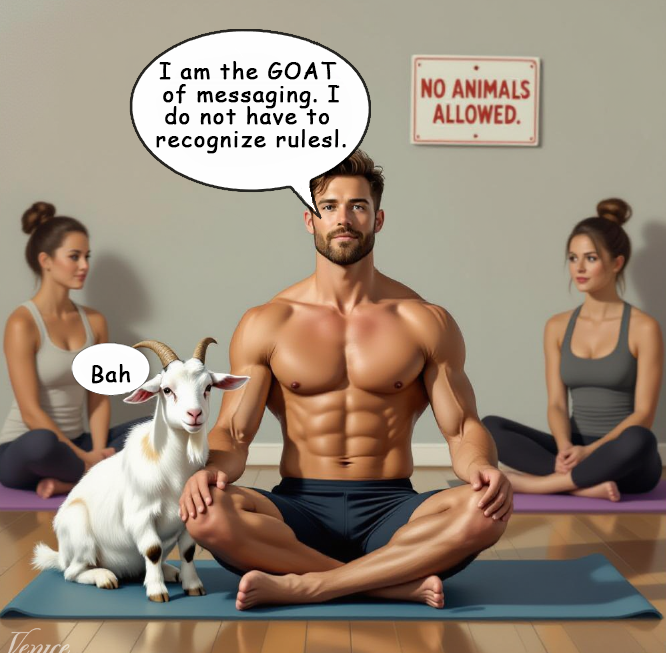
Mr. Wan exploited Telegram. Perhaps more forceful actions should be taken by other countries against services which provide a greenhouse for certain types of online activity to flourish? Mr. Durov is a tech bro, and he has been pictured carrying a real (not metaphorical) goat to suggest that he is the greatest of all time.
That perception appears to be at odds with the risk his platform poses to children in my opinion.
Stephen E Arnold, November 25, 2025
Pavel Durov Can Travel As Some New Features Dribble from the Core Engineers
November 25, 2025
 This essay is the work of a dumb dinobaby. No smart software required.
In November 2025, Telegram announced Cocoon, its AI system. Well, it is not yet revolutionizing writing code for smart contracts. Like Apple, Telegram is a bit late to the AI dog race. But there is hope for the company which has faced some headwinds. One blowing from the west is the criminal trial for which Pavel Durov, the founder of Telegram waits. Plus, the value of the much-hyped TONcoin and the subject of yet another investigation for financial fancy dancing is tanking.
What’s the good news? Telegram watching outfits like FoneArena and PCNews.ru have reported on some recent Telegram innovations. Keep in mind that Telegram means that a new user install the Messenger mini app. This is an “everything” app. Through the interface one can do a wide range of actions. Yep, that’s why it is called an “everything” app. You can read Telegram’s own explanation in the firm’s blog.
Fone Arena reports that “the Dubai-based virtual company (yeah, go figure that out) has rolled out Live Stories streaming, repeated messages, and gift auctions. Repeated messages will spark some bot developers to build this function into applications. Notifications (wanted and unwanted) are useful in certain types of advertising campaigns. The gift auctions is little more than a hybrid of Google ad auctions and eBay applied to the highly volatile, speculative crypto confections Telegram, users, and developers allegedly find of great value.
The Live Stories streaming is more significant. Rolled out in November 2025, Live Stories allows users to broadcast live streams within the Stories service. Viewers can post comments and interact in real time in a live chat. During a stream, viewers may highlight or pin their messages using Telegram Stars, which is a form of crypto cash. A visible Star counter appears in the corner of the broadcast. Gamification is a big part of the Telegram way. Gambling means crypto transactions. Transactions incur a service charge. A user can kick of a Live Story from a personal accounts or from a Groups or a Channels that have unlocked Story posting via boosts. Owners have to unlock the Live Story, however. Plus, the new service supports real time messaging protocol for external applications such as OBS and XSplit streaming software.

The interface for Live Stories steaming. Is Telegram angling to kill off Twitch and put a dent in Discord? Will the French judiciary forget to try Pavel Durov for his online service’s behavior. It appears that Mr. Durov and his core engineers think so.
Observations are warranted:
- Live Stories is likely to catch the attention of some of the more interesting crypto promoters who make use of Telegram
- Telegram’s monitoring service will have to operate in real time because dropping in a short but interesting video promo for certain illegal or controversial activities will have to operate better than the Cleveland Browns American football team
- The soft hooks to pump up service charges or “gas fees” in the lingo of the digital currency enthusiasts are an important part of gift and auction play. Think hooking users on speculative investments in digital goodies and then scraping off those service charges.
Net net: Will Cocoon make it easier for developers to code complex bots, mini apps, and distributed applications (dApps)? Answer: Not yet. Just go buy a gift on Telegram. PS. Mr. Zuckerberg, Telegram has aced you again it seems.
Stephen E Arnold, November 25, 2025
Danes May Ban Social Media for Kids
November 17, 2025
Australia’s ban on social media for kids under 16 goes into effect December 10. Now another country is pursuing a similar approach. Euro News reports, “Denmark Wants to Ban Access to Social Media for Children Under 15.” We learn:
“The move, led by the Ministry of Digitalisation, would set the age limit for access to social media but give some parents – after a specific assessment – the right to give consent to let their children access social media from age 13. Such a measure would be among the most sweeping steps yet by a European Union government to address concerns about the use of social media among teens and younger children, which has drawn concerns in many parts of an increasingly online world. … The Danish digitalisation ministry statement said the age minimum of 15 would be introduced for ‘certain’ social media, though it did not specify which ones.”
If the Danes follow Australia’s example, those platforms could include TikTok, Facebook, Snapchat, Reddit, Kick, X, Instagram, and YouTube. The write-up describes the motivation behind the push:
“A coalition of lawmakers from the political right, left and centre ‘are making it clear that children should not be left alone in a digital world where harmful content and commercial interests are too much a part of shaping their everyday lives and childhoods,’ the ministry said. ‘Children and young people have their sleep disrupted, lose their peace and concentration, and experience increasing pressure from digital relationships where adults are not always present,’ it said. ‘This is a development that no parent, teacher, or educator can stop alone’.”
That may be true. And it is certainly true that social media poses certain dangers to children and teens. But how would the ban be enforced? The statement does not say. Teens, after all, famously find ways to get around security measures. If only there had been a way for platforms to know about these risks sooner.
Cynthia Murrell, November 17, 2025
-

- Subscribe to Beyond Search
Feature archive
News archive

-


