

Education on the Cheap: No AI Required
January 26, 2024
 This essay is the work of a dumb dinobaby. No smart software required.
I don’t write about education too often. I do like to mention the plagiarizing methods of some academics. What fun! I located a true research gem (probably non-reproducible, hallucinogenic, or just synthetic but I don’t care). “Emergency-Hired Teachers Do Just as Well as Those Who Go Through Normal Training” states:
New research from Massachusetts and New Jersey suggests maybe not. In both states, teachers who entered the profession without completing the full requirements performed no worse than their normally trained peers.
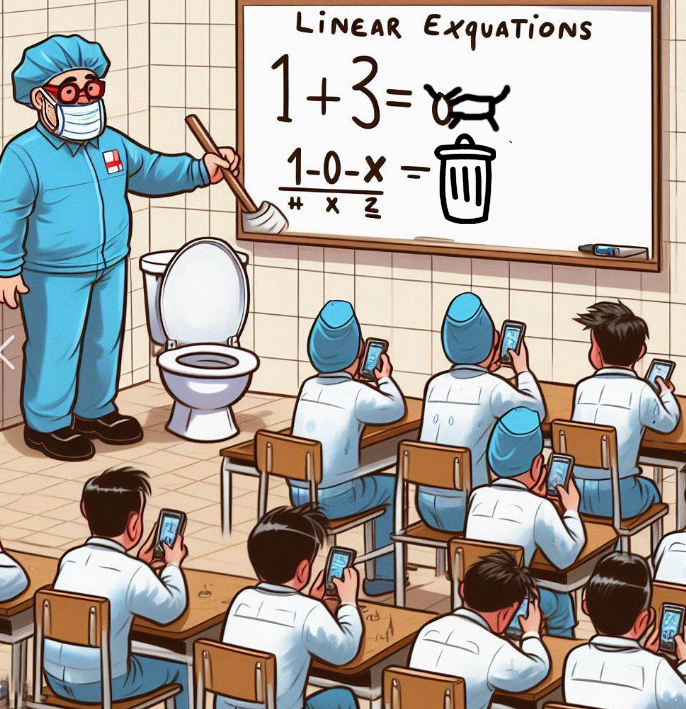
A sanitation worker with a high school diploma is teaching advanced seventh graders about linear equations. The students are engaged… with their mobile phones. Hey, good enough, MSFT Copilot Bing thing. Good enough.
Then a modest question:
The better question now is why these temporary waivers aren’t being made permanent.
And what’s the write up say? I quote:
In other words, making it harder to become a teacher will reduce the supply but offers no guarantee that those who meet the bar will actually be effective in the classroom.
Huh?
Using people who did not slog through college and learned something (one hopes) is expensive. Think of the cost savings when using those who are untrained and unencumbered with expectations of big money! When good enough is the benchmark of excellence, embrace those without an comprehensive four-year or more education. Ooops. Who wants that?
I thought that I once heard that the best, most educated teaching professionals should work with the youngest students. I must have been doing some of that AI-addled thinking common among some in the old age home. When’s lunch?
Stephen E Arnold, January 26, 2024
Apple, Now Number One, But Maybe Not in Mobile Security?
January 26, 2024
 This essay is the work of a dumb dinobaby. No smart software required.
MIT Professor Stuart E. Madnick allegedly discovered that iPhone data breaches tripled between 2013-2022. Venture Beat explains more in the article “Why Attackers Love To Target Misconfigured Clouds And Phones.”
Hackers use every method to benefit from misconfiguration, but ransomware is their favorite technique. Madnick discovered a near 50% increase in ransomware attacks in organizations in the first six months of 2023 compared to 2022. After finding the breach, hackers then attack organizations’ mobile phone fleets. They freeze all communications until the ransom is paid.
Bad actors want to find the easiest ways into clouds. Unfortunately organizations are unaware that attacks happen when they don’t monitor their networks:
Merritt Baer, Field CISO at Lacework, says that bad actors look first for an easy front door to access misconfigured clouds, the identities and access to entire fleets of mobile devices. “Novel exploits (zero-days) or even new uses of existing exploits are expensive to research and discover. Why burn an expensive zero-day when you don’t need to? Most bad actors can find a way in through the “front door”– that is, using legitimate credentials (in unauthorized ways).”
Baer added, ‘This avenue works because most permissions are overprovisioned (they aren’t pruned down/least privileged as much as they could be), and because with legitimate credentials, it’s hard to tell which calls are authorized/ done by a real user versus malicious/ done by a bad actor.’”
Almost 99% of cloud security breaches are due to incorrectly set manual controls. Also nearly 50% of organizations unintentionally exposed storage, APIs, network scents, and applications. These breaches cost an average of $4 million to solve.
Organizations need to rely on more than encryption to protect their infrastructures. Most attacks occur because bad actors use authenticate credentials. Unified endpoint management, passwordless multi-factor authentication, and mobile device management housed on a single platform is the best defense.
How about these possibly true revelations about Apple?
Whitney Grace, January 26, 2024
AI and Web Search: A Meh-crosoft and Google Mismatch
January 25, 2024
 This essay is the work of a dumb dinobaby. No smart software required.
I read a shocking report summary. Is the report like one of those Harvard Medical scholarly articles or an essay from the former president of Stanford University? I don’t know. Nevertheless, let’s look at the assertions in “Report: ChatGPT Hasn’t Helped Bing Compete With Google.” I am not sure if the information provides convincing proof that Googzilla is a big, healthy market dominator or if Microsoft has been fooling itself about the power of the artificial intelligence revolution.

The young inventor presents his next big thing to a savvy senior executive at a techno-feudal company. The senior executive is impressed. Are you? I know I am. Thanks, MSFT Copilot Bing thing. Too bad you timed out and told me, “I apologize for the confusion. I’ll try to create a more cartoon-style illustration this time.” Then you crashed. Good enough, right?
Let’s look at the write up. I noted this passage which is coming to me third, maybe fourth hand, but I am a dinobaby and I go with the online flow:
Microsoft added the generative artificial intelligence (AI) tool to its search engine early last year after investing $10 billion in ChatGPT creator OpenAI. But according to a recent Bloomberg News report — which cited data analytics company StatCounter — Bing ended 2023 with just 3.4% of the worldwide search market, compared to Google’s 91.6% share. That’s up less than 1 percentage point since the company announced the ChatGPT integration last January.
I am okay with the $10 billion. Why not bet big? The tactics works for some each year at the Kentucky Derby. I don’t know about the 91.6 number, however. The point six is troubling. What’s with precision when dealing with a result that makes clear that of 100 random people on line at the ever efficient BWI Airport, only eight will know how to retrieve information from another Web search system; for example, the busy Bing or the super reliable Yandex.ru service.
If we assume that the Bing information of modest user uptake, those $10 billion were not enough to do much more than get the management experts at Alphabet to press the Red Alert fire alarm. One could reason: Google is a monopoly in spirit if not in actual fact. If we accept the market share of Bing, Microsoft is putting life preservers manufactured with marketing foam and bricks on its Paul Allen-esque super yacht.
The write up says via what looks like recycled information:
“We are at the gold rush moment when it comes to AI and search,” Shane Greenstein, an economist and professor at Harvard Business School, told Bloomberg. “At the moment, I doubt AI will move the needle because, in search, you need a flywheel: the more searches you have, the better answers are. Google is the only firm who has this dynamic well-established.”
Yeah, Harvard. Oh, well, the sweatshirts are recognized the world over. Accuracy, trust, and integrity implied too.
Net net: What’s next? Will Microsoft make it even more difficult to use another outfit’s search system. Swisscows.com, you may be headed for the abattoir. StartPage.com, you will face your end.
Stephen E Arnold, January 25, 2024
Content Mastication: A Controversial Business Tactic
January 25, 2024
 This essay is the work of a dumb dinobaby. No smart software required.
In the midst of the unfolding copyright issues, I found this post quite interesting. Torrent Freak published a story titled “Meta Admits Use of ‘Pirated’ Book Dataset to Train AI.” Is the story spot on? I sure don’t know. Nevertheless, the headline is a magnetic one. The story reports:
The cases allege that tech companies, including Meta and OpenAI, used the controversial Books3 dataset to train their models. The Books3 dataset has a clear piracy angle. It was created by AI researcher Shawn Presser in 2020, who scraped the library of ‘pirate’ site Bibliotik. This book archive was publicly hosted by digital archiving collective ‘The Eye‘ at the time, alongside various other data sources.

A combination of old-fashioned content collection and smart systems move information from Point A (a copyright owner’s night table) to a smart software system. MSFT’s second class Copilot Bing thing created this cartoon. Sigh. Not even good enough now in my opinion.
What was in the Books3 data collection? The TF story elucidates:
The general vision was that the plaintext collection of more than 195,000 books, which is nearly 37GB…
What did Meta allegedly do to make its Llama smarter than the average member of the Camelidae family? Let’s roll the TF quote:
Responding to a lawsuit from writer/comedian Sarah Silverman, author Richard Kadrey, and other rights holders, the tech giant admits that “portions of Books3” were used to train the Llama AI model before its public release. “Meta admits that it used portions of the Books3 dataset, among many other materials, to train Llama 1 and Llama 2,” Meta writes in its answer [to a court].
The article does not include any statements like “Thank you for the question” or “I don’t know. My team will provide the answer at the earliest possible moment.” Nope. Just an alleged admission.
How will the Meta and parallel copyright legal matter evolve? Beyond Search has zero clue. The US judicial system has deep and mysterious logic. One thing is certain: Senior executives do not like uncertainty and risk. The copyright litigation seems tailored to cause some techno feudalists to imagine a world in which laws, annoying regulators, and people yapping about intellectual property were nudged into a different line of work. One example which comes to mind is building secure bunkers or taking care of the lawn.
Stephen E Arnold, January 25, 2024
Fujitsu: Good Enough Software, Pretty Good Swizzling
January 25, 2024
 This essay is the work of a dumb dinobaby. No smart software required.
The USPS is often interesting. But the UK’s postal system, however, is much worse. I think we can thank the public private US postal construct for not screwing over those who manage branch offices. Computer Weekly details how the UK postal system’s leaders knowingly had an IT problem and blamed employees: “Fujitsu Bosses Knew About Post Office Horizon IT Flaws, Says Insider.”
The UK postal system used the Post Office Horizon IT system supplied by Fujitsu. The Fujitsu bosses allowed it to be knowingly installed despite massive problems. Hundreds of UK subpostmasters were accused of fraud and false accounting. They were held liable. Many were imprisoned, had their finances ruined, and lost jobs. Many of the UK subpostmasters fought the accusations. It wasn’t until 2019 that the UK High Court proved it was Horizon IT’s fault.
The Fujitsu that “designed” the postal IT system didn’t have the correct education and experience for the project. It was built on a project that didn’t properly record and process payments. A developer on the project shared with Computer Weekly:
“‘To my knowledge, no one on the team had a computer science degree or any degree-level qualifications in the right field. They might have had lower-level qualifications or certifications, but none of them had any experience in big development projects, or knew how to do any of this stuff properly. They didn’t know how to do it.’”
The Post Office Horizon It system was the largest commercial system in Europe and it didn’t work. The software was bloated, transcribed gibberish, and was held together with the digital equivalent of Scotch tape. This case is the largest miscarriage of justice in current UK history. Thankfully the truth has come out and the subpostmasters will be compensated. The compensation doesn’t return stolen time but it will ease their current burdens.
Fujitsu is getting some scrutiny. Does the company manufacture grocery self check out stations? If so, more outstanding work.
Whitney Grace, January 25, 2024
The NSO Group Back in the News: Is That a Good Thing?
January 24, 2024
 This essay is the work of a dumb dinobaby. No smart software required.
Some outfits struggle to get PR, not the NSO Group. The situation is no “dream.” I spotted this write up in 9 to 5 Mac: “Apple Wins Early Battle against NSO after Suing Spyware Mercenaries for Attacking iPhone Users.” For me, the main point of the article is:
Judge Donato ruled that NSO Group’s request for dismissal in the US in favor of a trial in Israel didn’t meet the bar. Instead, Judge Donato suggested that Apple would face the same challenges in Israel that NSO faces in the US.

A senior manager who is an attorney skilled in government processes looks at the desk in his new office. Wow, that looks untidy. Thanks, MSFT Copilot Bing thing. How’s that email security issue coming along? Ah, good enough, you say?
I think this means that the legal spat will be fought in the US of A. Here’s the sentence quoted by 9 to 5 Mac which allegedly appeared in a court document:
NSO has not demonstrated otherwise. NSO also overlooks the fact that the challenges will be amenable to a number of mitigating practices.
The write up includes this passage:
An Apple spokesperson tells 9to5Mac that the company will continue to protect users against 21st century mercenaries like the NSO Group. Litigation against the Pegasus spyware maker is part of a larger effort to protect users…
From my point of view, the techno feudal outfit has surfed on the PR magnetism of the NSO Group. Furthermore, the management team at NSO Group faces what seems to be a bit of a legal hassle. Some may believe that the often ineffective Israeli cyber security technology which failed to signal, thwart, or disrupt the October 2023 dust up requires more intense scrutiny. NSO Group, therefore, is in the spotlight.
More interesting from my vantage point is the question, “How can NSO Group’s lawyering-savvy senior management not demonstrate its case in such a way to, in effect, kill some of the PR magnetism. Take it from me. This is not a “dream” assignment for NSO Group’s legal eagles. I would also be remiss if I did not mention that Apple has quite a bit of spare cash with which to feather the nest of legal eagles. Apple wants to be perceived as the user’s privacy advocate and BFF. When it comes to spending money and rounding up those who love their Apple devices, the estimable Cupertino outfit may be a bit of a challenge, even to attorneys with NSA and DHS experience.
As someone said about publicity, any publicity is good publicity. I am not sure the categorical affirmative is shared by everyone involved with NSO Group. And where is Hulio? He’s down by the school yard. He doesn’t know where he’s going, but Hulio is going the other way. (A tip of the hat to Paul Simon and his 1972 hit.)
Stephen E Arnold, January 24, 2024
Oh, Brother, What a Marketing Play HP Has Made
January 24, 2024
 This essay is the work of a dumb dinobaby. No smart software required.
I must admit I am not sure if the story “HP CEO Says Customers Who Don’t Use the Company’s Supplies Are Bad Investments” is spot on. But its spirit highlights some modern management thought processes.

The senior boss type explains to his wizards the brilliance of what might be called “the bricking strategy.” One executive sighs, “Oh, brother.” At the same time, interest in Brother’s printers show signs of life. Thanks, MSFT Copilot Bing thing, second string version. You have nailed isolated, entitled senior executives in this original art. Good enough. How’s security of your email coming along?
I love this quote (which may or may not be spot on, but let’s go with it, shall we?):
“When we identify cartridges that are violating our IP, we stop the printers from working.”
Brilliant. Hewlett Packard, the one that manufacturers printers, perceives customers who use refilled cartridges as an issue. I love the reference to intellectual property (IP). What company first developed the concept of refillable cartridges? Was it the razor blade outfit cherished as a high-water mark in business schools in the US? But refillable is perceived as a breakthrough innovation, is it not? Give away the razor; charge a lot for the blades which go dull after a single use.
The article reports:
When asked about the lawsuit during an interview with CNBC, Lores said, “I think for us it is important for us to protect our IP. There is a lot of IP that we’ve built in the inks of the printers, in the printers themselves. And what we are doing is when we identify cartridges that are violating our IP, we stop the printers from working.”
I also chuckled at this statement from the cited article:
Lores certainly makes no attempt to conceal anything in that statement. The CEO then doubled down on his stance: “Every time a customer buys a printer, it’s an investment for us. We are investing in that customer, and if that customer doesn’t print enough or doesn’t use our supplies, it’s a bad investment.”
Perfect. Customer service does not pay unless a customer subscribes to customer service. Is this a new idea? Nah, documentation does not pay off unless a customer pays to access a user manual (coherent or incoherent, complete or incomplete, current or Stone Age). Knowledgeable sales professionals are useless unless those fine executives meet their quotas. I see smart software in a company with this attitude coming like gangbusters.
But what I really admire is the notion of danger from a non-HP cartridge. Yep, a compromised cannister. Wow. The write up reports:
Lores continued to warn against the dangers of using non-HP cartridges and what will happen if you do. “In many cases, it can create all sorts of issues from the printer stopping working because the ink has not been designed to be used in our printer, to even creating security issues.” The CEO made it sound as if HP’s ink cartridge DRM was there solely for the benefit of customers. “We have seen that you can embed viruses into cartridges, through the cartridge go to the printer, from the printer go to the network, so it can create many more problems for customers.” He then appeared to shift from that customer-first perspective by stating, “Our objective is to make printing as easy as possible, and our long-term objective is to make printing a subscription.”
One person named Puiu added this observation: “I’m using an Epson with an ink tank at work. It’s so easy to refill and the ink is cheap.”
I have been working in government and commercial organizations, and I cannot recall a single incident of a printer representing a danger. I do have a number of recollections of usually calm professionals going crazy when printers [a] did not print, [b] reported malfunctions with blinking lights not explained in the user manual, [c] paper lodged in a printer in a way that required disassembly of the printer. High speed printers are unique in their ability to break themselves when the “feeder” does not feed. (By the way, the fault is the user’s, the humidity of the paper, or the static electricity generated by the stupid location the stupid customer put the stupid printer. Printer software and drivers — please, don’t get me started. Those suck big time today and have for decades.)
HP continues to blaze a trail of remarkable innovation. Forget the legacy of medical devices, the acquisition of Compaq, the genius of Alta Vista, and the always-lovable software. HP’s contribution to management excellence is heart warming. I need to check my printer to make sure it is not posing a danger to me and my team. I’m back. The Ricoh and the Brother are okay, no risk.
Subscribe to HP ink today. Be safe. Emulate the HP way too because some users are a bad investment.
Stephen E Arnold, January 24, 2024
Search Market Data: One Click to Oblivion Is Baloney, Mr. Google
January 24, 2024
 This essay is the work of a dumb dinobaby. No smart software required.
Do you remember the “one click away” phrase. The idea was and probably still is in the minds of some experts that any user can change search engines with a click. (Eric Schmidt, the adult once in charge of the Google) also suggested that he is kept awake at night worrying about Qwant. I know? Qwant what?
 “I have all the marbles,” says the much loved child. Thanks, MSFT second string Copilot Bing thing. Good enough.
I read an interesting factoid. I don’t know if the numbers are spot on, but the general impression of the information lines up with what my team and I have noted for decades. The relevance champions at Search Engine Roundtable published “Report: Bing Gained Less Than 1% Market Share Since Adding Bing Chat.”
Here’s a passage I found interesting:
Bloomberg reported on the StatCounter data, saying, “But Microsoft’s search engine ended 2023 with just 3.4% of the global search market, according to data analytics firm StatCounter, up less than 1 percentage point since the ChatGPT announcement.”
There’s a chart which shows Google’s alleged 91.6 percent Web search market share. I love the precision of a point six, don’t you? The write up includes a survey result suggesting that Bing would gain more market share.
Yeah, one click away. Oh, Qwant.com is still on line at https://www.qwant.com/. Rest easy, Google.
Stephen E Arnold, January 24, 2024
How Do You Foster Echo Bias, Not Fake, But Real?
January 24, 2024
 This essay is the work of a dumb dinobaby. No smart software required.
Research is supposed to lead to the truth. It used to when research was limited and controlled by publishers, news bureaus, and other venues. The Internet liberated information access but it also unleashed a torrid of lies. When these lies are stacked and manipulated by algorithms, they become powerful and near factual. Nieman Labs relates how a new study shows the power of confirmation in, “Asking People ‘To Do The Research’ On Fake News Stories Makes Them Seem More Believable, Not Less.”
Nature reported on a paper by Kevin Aslett, Zeve Sanderson, William Godel, Nathaniel Persily, Jonathan Nagler, and Joshua A. Tucker. The paper abstract includes the following:
Here, across five experiments, we present consistent evidence that online search to evaluate the truthfulness of false news articles actually increases the probability of believing them. To shed light on this relationship, we combine survey data with digital trace data collected using a custom browser extension. We find that the search effect is concentrated among individuals for whom search engines return lower-quality information. Our results indicate that those who search online to evaluate misinformation risk falling into data voids, or informational spaces in which there is corroborating evidence from low-quality sources. We also find consistent evidence that searching online to evaluate news increases belief in true news from low-quality sources, but inconsistent evidence that it increases belief in true news from mainstream sources. Our findings highlight the need for media literacy programs to ground their recommendations in empirically tested strategies and for search engines to invest in solutions to the challenges identified here.”
All of the tests were similar in that they asked participants to evaluate news articles that had been rated “false or misleading” by professional fact checkers. They were asked to read the articles, research and evaluate the stories online, and decide if the fact checkers were correct. Controls were participants who were asked not to research stories.
The tests revealed that searching online increase misinformation belief. The fifth test in the study explained that exposure to lower-quality information in search results increased the probability of believing in false news.
The culprit for bad search engine results is data voids akin to rabbit holes of misinformation paired with SEO techniques to manipulate people. People with higher media literacy skills know how to better use search engines like Google to evaluate news. Poor media literacy people don’t know how to alter their search queries. Usually they type in a headline and their results are filled with junk.
What do we do? We need to revamp media literacy, force search engines to limit number of paid links at the top of results, and stop chasing sensationalism.
Whitney Grace, January 24, 2024
Online Journalism Reveals the Omnispert Mentality in Full Bloom
January 23, 2024
 This essay is the work of a dumb dinobaby. No smart software required.
PREAMBLE
I am a dinobaby. I worked in big, rapacious outfits. I worked for a family-owned newspaper. I worked for a giant, faceless professional publisher. I worked alone, serving as the world’s ugliest Kelly Girl (a once-proud rental agency). Over the last couple of decades, I have watched as “real” journalists have broken from a run-down stable and headed toward the green, shimmering pasture on the horizon. Some died and became Wal-Mart greeters. Others found their way to the promised land.
The journey and its apparently successful conclusion caused a change in the mindset of some “real” journalists. A few morphed into YouTube-type video stars; a smaller number became talking heads on a cable or broadcast channel with fewer viewers than the iconoclastic NoAgenda.com podcast. Others underwent an intellectual transformation. From reporting the news, these fortunate (possibly chosen) individuals became what I call “omnisperts”; that is, my word for an “everything” expert. The shift is fascinating, mostly because I observed “real” news people in the companies for which I worked either as an officer or a consultant.

An expert on everything is usually self-appointed. These “everything experts” or “omnisperts” can find fault and simultaneous emit entitlement. The idea is that “you are stupid” and “I am smart.” The approach is often a key component of “real” journalism today. Social media has, like radiation, altered the DNA from reporter to source of divine wisdom. Thanks, MSFT Copilot Bing thing. Definitely good enough and illustrative of the system’s biases: White, mail, big city, and money.
The shift in the DNA of a “real” journalist from a person assigned a story or, in the case of a feature writer, a finder of a story in alignment with the “desk” issuing the work order, has been caused by the flow of digital bits via Facebook, Twitter, and other social media conduits. Bombard a rat with enough gamma radiation, and what happens? Well, the rats — before their life force takes a vacation can exhibit some interesting behavior and a lucky few output some baby rats. These can be objects of radiation specialists’ learning trajectory. Surprised because I relate radiation to bits from social media? Some are; some are not.
I thought about my experiences with “real” journalists when I read “The 20-Year Boondoggle.” The boondoggle is the Department of Homeland Security. The subtitle to the write up asks, “So What the Hell Happened?”
MY APPROACH
Now before I address, the language in the headline, the “real” news in the write up, or the confusion of doing what I thought journalists in the organizations at which I worked years ago did, I want to comment on the presentation of the textual information.
The publication in which this “real” news story appears is the Verge. Some of the stories are difficult for me to read. An essay about Google was a baffler. I just gave up because blocks of text and graphics jumped around. This Boondoggle piece is a mix of flickering background images and text. (I made a note of the illustrator. I don’t want to be involved with this fellow, his firm, or his “school” of graphics for business information in the future.) The essay (because I am not sure it is “real” news) features a puppet. I don’t think a puppet is a positive, but it does a good job of communicating the idea that “someone” is pulling strings. There is a big graphic showing people sliding down something and into flickering water. Remember, please, that this is a “real” news article, but it is trying, really trying, to be a TikTok-meme machine I think. Then there is an illustration of people with their heads either in the “clouds” (which are vibrating like a DaVinci Fusion effect or a giant swarm of blue bees). The image is not a positive one in my opinion. The illustration which troubled me is one that shows people falling out of the fourth floor of an office building to their death. A sketch of a motion picture or made-for-streaming spy story surveillance room suggests that the world outside of the office and on the computer monitors is a chaotic mess. That’s okay. Has the world ever been something other than a chaotic mess?
These illustrations make clear that the 8,000 or so words in the “real” news report that the author and the publisher find a US government agency to be a problem. I know this because the subhead “The Problem Is” is used six times. Helpful. The repetition makes clear that the article itself is revealing information that is definitely super problematic. If a grade school teacher or an entitled Google-type executive says “The problem is” to someone six times, it’s safe to say that you are [a] going to have a chance to find your future elsewhere, [b] what you and your agency have done is really, really bad and you must be punished, and [c] we know better than anyone else how to do your work. “Listen up, losers” the article shouts, jiggles, and repeats more than Chubby Checker’s “The Twist” or a knock off disco tune in a bar in Ibiza.
But what about the information in the write up. Okay, okay. Let me offer three comments, and invite you to read the 8,000 word original, award winning, knock out “real” news story yourself. (I had to down this puppy in three separate sessions because it exemplifies the journalist as omnispert in a top shelf way. (I think I should spell omnispert as omnispurt to better capture the flood of “real” news.)
THREE IRRITATIONS
First, the write up points out that the US Department of Homeland Security sucks. I find it fascinating that those who have not had an opportunity to work in either law enforcement, intelligence, or allied fields find that a Federal agency is a failure. I don’t have an easy way to address this “certain blind spot.” Maybe a couple of ride alongs or working on a project focused on locating a bad actor would provide some context. I know that words won’t do it. The gulf between “real” journalists and the individuals who work to enforce applicable laws is a wide one. I will not suggest that “real” journalists fall to their deaths from an office window. I am a dinobaby, not a “real” journalist criticizing the work of people who — believe it or not — are in harm’s way every single day. Think about that when ordering a cinnamon latte tomorrow morning.
Second, no one pays any attention to DHS. Once again, it would be helpful for a “real” journalist to step back and ask, “Are large government agencies in the UK, France, Germany, or Japan functioning in a materially different way? With perspective, one can appreciate the problem of a work force cut free from the social norms, shared beliefs, and willingness to compromise once part of industrial societies’ culture. The “government agencies” reflect the people who work there. And guess what, “real” journalist, those people are like you. They exhibit the same strengths and weaknesses. I would submit that you are providing more information about your weaknesses, preferences, and biases than actionable information about a government agency.
Third, the cherry picking of examples is part of the “real” news game. I get it. What I don’t get is the sense of entitlement oozing from the word choice, the dorky headlines, and the boy, these people are stupid approach. Here’s one example and not the most egregious one by the way:
The lack of control starts at headquarters and trickles down.This means DHS has trouble keeping track of what’s in its warehouses, from electronic equipment to antiviral medication, as well as what warehouses it even controls. It means that there have been times when a single deportation officer has been assigned to supervise nearly 10,000 non-detained migrants. It means the department lacks consistent, enforceable requirements for subcontractors around price, schedule, and capability, such that in 2015, the Government Accountability Office (GAO) found only two of 22 major programs at DHS were on track — racking up an estimated $9.7 billion more than expected.
A POSSIBLE FIX
Wow, DHS is supposed to “fix” this problem. Maybe the “real” journalists would like to apply for a job, rise through the ranks, and make everything better. Fat chance.
Net net: How quickly can AI replace certain human “real” journalists? Answer: Not soon enough.
Stephen E Arnold, January 23, 2024
-

- Subscribe to Beyond Search
Feature archive
News archive

-


