

US Big Tech to EU: Please, Knock Off the Outputs
May 23, 2024
 This essay is the work of a dinobaby. Unlike some folks, no smart software improved my native ineptness.
I read “Big Tech to EU: “Drop Dead.” I think the write up depicts the US alleged quasi monopolies of indifference to the wishes of the European Union. Stated another way, “The Big Dogs are battling for AI dominance.” The idea is that these outfits do not care what the EU wants. The Big Dogs care about what they want.
The write up contains several interesting statements. Let me highlight a handful and encourage you to read this article which explains some of the tension between governments and companies with more cash than some nation states. In fact, some of the Big Boys control more digitally inclined people than the annoying countries complaining about predatory business models. The illustration shows how much attention some Big Dogs allow EU and other government regulatory authorities.
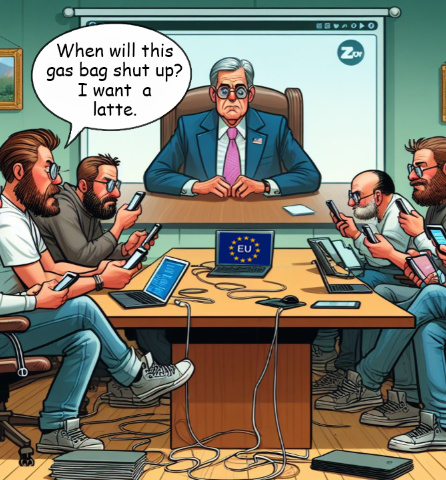
The Big Dogs of technology participate in a Microsoft Teams’s session with and EU official. The Big Dogs seem to be more interested in their mobile phones than the political word salad from the august official. Thanks, MSFT Copilot. Keep following your security recipe.
Consider this statement:
Right from the start, it was obvious that the tech giants were going to war against the [European Digital Markets Act or] DMA, and the freedom it promised to their users.
But isn’t that what companies in a free market do?
Here’s another gem:
Apple charges app vendors a whopping 30 percent commission on most transactions, both the initial price of the app and everything you buy from it thereafter. This is a remarkably high transaction fee —compare it to the credit-card sector, itself the subject of sharp criticism for its high 3-5 percent fees. To maintain those high commissions, Apple also restricts its vendors from informing their customers about the existence of other ways of paying (say, via their website) and at various times has also banned its vendors from offering discounts to customers who complete their purchases without using the app.
What’s the markup for blue chip consulting firms or top end lawyers? Plus, Apple is serving its shareholders. As a public company, that is what shareholders have a right to expect. Once again, the underlying issue is how capitalism works in the US market.
And this statement:
These are high-stakes clashes. As the tech sector grew more concentrated, it also grew less accountable, able to substitute lock-in and regulatory capture for making good products and having their users’ backs. Tech has found new ways to compromise our privacy rights, our labor rights, and our consumer rights – at scale.
Once again the problem is capitalism. The companies have to generate growth, revenue, and profits. Can a government agency manage the day-to-day operations of these technology-centric firms? Governments struggle to maintain roads and keep their Web sites updated. The solution may have been a bit more interest 25 years ago. In my opinion, the “better late than never” approach is not going to work unless governments put these outfits out of business… one way or another.
Net net: The write up is not about Big Dog tech companies ignoring the DMA. The write up wants the basic function of publicly-traded companies to change. Go to a zoo. Find a jungle cat. Tell it to change its stripes. How is that going to work out?
Stephen E Arnold, May 23, 2024
Googzilla Makes a Move in a High Stakes Contest
May 22, 2024
 This essay is the work of a dinobaby. Unlike some folks, no smart software improved my native ineptness.
The trusted “real news” outfit Thomson Reuters published this popular news story about dancing with Googzilla. The article is titled by the click seekers as “Google Cuts Mystery Check to US in Bid to Sidestep Jury Trial.” I love the “mystery check.” I thought FinCEN was on the look out for certain types of transactions.

The contest is afoot. Thanks, MSFT Copilot.
Here’s the core of the story: On one side of the multi-dimensional Go board is the US Department of Justice. Yes, that was the department with the statues in the area where employees once were paid each week. On the other side of the game board is Googzilla. This is the digital construct which personifies the Alphabet, Google, YouTube, DeepMind, et al outfit. Some in Google’s senior management are avid game players. After all, one must set up a system in which no matter who plays a Googzilla-branded game, the “just average wizards” who run the company wins. The mindset has worked wonders in the online advertising and SEO sector. The SEO “experts” were the people who made a case to their clients for the truism “If you want traffic, it is a pay-to-play operation.” The same may be said for YouTube and content creators who make content so Google can monetize that digital flow and pay a sometimes unknown amount to a creator who is a one-person 1930s motion picture production company. Ditto for the advertisers who use the Google system to buy advertising and benefit by providing advertising space. What’s Google do? It makes the software that controls the game.
Where’s this going? Google is playing a game with the Department of Justice. I am certain some in the DoJ understand this approach. Others may not grasp the concept of Googzilla’s absolute addiction to gaming and gamesmanship. Casinos are supposed to make money. There are exceptions, of course. I can think of a high-profile case history of casino failure, but Google is a reasonably competent casino operator. Sure, there are some technical problems when the Cloud back end fails and the staff become a news event because they protest with correctly spelled signage. But overall, I would suggest that the depth of Googzilla’s game playing is not appreciated by its users, its competition, or some of the governments trying to regain data and control of information pumped into the creatures financial blood bank.
Let’s look at the information the trusted outfit sought to share as bait for a begging-for-dollars marketing play:
Google has preemptively paid damages to the U.S. government, an unusual move aimed at avoiding a jury trial in the Justice Department’s antitrust lawsuit over its digital advertising business. Google disclosed the payment, but not the amount, in a court filing last week that said the case should be heard and decided by a judge directly. Without a monetary damages claim, Google argued, the government has no right to a jury trial.
That’s the move. The DoJ now has to [a] ignore the payment and move forward to a trial with a jury deciding if Googzilla is a “real” monopoly or a plain vanilla, everyday business like the ones Amazon, Facebook, and Microsoft have helped go out of business. [b] Cash the check and go back to scanning US government job listings for a positive lateral arabesque on a quest to the SES (senior executive service). [c] Keep the check and pile on more legal pressure because the money was an inducement, not a replacement for the US justice system. With an election coming up, I can see option [d] on the horizon: Do nothing.
The idea is that in multi-dimensional Go, Google wants to eliminate the noise of legal disputes. Google wins if the government cashes the check. Google wins if the on-rushing election causes a slow down of an already slow process. Google wins if the DoJ keeps piling on the pressure. Google has the money and lawyers to litigate. The government has a long memory but that staff and leadership turnover shifts the odds to Googzilla. Google Calendar keeps its attorneys filing before deadlines and exploiting the US legal system to its fullest extent. If the US government sues Google because the check was a bribe, Google wins. The legal matter shifts to resolving the question about the bribe because carts rarely are put in front of horses.
In this Googzilla-influenced games, Googzilla has created options and set the stage to apply the same tactic to other legal battles. The EU may pass a law prohibiting pre-payment in lieu of a legal process, but if that does not move along at the pace of AI hyperbole, Google’s DoJ game plan can be applied to the lucky officials in Brussels and Strasbourg.
The Reuters’ report says:
Stanford Law School’s Mark Lemley told Reuters he was skeptical Google’s gambit would prevail. He said a jury could ultimately decide higher damages than whatever Google put forward.
“Antitrust cases regularly go to juries. I think it is a sign that Google is worried about what a jury will do,” Lemley said. Another legal scholar, Herbert Hovenkamp of the University of Pennsylvania’s law school, called Google’s move "smart" in a post on X. “Juries are bad at deciding technical cases, and further they do not have the authority to order a breakup,” he wrote.
Okay, two different opinions. The Google check is proactive.
Why? Here are some reasons my research group offered this morning:
- Google has other things to do with its legal resources; namely, deal with the copyright litigation which is knocking on its door
- The competitive environment is troubling so Googzilla wants to delete annoyances like the DoJ and staff who don’t meet the new profile of the ideal Googler any longer
- Google wants to set a precedent so it can implement its pay-to-play game plan for legal hassles.
I am 99 percent confident that Google is playing a game. I am not sure that others perceive the monopoly litigation as one. Googzilla has been refining its game plan, its game-playing skills, and its gaming business systems for 25 years. How long has the current crop of DoJ experts been playing Googley games? I am not going to bet against Googzilla. Remember what happened in the 2021 film Godzilla vs. Kong. Both beasties make peace and go their separate ways. If that happens, Googzilla wins.
Stephen E Arnold, May 22, 2024
A Cultural Black Hole: Lost Data
May 22, 2024
 This essay is the work of a dinobaby. Unlike some folks, no smart software improved my native ineptness.
A team in Egypt discovered something mysterious near the pyramids. I assume National Geographic will dispatch photographers. Archeologists will probe. Artifacts will be discovered. How much more is buried under the surface of Giza? People have been digging for centuries, and their efforts are rewarded. But what about the artifacts of the digital age?
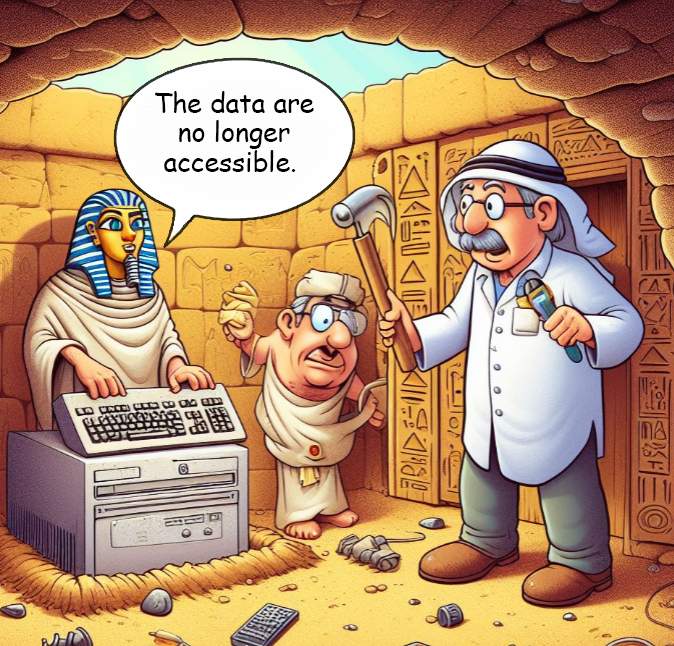
Upon opening the secret chamber, the digital construct explains to the archeologist from the future that there is a little problem getting the digital information. Thanks, MSFT Copilot.
My answer is, “Yeah, good luck.” The ephemeral quality of online information means that finding something buried near the pyramid of Djoser is going to be more rewarding than looking for the once findable information about MIC, RAC, and ZPIC on a US government Web site. The same void exists for quite a bit of human output captured in now-disappeared systems like The Point (Top 5% of the Internet) and millions of other digital constructs.
A survey report conducted by the Pew Research Center highlights link rot. The idea is simple. Click on a link and the indexed or pointed to content cannot be found. “When Online Content Disappears” has a snappy subtitle:
38 percent of Web pages that existed in 2013 are no longer accessible a decade later.
Wait, are national libraries like the Library of Congress supposed to keep “information.” What about the National Archives? What about the Internet Archive (an outfit busy in court)? What about the Google? (That’s the “all” the world’s information, right?) What about Bibliothèque nationale de France with its rich tradition of keeping French information?
News flash. Unlike the fungible objects unearthed in Egypt, data archeologists are going to have to buy old hard drives on eBay, dig through rubbish piles in “recycling” facilities, or scour yard sales for old machines. Then one has to figure out how to get the data. Presumably smart software can filter through the bits looking for useful data. My suggestion? Don’t count on this happening?
Here are several highlights from the Pew Report:
- Some 38% of webpages that existed in 2013 are not available today, compared with 8% of pages that existed in 2023.
- Nearly one-in-five tweets are no longer publicly visible on the site just months after being posted.
- 21% of all the government webpages we examined contained at least one broken link… Across every level of government we looked at, there were broken links on at least 14% of pages; city government pages had the highest rates of broken links.
The report presents a picture of lost data. Trying to locate these missing data will be less fruitful than digging in the sands of Egypt.
The word “rot” is associated with decay. The concept of “link rot” complements the business practices of government agencies and organizations once gathering, preserving, and organizing data. Are libraries at fault? Are regulators the problem? Are the content creators the culprits?
Sure, but the issue is that as the euphoria and reality of digital information slosh like water in a swimming pool during an earthquake, no one knows what to do. Therefore, nothing is done until knee jerk reflexes cause something to take place. In the end, no comprehensive collection plan is in place for the type of information examined by the Pew folks.
From my vantage point, online and digital information are significant features of life today. Like goldfish in a bowl, we are not able to capture the outputs of the digital age. We don’t understand the datasphere, my term for the environment in which much activity exists.
The report does not address the question, “So what?”
That’s part of the reason future data archeologists will struggle. The rush of zeros and ones has undermined information itself. If ignorance of these data create bliss, one might say, “Hello, Happy.”
Stephen E Arnold, May 22, 2023
TikTok Rings the Alarm for Yelp
May 22, 2024
 This essay is the work of a dinobaby. Unlike some folks, no smart software improved my native ineptness.
Social media influencers have been making and breaking restaurants since MySpace was still a thing. GrubStreet, another bastion for foodies and restaurant owners, reported that TikTok now controls the Internet food scene over Yelp: “How TikTok Took Over The Menu.” TikTok, Instagram, and YouTube are how young diners are deciding where to eat. These are essential restaurant discovery tools. Aware of the power of these social media platforms, restaurants are adapting their venues to attract popular influencer food critics. These influencers replace the traditional newspaper food critic and become ad hoc publicists for the restaurants. They’re lured to venues with free food or even a hefty cash payment.
The new restaurant critic business created SOP for ideas business practices, and ingredients to appeal to the social media algorithms. Many influencers ask the businesses “collab” in exchange for a free meal. Established influencers with huge followings not only want a free lunch but also demand paychecks. There are entire companies established on connecting restaurants and other business with social media influencers. The services have an a la carte pricing menu.
Another problem from the new type of food critics are the LED lights required to shoot the food. LED lights are the equivalent of camera flashes and can disturb other diners. Many restaurants welcome filming with the lights while other places ban them. (Filming is still allowed though.)
Huge tactics to lure influencers is creating scarcity and create an experience with table side actions. Another important tactic is almost sinful:
“Above all, the goal is excess; the most unforgivable social-media sin for any restaurant is to project an image of austerity…The chef Eyal Shani knows how to generate this particular energy. His HaSalon restaurants serve 12-foot-long noodles and encourage diners to dance on their tables, waving white napkins over their heads while disco blares from speakers. “Thirty years ago, it was about the content” of a dish or an idea, says Shani, who runs 40 restaurants around the world and has seen trends ebb and flow over the decades. ‘People tried to understand the structure of your creation.’ Today, it’s much more visual: ‘It’s very flat — it’s not about going into depth.’”
If restaurants focus more on shallowness and showmanship, then quality is going to tank. It’s going to go the way of the American attention span. TikTok ruins another thing.
Whitney Grace, May 22, 2023
Google Dings MSFT: Marketing Motivated by Opportunism
May 21, 2024
 This essay is the work of a dinobaby. Unlike some folks, no smart software improved my native ineptness.
While not as exciting as Jake Paul versus Mike Tyson, but the dust up is interesting. The developments leading up to this report about Google criticizing Microsoft’s security methods have a bit of history:
- Microsoft embraced OpenAI, Mistral, and other smart software because regulators are in meetings about regulating
- Google learned that after tire kicking, Apple found OpenAI (Microsoft’s pal) more suitable to the now innovation challenged iPhone. Google became a wallflower, a cute one, but a wallflower nevertheless
- Google faces trouble on three fronts: [a] Its own management of technology and its human resources; [b] threats to its online advertising and brokering business; and [c] challenges in cost control. (Employees get fired, and CFOs leave for a reason.)
Google is not a marketing outfit nor is it one that automatically evokes images associated with trust, data privacy, and people sensitivity. Google seized an opportunity to improve Web search. When forced to monetize, the company found inspiration in the online advertising “pay to play” ideas of Yahoo (Overture and GoTo). There was a legal dust up and Google paid up for that Eureka! moment. Then Google rode the demand for matching ads to queries. After 25 years, Google remains dependent on its semi-automated ad business. Now that business must be supplemented with enterprise cloud revenue.

Two white collar victims of legal witch hunts discuss “trust”. Good enough, MSFT Copilot.
How does the company market while the Red Alert klaxon blares into the cubicles, Google Meet sessions, and the Foosball game areas.?
The information in “Google Attacks Microsoft Cyber Failures in Effort to Steal Customers.” I wonder if Foundem and the French taxation authority might find the Google bandying about the word “steal”? I don’t know the answer to this question. The title indicates that Microsoft’s security woes, recently publicized by the US government, provide a marketing opportunity.
The article reports Google’s grand idea this way:
Government agencies that switch 500 or more users to Google Workspace Enterprise Plus for three years will get one year free and be eligible for a “significant discount” for the rest of the contract, said Andy Wen, the senior director of product management for Workspace. The Alphabet Inc. division is offering 18 months free to corporate customers that sign a three-year contract, a hefty discount after that and incident response services from Google’s Mandiant security business. All customers will receive free consulting services to help them make the switch.
The idea that Google is marketing is an interesting one. Like Telegram, Google has not been a long-time advocate of Madison Avenue advertising, marketing, and salesmanship. I was once retained by a US government agency to make a phone call to one of my “interaction points” at Google so that the director of the agency could ask a question about the quite pricey row of yellow Google Search Appliances. I made the call and obtained the required information. I also got paid. That’s some marketing in my opinion. An old person from rural Kentucky intermediating between a senior government official and a manager in one of Google’s mind boggling puzzle palace.
I want to point out that Google’s assertions about security may be overstated. One recent example is the Register’s report “Google Cloud Shows It Can Break Things for Lots of Customers – Not Just One at a Time.” Is this a security issue? My hunch is that whenever something breaks, security becomes an issue. Why? Rushed fixes may introduce additional vulnerabilities on top of the “good enough” engineering approach implemented by many high-flying, boastful, high-technology outfits. The Register says:
In the week after its astounding deletion of Australian pension fund UniSuper’s entire account, you might think Google Cloud would be on its very best behavior. Nope.
So what? When one operates at Google scale, the “what” is little more than users of 33 Google Cloud services were needful of some of that YouTube TV Zen moment stuff.
My reaction is that these giant outfits which are making clear that single points of failure are the norm in today’s online environment may not do the “fail over” or “graceful recovery” processes with the elegance of Mikhail Baryshnikov’s tuning point solo move. Google is obviously still struggling with the after effects of Microsoft’s OpenAI announcement and the flops like the Sundar & Prabhakar Comedy Show in Paris and the “smart software” producing images orthogonal to historical fact.
Online advertising expertise may not correlate with marketing finesse.
Stephen E Arnold, May 21, 2024
E2EE: Not Good Enough. So What Is Next?
May 21, 2024
 This essay is the work of a dinobaby. Unlike some folks, no smart software improved my native ineptness.
What’s wrong with software? “
I think one !*#$ thing about the state of technology in the world today is that for so many people, their job, and therefore the thing keeping a roof over their family’s head, depends on adding features, which then incentives people to, well, add features. Not to make and maintain a good app.

Who has access to the encrypted messages? Someone. That’s why this young person is distraught as she is escorted to the police van. Thanks, MSFT Copilot. Good enough.
This statement appears in “A Rant about Phone Messaging Apps UI.” But there are some more interesting issues in messaging; specifically, E2EE or end to end encrypted messaging. The current example of talking about the wrong topic in a quite important application space is summarized in Business Insider, an estimable online publication with snappy headlines like this one: “”In the Battle of Telegram vs Signal, Elon Musk Casts Doubt on the Security of the App He Once Championed.” That write up reports as “real” news:
Signal has also made its cryptography open-source. It is widely regarded as a remarkably secure way to communicate, trusted by Jeff Bezos and Amazon executives to conduct business privately.
I want to point out that Edward Snowden “endorses” Signal. He does not use Telegram. Does he know something that others may not have tucked into their memory stack?
The Business Insider “real” news report includes this quote from a Big Dog at Signal:
“We use cryptography to keep data out of the hands of everyone but those it’s meant for (this includes protecting it from us),” Whittaker wrote. “The Signal Protocol is the gold standard in the industry for a reason–it’s been hammered and attacked for over a decade, and it continues to stand the test of time.”
Pavel Durov, the owner of Telegram, and the brother of the person like two Ph.D.’s (his brother Nikolai), suggests that Signal is insecure. Keep in mind that Mr. Durov has been the subject of some scrutiny because after telling the estimable Tucker Carlson that Telegram is about free speech. Why? Telegram blocked Ukraine’s government from using a Telegram feature to beam pro-Ukraine information into Russia. That’s a sure-fire way to make clear what country catches Mr. Durov’s attention. He did this, according to rumors reaching me from a source with links to the Ukraine, because Apple or maybe Google made him do it. Blaming the alleged US high-tech oligopolies is a good red herring and a sinky one at that.
What Telegram got to do with the complaint about “features”? In my view, Telegram has been adding features at a pace that is more rapid than Signal, WhatsApp, and a boatload of competitors. have those features created some vulnerabilities in the Telegram set up? In fact, I am not sure Telegram is a messaging platform. I also think that the company may be poised to do an end run around open sourcing its home-grown encryption method.
What does this mean? Here are a few observations:
- With governments working overtime to gain access to encrypted messages, Telegram may have to add some beef.
- Established firms and start ups are nosing into obfuscation methods that push beyond today’s encryption methods.
- Information about who is behind an E2EE messaging service is tough to obtain? What is easy to document with a Web search may be one of those “fake” or misinformation plays.
Net net: E2EE is getting long in the tooth. Something new is needed. If you want to get a glimpse of the future, catch my lecture about E2EE at the upcoming US government Cycon 2024 event in September. Want a preview? We have a briefing. Write benkent2020 at yahoo dot com for restrictions and prices.
Stephen E Arnold, May 21, 2024
Dexa: A New Podcast Search Engine
May 21, 2024
 This essay is the work of a dinobaby. Unlike some folks, no smart software improved my native ineptness.
Google, Bing, and DuckDuckGo (a small percentage) dominate US search. Spotify, Apple Podcasts, and other platforms host and aggregate podcast shows. The problem is neither the twain shall meet when people are searching for video or audio content. Riley Tomasek was inspired by the problem and developed the Deva app:
“Dexa is an innovative brand that brings the power of AI to your favorite podcasts. With Dexa’s AI-powered podcast assistants, you can now explore, search, and ask questions related to the knowledge shared by trusted creators. Whether you’re curious about sleep supplements, programming languages, growing an audience, or achieving financial freedom, Dexa has you covered. Dexa unlocks the wisdom of experts like Andrew Huberman, Lex Fridman, Rhonda Patrick, Shane Parrish, and many more.
With Dexa, you can explore the world of podcasts and tap into the knowledge of trusted creators in a whole new way.”
Alex Huberman of Huberman Labs picked up the app and helped it go viral.
From there the Deva team built an intuitive, complex AI-powered search engine that indexes, analyzes, and transcribes podcasts. Since Deva launched nine months ago it has 50,000 users, answered almost one million, and partnered with famous podcasters. A recent update included a chat-based interface, more search and discover options, and ability watch referenced clips in a conversation.
Deva has raised $6 million in seed money and an exclusive partnership with Huberman Lab.
Deva is still a work in progress but it responds like ChatGPT but with a focus of conveying information and searching for content. It’s an intuitive platform that cites its sources directly in the search. It’s probably an interface that will be adopted by other search engines in the future.
Whitney Grace, May 21, 2024
AI and Work: Just the Ticket for Monday Morning
May 20, 2024
 This essay is the work of a dinobaby. Unlike some folks, no smart software improved my native ineptness.
Well, here’s a cheerful essay for the average worker in a knowledge industry. “If Your Work’s Average, You’re Screwed It’s Over for You” is the ideal essay to kick off a new work week. The source of the publication is Digital Camera World. I thought traditional and digital cameras were yesterday’s news. Therefore, I surmise the author of the write up misses the good old days of Kodak film, chemicals, and really expensive retouching.

How many US government professionals will find themselves victims of good enough AI? Answer: More than than the professional photographers? Thanks, MSFT Copilot. Good enough, a standard your security systems seem to struggle to achieve.
What’s the camera-focuses (yeah, lame pun) essay report. Consider this passage:
there’s one thing that only humans can do…
Okay, one thing. I give up. What’s that? Create other humans? Write poetry? Take fentanyl and lose the ability to stand up for hours? Captain a boat near orcas who will do what they can to sink the vessel? Oh, well. What’s that one thing?
"But I think the thing that AI is going to have an impossible job of achieving is that last 1% that stands between everything [else] and what’s great. I think that that last 1%, only a human can impart that.
AI does the mediocre. Humans, I think, do the exceptional. The logic seems to point to someone in the top tier of humans will have a job. Everyone else will be standing on line to get basic income checks, pursuing crime, or reading books. Strike that. Scrolling social media. No doom required. Those not in the elite will know doom first hand.
Here’s another passage to bring some zip to a Monday morning:
What it’s [smart software] going to do is, if your work’s average, you’re screwed. It’s [having a job] over for you. Be great, because AI is going to have a really hard time being great itself.
Observations? Just that cost cutting may be Job One.
Stephen E Arnold, May 20, 2024
Hoot Hoot Hoot: A Xoogler Pushes the Help Button
May 20, 2024
 This essay is the work of a dinobaby. Unlike some folks, no smart software improved my native ineptness.
The Daily Express US (?) published a remarkable story: “Former Google VP Issues Horror AI Warning As Technology Set to Leave Millions Jobless.” That’s a catchy assertion. Who is the Xoogler (that’s a former Googler for those who don’t know) that is mashing the Redder Alert siren? It is Geoffrey Hinton, who is a Big Wheel in the Land of AI.

Like a teacher with an out-of-control class, help is needed. Unfortunately pressing the big red button is performative. It is too late to get the class under control. Does AI behave like these kids? Thanks, MSFT Copilot. Good enough.
He believes that some entity has to provide a universal basic income to those people who are unable to find work because AI ate their jobs. The acronym UBI in the vernacular of a dinobaby means welfare. But those younger than I will interpret the UBI idea as something that “they” must provide.
The write up quotes the computer and AI wizard as opining:
"If you pay everybody a universal basic income, that solves the problem of them starving and not being able to pay the rent but that doesn’t solve the self-respect problem."
I like the reference to self-respect. I have not encountered too many examples in the last day or so. I have choked off the flood of “information” about the assorted trials of a former elected official, the hooligan trashing of Macy stores, and the arrest and un-arrest of a certain celebrity golfer. That’s enough of the self-respect thing for me.
The write up continues:
He added: "I am very worried about AI taking over lots of mundane jobs. That should be a good thing. It’s going to lead to a big increase in productivity, which leads to a big increase in wealth, and if that wealth was equally distributed that would be great, but it’s not going to be. "In the systems we live in, that wealth is going to go to the rich and not to the people whose jobs get lost, and that’s going to be very bad for society, I believe. It’s going to increase the gap between rich and poor, which increases the chances of right-wing populists getting elected."
Okay, that’s an interesting moment of insight from one of the people who assisted in the creation of this sprint to societal change.
I find it interesting that technology marches forward in a way that prevents smart people from peering down the road from a vantage point defined by their computer monitor and lab partners. The bird’s-eye view of a technology like AI is of interest only when the individual steps away from a Google-type outfit.
AI can hallucinate. I think it is clear that the wizards “inventing” smart software also hallucinate within their digital constructs.
What happens when the hallucinogenic wears off? For Dr. Hinton it is time to call for help. I assume the UBI help will arrive from “the government.” Will “the government” listen, get organized, and take action. Dr. Hinton, like some smart software, might be experiencing what some of his AI colleagues call hallucinating. Am I surprised? Nope. Wizards are quirky.
Stephen E Arnold, May 20, 2024
Germany Has Had It with Some Microsoft Products
May 20, 2024
 This essay is the work of a dinobaby. Unlike some folks, no smart software improved my native ineptness.
Can Schleswig-Holstein succeed where Munich and Lower Saxony failed? Those two German states tried switching their official IT systems from Microsoft to open source software but were forced to reverse course. Emboldened by Microsoft’s shove to adopt Windows 11 and Office 365, informed by its neighbors’ defeats, and armed with three years of planning, Germany’s northernmost state is forging ahead. The Register frames the initiative as an epic battle in, “Open Source Versus Microsoft: The New Rebellion Begins.”
With cries of “Digital Sovereignty,” Schleswig-Holstein shakes its fist at its corporate overlord. Beginning with the aptly named LibreOffice suite, these IT warriors plan to replace Microsoft products top to bottom with open source alternatives. Writer Rupert Goodwins notes open source software has improved since Munich and Lower Saxony were forced to retreat, but will that be enough? He considers:
“Microsoft has a lot of cards to play here. Schleswig-Holstein will have to maintain compatibility with Windows within its own borders, with the German federation, with Europe, and the rest of the world. If a change to Windows happens to break that compatibility, guess who picks up the pain and the bills. Microsoft wouldn’t dream of doing that deliberately, no matter how high the stakes, yet these things happen. Freedom to innovate, don’t you know. If in five years the transition is a success, the benefits to the state, the people, and open source will be immeasurable. As well as bringing data protection back to those charged with providing it, it will give European laws new teeth. It will increase expertise, funding, and opportunities for open source. Schleswig-Holstein itself will become a new hub of technical excellence in an area that intensely interests the rest of the world, in public and private organizations. Microsoft cannot afford to let this happen. Schleswig-Holstein cannot back down, now it’s made it a battle for independence.”
See the write-up for more warfare language as well as Goodwins’ likening of user agreements to the classic suzerain-vassal relationship. Will Schleswig-Holstein emerge victorious, or will mighty Microsoft prevail? Governments depend on Microsoft. The US is now putting pressure on the Softies to do something more than making Windows 11 more annoying and creating a Six Flags Over Cyber Crime with their security methods. Will anything change? Nah.
Cynthia Murrell, May 22, 2024
-

- Subscribe to Beyond Search
Feature archive
News archive

-


