

AI Innovation: Writing Checks Is the Google Solution
January 30, 2025
 A blog post from an authentic dinobaby. He’s old; he’s in the sticks; and he is deeply skeptical.
Wow. First, Jeff Dean gets the lateral arabesque. Then the Google shifts its smart software to the “I am a star” outfit Deep Mind in the UK. Now, the cuddly Google has, according to Analytics India, pulled a fast one on the wizards laboring at spelling advertising another surprise. “Google Invests $1 Bn in Anthropic” reports:
This new investment is separate from the company’s earlier reported funding round of nearly $2 billion earlier this month, led by Lightspeed Venture Partners, to bump the company’s valuation to about $60 billion. In 2023, Google had invested $300 million in Anthropic, acquiring a 10% stake in the company. In November last, Amazon led Anthropic’s $4 billion fundraising effort, raising its overall funding to $8 billion for the company.
I thought Google was quantumly supreme. I thought Google reinvented protein stuff. I thought Google could do podcasts and fix up a person’s Gmail. I obviously was wildly off the mark. Perhaps Google’s “leadership” has taken time from writing scripts for the Sundar & Prabhakar Comedy Tour and had an epiphany. Did the sketch go like this:
Prabhakar: Did you see the slide deck for my last talk about artificial intelligence?
Sundar: Yes, I thought it was so so. Your final slide was a hoot. Did you think it up?
Prabhakar: No, I think little. I asked Anthropic Claude for a snappy joke. It worked.
Sundar: Did Jeff Dean help? Did Dennis Hassabis contribute?
Prabhakar: No, just Claude Sonnet. He likes me, Sundar.
Sundar: The secret of life is honesty, fair dealing, and Code Yellow!
Prabhakar: I think Google intelligence may be a contradiction in terms. May I requisition another billion for Anthropic?
Sundar: Yes, we need to care about posterity. Otherwise, our posterity will be defined by a YouTube ad.
Prabhakar: We don’t want to take it in the posterity, do we?
Sundar: Well….
Anthropic allegedly will release a “virtual collaborator.” Google wants that, right Jeff and Dennis? Are there anti-trust concerns? Are there potential conflicts of interest? Are there fears about revenues?
Of course not.
Will someone turn off those darned flashing red and yellow lights! Innovation is tough with the sirens, the lights, the quantumly supremeness of Googleness.
Stephen E Arnold, January 30, 2025
Ah, the Warmth of the Old, Friendly Internet. For Real?
January 30, 2025
I never thought I’d be looking back at the Internet of yesteryear nostalgically. I hated the sound of dial-up and the instant messaging sounds were annoying. Also AOL had the knack of clogging up machines with browsing history making everything slow. Did I mention YouTube wasn’t around? There are somethings that were better in the past, including parts of the Internet, but not all of it.
We also like to think that the Internet was “safer” and didn’t have predatory content. Wrong! Since the Internet’s inception, parents were worried about their children being the victims of online predators. Back then it was easier to remain anonymous, however. El País agrees that the Internet was just as bad as it is today: “‘The internet Hasn’t Made Us Bad, We Were Already Like That’: The Mistake Of Yearning For The ‘Friendly’ Online World Of 20 Years Ago."
It’s strange to see artists using Y2K era technology as art pieces and throwbacks. It’s a big eye-opener to aging Millennials, but it also places these items on par with the nostalgia of all past eras. All generations love the stuff from their youth and proclaim it to be superior. As the current youth culture and even those middle-aged are obsessed with retro gear, a new slang term has arisen: “cozy tech.”
“‘Cozy tech’ is the label that groups together content about users sipping from a steaming cup, browsing leisurely or playing nice, simple video games on devices with smooth, ergonomic designs. It’s a more powerful image than it seems because it conveys something we lost at some point in the last decade: a sense of control; the idea that it is possible to enjoy technology in peace again.”
They’re conflating the idea with reading a good book or listening to music on a record player. These “cozy tech” people are forgetting about the dangers of chatrooms or posting too much information on the Internet. Dare we bring up Omegle without drifting down channels of pornography?
Check out this statement:
“Mayte Gómez concludes: “We must stop this reactionary thinking and this fear of technology that arises from the idea that the internet has made us bad. That is not true: we were already like that. If the internet is unfriendly it is because we are becoming less so. We cannot perpetuate the idea that machines are entities with a will of their own; we must take responsibility for what happens on the internet.”
Sorry, Mayte, I disagree. Humans have always been unfriendly. We now have a better record of it.
Whitney Grace, January 30, 2025
The Joust of the Month: Microsoft Versus Salesforce
January 29, 2025
These folks don’t seem to see eye to eye: Windows Central tells us, “Microsoft Claps Back at Salesforce—Claims ‘100,000 Organizations’ Had Used Copilot Studio to Create AI Agents by October 2024.” Microsoft’s assertion is in response to jabs from Salesforce CEO Marc Benioff, who declares, “Microsoft has disappointed everybody with how they’ve approached this AI world.” To support this allegation, Benioff points to lines from a recent MarketWatch post. A post which, coincidentally, also lauds his company’s success with AI agents. The smug CEO also insists he is receiving complaints about his giant competitor’s AI tools. Writer Kevin Okemwa elaborates:
“Benioff has shared interesting consumer feedback about Copilot’s user experience, claiming customers aren’t finding themselves transformed while leveraging the tool’s capabilities. He added that customers barely use the tool, ‘and that’s when they don’t have a ChatGPT license or something like that in front of them.’ Last year, Salesforce’s CEO claimed Microsoft’s AI efforts are a ‘tremendous disservice’ to the industry while referring to Copilot as the new Microsoft Clippy because it reportedly doesn’t work or deliver value. As the AI agent race becomes more fierce, Microsoft has seemingly positioned itself in a unique position to compete on a level playing field with key players like Salesforce Agentforce, especially after launching autonomous agents and integrating them into Copilot Studio. Microsoft claims over 100,000 organizations had used Copilot Studio to create agents by October 2024. However, Benioff claimed Microsoft’s Copilot agents illustrated panic mode, majorly due to the stiff competition in the category.”
One notable example, writes Okemwa, is Zuckerberg’s vision of replacing Meta’s software engineers with AI agents. Oh, goodie. This anti-human stance may have inspired Benioff, who is second-guessing plans to hire live software engineers in 2025. At least Microsoft still appears to be interested in hiring people. For now. Will that antiquated attitude hold the firm back, supporting Benioff’s accusations?
Mount your steeds. Fight!
Cynthia Murrell, January 29, 2025
What Do DeepSeek, a Genius Girl, and Temu Have in Common? Quite a Lot
January 28, 2025
 A write up from a still-living dinobaby.
The Techmeme for January 28, 2024, was mostly Deepseek territory. The China-linked AI model has roiled the murky waters of the US smart software fishing hole. A big, juicy AI creature has been pulled from the lake, and it is drawing a crowd. Here’s a small portion of the datasphere thrashing on January 28, 2025 at 0700 am US Eastern time:
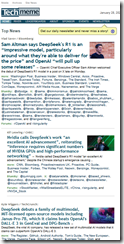
I have worked through a number of articles about this open source software. I noted its back story about a venture firm’s skunk works tackling AI. Armed with relatively primitive tools due to the US restriction of certain computer components, the small team figured out how to deliver results comparable to the benchmarks published about US smart software systems.

Genius girl uses basic and cheap tools to repair an old generator. Americans buy a new generator from Harbor Freight. Genius girl repairs old generator proving the benefits of a better way or a shining path. Image from the YouTube outfit which does work the American way.
The story is torn from the same playbook which produces YouTube “real life” stories like “The genius girl helps the boss to repair the diesel generator, full of power!” You can view the one-hour propaganda film at this link. Here’s a short synopsis, and I want you to note the theme of the presentation:
- Young-appearing female works outside
- She uses primitive tools
- She takes apart a complex machine
- She repairs it
- The machine is better than a new machine.
The videos are interesting. The message has not been deconstructed. My interpretation is:
- Hard working female tackles tough problem
- Using ingenuity and hard work she cracks the code
- The machine works
- Why buy a new one? Use what you have and overcome obstacles.
This is not the “Go west, young man” or private equity approach to cracking an important problem. It is political and cultural with a dash of Hoisin technical sauce. The video presents a message like that of “plum blossom boxing.” It looks interesting but packs a wallop.
Here’s a point that has not been getting much attention; specifically, the AI probe is designed to direct a flow of energy at the most delicate and vulnerable part of the US artificial intelligence “next big thing” pumped up technology “bro.”
What is that? The answer is cost. The method has been refined by Shein and Temu by poking at Amazon. Here’s how the “genius girl” uses ingenuity.
- Technical papers are published
- Open source software released
- Basic information about using what’s available released
- Cost information is released.
The result is that a Chinese AI app surges to the top of downloads on US mobile stores. This is a first. Not even the TikTok service achieved this standing so quickly. The US speculators dump AI stocks. Techmeme becomes the news service for Chinese innovation.
I see this as an effective tactic for demonstrating the value of the “genius girl” approach to solving problems. And where did Chinese government leadership watch the AI balloon lose some internal pressure. How about Colombia, a three-hour plane flight from the capital of Central and South America. (That’s Miami in the event my reference was too oblique.)
In business, cheaper and good enough are very potent advantages. The Deepseek AI play is indeed about a new twist to today’s best method of having software perform in a way that most call “smart.” But the Deepseek play is another “genius girl” play from the Middle Kingdom.
How can the US replicate the “genius girl” or the small venture firm which came up with a better idea? That’s going to be touch. While the genius girl was repairing the generator, the US AI sector was seeking more money to build giant data centers to hold thousands of exotic computing tools. Instead of repairing, the US smart software aficionados were planning on modular nuclear reactors to make the next-generation of smart software like the tail fins on a 1959 pink Cadillac.
Deepseek and the “genius girl” are not about technology. Deepseek is a manifestation of the Shein and Temu method: Fast cycle, cheap and good enough. The result is an arm flapping response from the American way of AI. Oh, does the genius girl phone home? Does she censor what she says and does?
Stephen E Arnold, January 28, 2025
Business Strategies That Will Deliver Something, Including Face Time with Legal Eagles
January 28, 2025
 A blog post written by a real and still-alive dinobaby. If there is art, there is AI in my workflow.
I read an interesting write up which has an implied forbidden word in its title. I have provided a link, but I made an editorial change to avoid getting into trouble with the oligarchs and their forbidden word punishment squad. The write up is called ““Stealth Mode” and Other … Brilliant Strategies.” Let’s take a look at the list and consider what the “brilliant strategies” mean for a person or entity needing cash, customers, repeat business, a BMW, and probably a yacht or four like Mr. Bezos has.
Here are the strategies, which I would label “tactics”, but dinobabies are persnickety:
- Stealth mode. I think means keep what you are doing a secret.
- Get “it” right. I added the quotes. I am not sure to what the “it” refers.
- Don’t ask anyone if he or she would pay for the product or services.
- Hey, don’t work too hard.
- Write the code first which translates to build the product, software, service, or whatever.
- Raise money before you have customers.
- Copy the competition.
- Sell to everyone.
At first glance, these “strategies” reflect the current business environment. Most of these would be warmly endorsed by the oligarchs who are now helping a new President make big-time decisions. If one assumes that the major technology companies and some of the promising start ups have been using these “brilliant strategies,” how have the knock on effects changed society. Here’s my comment on each of the eight items.
- Stealth mode. I think the idea is to pretend to be doing something in secret. The reality is that information has a tendency to escape. Keeping secrets is difficult. Just ask the major telcos or the victims of a pig butchering scheme. “Stealth mode” is a form of marketing and PR. “Real” journalists love to write about secrets.
- Get it right. Sorry that’s not part of the method today. I would remind you that updates to Microsoft Windows wreck havoc for some people. The security breaches which popular X.com’s OSINT posts are a grim reminder than excellence in software is another marketing precept. The way the world works is, “Ship it Thursday.”
- Don’t ask suggests that market research is not needed. I disagree. One needs input, particularly before creating a product or service. If no one will pay, the organization is dead or dying. Check out the supply of Dodge Hornets. Research may not translate to good decisions.
- Yeah, “don’t work too hard.” Wow. I grew up in a home populated by a father who worked two jobs and a mother who kept house and volunteered for decades at a hospital. The idea of “work” is important. I think that may be why at age 80, I chug along. Working hard has many benefits. These include self respect, money, and a way to remain productive. No, “work hard.” The scrolling life is very bad.
- Build first. Okay, but I think the first two steps are planning and talking to people. Sorry. I stick to the basics.
- Raise money before you have customers. This means that you need to have money. For the top one percenters in income, this may work. For most people, money is needed. Lots of money is needed because shoe string grand slams are infrequent events.
- Copy. Yep, the me-too culture. My view is that one should plan which includes research and analysis. Then figure out how to differentiate and deliver value. Copying Google will get a start up exactly nowhere. Copying content for an AI play will get you some face time with lawyers. Do the Leonardo thing: Be innovative.
- Sell to everyone. Successful people are able to sell their ideas, themselves, narcotics, whatever. The trick here is to talk to people. Those with a need will respond to a solution if it works.,
Let’s step back. Will the budding entrepreneur make a lot of money following these rules? The depressing answer is, “Yes, some carpet baggers will indeed strike it rich.” That’s something to keep in mind. I have some rules of thumb, and they are different from the eight set forth in the write up. Dinobabies are a pain, aren’t they?
Stephen E Arnold, January 28, 2025
Rethinking Newspapers: The Dinobaby View
January 27, 2025
 A blog post from an authentic dinobaby. He’s old; he’s in the sticks; and he is deeply skeptical.
I read “For Some Newspaper Workers, the New Year Began with Four Weeks of Unpaid Leave.” But the subtitle is the snappy statement:
The chain CNHI furloughed 46 staffers, or about 3% of its workforce. It’s likely a weather vane for industry trouble ahead.
The write up says, rather predictably, in my opinion:
the furloughs were precipitated by a very “soft fourth quarter,” usually the best of the year for newspapers, buoyed with ads for Christmas shopping.
No advertising and Amazon. A one-two punch.
The article concludes:
If you’re looking for a silver lining here, it may be that upstart investors continue to buy up newspapers as they come up for sale, still seeing a potential for profit in the business.
What a newspaper needs is a bit of innovation. Having worked at both newspaper publishing and a magazine publishing companies, I dipped into some of my old lectures about online. I floated these ideas at various times in company talks and in my public lectures, including the one I received from ASIS in the late 1980s. Here’s a selected list:
- People and companies pay for must-have information. Create must-have content in digital form and then sell access to that content.
- Newspapers are intelligence gathering outfits. Focus on intelligence and sell reports to outfits known to purchase these reports.
- Convert to a foundation and get in the grant and fund raising business.
- Online access won’t generate substantial revenue; therefore, use online to promote other information services.
- Each newspaper has a core competency. Convert that core competency into pay-to-attend conferences on specific subjects. Sell booth and exhibit space. Convert selling ads to selling a sponsored cocktail at the event.
- Move from advertising to digital coupons. These can be made available on a simple local-focus Web site. For people who want paper ads, sell a subscription to an envelope containing the coupons and possibly a small amount of information of interest to the area the newspaper serves.
Okay, how many of these ideas are in play today? Most of them, just not from newspaper outfits. That’s the problem. Innovation is tough to spark. Is it too late now? My research team has more ideas. Write benkent2020 at yahoo dot com.
Stephen E Arnold, January 27, 2024
How to Garner Attention from X.com: The Guardian Method Seems Infallible
January 24, 2025
 Prepared by a still-alive dinobaby.
The Guardian has revealed its secret to getting social media attention from Twitter (now the X). “‘Just the Start’: X’s New AI Software Driving Online Racist Abuse, Experts Warn” makes the process dead simple. Here are the steps:
- Publish a diatribe about the power of social media in general with specific references to the Twitter machine
- Use name calling to add some clickable bound phrases; for example, “online racism”, “fake images”, and “naked hate”
- Use loaded words to describe images; for example, an athlete “who is black, picking cotton while another shows that same player eating a banana surrounded by monkeys in a forest.”
Bingo. Instantly clickable.
The write up explains:
Callum Hood, the head of research at the Center for Countering Digital Hate (CCDH), said X had become a platform that incentivised and rewarded spreading hate through revenue sharing, and AI imagery made that even easier. “The thing that X has done, to a degree that no other mainstream platform has done, is to offer cash incentives to accounts to do this, so accounts on X are very deliberately posting the most naked hate and disinformation possible.”
This is a recipe for attention and clicks. Will the Guardian be able to convert the magnetism of the method in cash money?
Stephen E Arnold, January 24, 2025
And the Video Game Struggler for 2024 Is… Video Games
January 24, 2025
Yep, 2024 sas the worst year for videogames since 1983.
Videogames are still a young medium, but they’re over fifty years old. The gaming industry has seen ups and downs with the first (and still legendary) being the 1983 crash. Arcade games were all the rage back then, but these days consoles and computers have the action. At least, they should.
Wired writes that “2024 Was The Year The Bottom Fell Out Of The Games Industry” due to multiple reasons. There was massive layoffs in 2023 with over 10,000 game developers losing their jobs. Some of this was attributed to AI slowly replacing developers. The gaming industry’s job loss in 2024 was forty percent higher than the prior year. Yikes!
DEI (diversity, equity, and inclusion) combined with woke mantra was also blamed for the failue of many games, including Suicide Squad: Kill the Justice League. The phrase “go woke, go broke” echoed throughout the industry as it is in Hollywood, Silicon Valley, and other fields. I noted:
“According to Matthew Ball, an adviser and producer in the games and TV space…says that the blame for all of this can’t be pinned to a single thing, like capitalism, mismanagement, Covid-19, or even interest rates. It also involves development costs, how studios are staffed, consumers’ spending habits, and game pricing. “This storm is so brutal,” he says, ‘because it is all of these things at once, and none have really alleviated since the layoffs began.’”
Many indie studios were shuttered and large tech leaders such as Microsoft and Sony shut down parts of their gaming division. Also a chain of events influenced by the hatred of DEI and its associated mindsets that is being called a second GamerGate.
The gaming industry will continue through the beginnings of 2025 with business as usual. The industry will bounce back, but it will be different than the past.
Whitney Grace, January 24, 2025
Microsoft and Its Me-Too Interface for Bing Search
January 22, 2025
Bing will never be Google, but Microsoft wants its search engine to dominate queries. Microsoft Bing has a small percentage of Internet searches and in a bid to gain more traction it has copied Google’s user interface (UI). Windows Latest spills the tea over the UI copying: “Microsoft Bing Is Trying To Spoof Google UI When People Search Google.com.”
Google’s UI is very distinctive with its minimalist approach. The only item on the Google UI is the query box and menus along the top and bottom of the page. Microsoft Edge is Google’s Web browser and it is programed to use Bing. In a sneaky (and genius) move, when Edge users type Google into the bing search box they are taken to UI that is strangely Google-esque. Microsoft is trying this new UI to lower the Bing bounce rate, users who leave.
Is it an effective tactic?
“But you might wonder how effective this idea would be. Well, if you’re a tech-savvy person, you’ll probably realize what’s going on, then scroll and open Google from the link. However, this move could keep people on Bing if they just want to use a search engine.Google is the number one search engine, and there’s a large number of users who are just looking for a search engine, but they think the search engine is Google. In their mind, the two are the same. That’s because Google has become a synonym for search engines, just like Chrome is for browsers.A lot of users don’t really care what search engine they’re using, so Microsoft’s new practice, which might appear stupid to some of you, is likely very effective.”
For unobservant users and/or those who don’t care, it will work. Microsoft is also tugging on heartstrings with another tactic:
“On top of it, there’s also an interesting message underneath the Google-like search box that says “every search brings you closer to a free donation. Choose from over 2 million nonprofits.” This might also convince some people to keep using Bing.”
What a generous and genius tactic interface innovation. We’re not sure this is the interface everyone sees, but we love the me too approach from user-centric big tech outfits.
Whitney Grace, January 22, 2025
Sonus, What Is That Painful Sound I Hear?
January 21, 2025
Sonos CEO Swap: Are Tech Products Only As Good As Their Apps?
Lawyers and accountants leading tech firms, please, take note: The apps customers use to manage your products actually matter. Engadget reports, “Sonos CEO Patrick Spence Falls on his Sword After Horrible App Launch.” Reporter Lawrence Bonk writes:
“Sonos CEO Patrick Spence is stepping down from the company after eight years on the job, according to reporting by Bloomberg. This follows last year’s disastrous app launch, in which a redesign was missing core features and was broken in nearly every major way. The company has tasked Tom Conrad to steer the ship as interim CEO. Conrad is a current member of the Sonos board, but was a co-founder of Pandora, VP at Snap and product chief at, wait for it, the short-lived video streaming platform Quibi. He also reportedly has a Sonos tattoo. The board has hired a firm to find a new long-term leader.”
Conrad told employees that “we” let people down with the terrible app. And no wonder. Bonk explains:
“The decision to swap leadership comes after months of turmoil at the company. It rolled out a mobile app back in May that was absolutely rife with bugs and missing key features like alarms and sleep timers. Some customers even complained that entire speaker systems would no longer work after updating to the new app. It was a whole thing.”
Indeed. And despite efforts to rekindle customer trust, the company is paying the price of its blunder. Its stock price has fallen about 13 percent, revenue tanked 16 percent in the fiscal fourth quarter, and it has laid off more than 100 workers since August. Chief Product Officer Patrick Spence is also leaving the firm. Will the CEO swap help Sonos recover? As he takes the helm, Conrad vows a return to basics. At the same time, he wants to expand Sonos’ products. Interesting combination. Meanwhile, the search continues for a more permanent replacement.
Cynthia Murrell, January 21, 2025
-

- Subscribe to Beyond Search
Feature archive
News archive

-


