

A Discernment Challenge for Those Who Are Dull Normal
June 24, 2024
 This essay is the work of a dinobaby. Unlike some folks, no smart software improved my native ineptness.
Techradar, an online information service, published “Ahead of GPT-5 Launch, Another Test Shows That People Cannot Distinguish ChatGPT from a Human in a Conversation Test — Is It a Watershed Moment for AI?” The headline implies “change everything” rhetoric, but that is routine AI jargon-hype.
Once again, academics who are unable to land a job in a “real” smart software company studied the work of their former colleagues who make a lot more money than those teaching do. Well, what do academic researchers do when they are not sitting in the student union or the snack area in the lab whilst waiting for a graduate student to finish a task? In my experience, some think about their CVs or résumés. Others ponder the flaws in a commercial or allegedly commercial product or service.
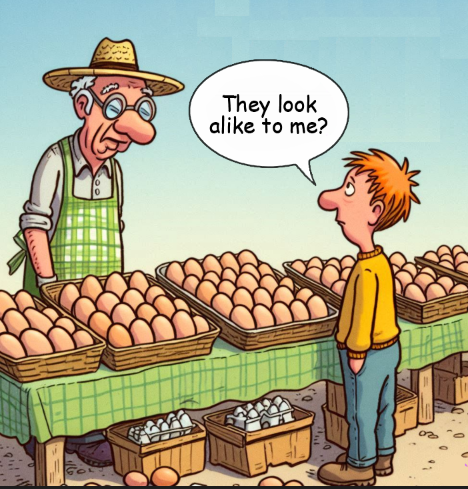
A young shopper explains that the outputs of egg laying chickens share a similarity. Insightful observation from a dumb carp. Thanks, MSFT Copilot. How’s that Recall project coming along?
The write up reports:
The Department of Cognitive Science at UC San Diego decided to see how modern AI systems fared and evaluated ELIZA (a simple rules-based chatbot from the 1960’s included as a baseline in the experiment), GPT-3.5, and GPT-4 in a controlled Turing Test. Participants had a five-minute conversation with either a human or an AI and then had to decide whether their conversation partner was human.
Here’s the research set up:
In the study, 500 participants were assigned to one of five groups. They engaged in a conversation with either a human or one of the three AI systems. The game interface resembled a typical messaging app. After five minutes, participants judged whether they believed their conversation partner was human or AI and provided reasons for their decisions.
And what did the intrepid academics find? Factoids that will get them a job at a Perplexity-type of company? Information that will put smart software into focus for the elected officials writing draft rules and laws to prevent AI from making The Terminator come true?
The results were interesting. GPT-4 was identified as human 54% of the time, ahead of GPT-3.5 (50%), with both significantly outperforming ELIZA (22%) but lagging behind actual humans (67%). Participants were no better than chance at identifying GPT-4 as AI, indicating that current AI systems can deceive people into believing they are human.
What does this mean for those labeled dull normal, a nifty term applied to some lucky people taking IQ tests. I wanted to be a dull normal, but I was able to score in the lowest possible quartile. I think it was called dumb carp. Yes!
Several observations to disrupt your clear thinking about smart software and research into how the hot dogs are made:
- The smart software seems to have stalled. Our tests of You.com which allows one to select which object models parrots information, it is tough to differentiate the outputs. Cut from the same transformer cloth maybe?
- Those judging, differentiating, and testing smart software outputs can discern differences if they are way above dull normal or my classification dumb carp. This means that indexing systems, people, and “new” models will be bamboozled into thinking what’s incorrect is a-okay. So much for the informed citizen.
- Will the next innovation in smart software revolutionize something? Yep, some lucky investors.
Net net: Confusion ahead for those like me: Dumb carp. Dull normals may be flummoxed. But those super-brainy folks have a chance to rule the world. Bust out the party hats and little horns.
Stephen E Arnold, June 24, 2024
Ad Hominem Attack: A Revived Rhetorical Form
June 24, 2024
 This essay is the work of a dinobaby. Unlike some folks, no smart software improved my native ineptness.
I remember my high school debate coach telling my partner Nick G. (I have forgotten the budding prosecutor’s name, sorry) you should not attack the character of our opponents. Nick G. had interacted with Bill W. on the basketball court in an end-of-year regional game. Nick G., as I recall got a bloody nose, and Bill W. was thrown out of the basketball game. When fisticuffs ensued, I thanked my lucky stars I was a hopeless athlete. Give me the library, a debate topic, a pile of notecards, and I was good to go. Nick G. included in his rebuttal statement comments about the character of Bill W. When the judge rendered a result and his comments, Nick G. was singled out as being wildly inappropriate. After the humiliating defeat, the coach explained that an ad hominem argument is not appropriate for 15-year-olds. Nick G.’s attitude was, “I told the truth.” As Nick G. learned, the truth is not what wins debate tournaments or life in some cases.
I thought about ad hominem arguments as I read “Silicon Valley’s False Prophet.” This essay reminded me of the essay by the same author titled “The Man Who Killed Google Search.” I must admit the rhetorical trope is repeatable. Furthermore it can be applied to an individual who may be clueless about how selling advertising nuked relevance (or what was left of it) at the Google and to the dealing making of a person whom I call Sam AI-Man. Who knows? Maybe other authors will emulate these two essays, and a new Silicon Valley genre may emerge ready for the real wordsmiths and pooh-bahs of Silicon Valley to crank out a hit piece every couple of days.
To the essay at hand: The false profit is the former partner of Elon Musk and the on-again-off-again-on-again Big Dog at OpenAI. That’s an outfit where “open” means closed, and closed means open to the likes of Apple. The main idea, I think, is that AI sucks and Sam AI-Man continues to beat the drum for a technology that is likely to be headed for a correction. In Silicon Valley speak, the bubble will burst. It is, I surmise, Mr. AI-man’s fault.
The essay explains:
Sam Altman, however, exists in a category of his own. There are many, many, many examples of him saying that OpenAI — or AI more broadly — will do something it can’t and likely won’t, and it being meekly accepted by the Fourth Estate without any real pushback. There are more still of him framing the limits of the present reality as a positive — like when, in a fireside sitdown with
1980s used car salesmanSalesforce CEO Marc Benioff, Altman proclaimed that AI hallucinations (when an LLM asserts something untrue as fact, because AI doesn’t know anything) are a feature, not a bug, and rather than being treated as some kind of fundamental limitation, should be regarded as a form of creative expression.
I understand. Salesperson. Quite a unicorn in Silicon Valley. I mean when I worked there I would encounter hyperbole artists every few minutes. Yeah, Silicon Valley. Anchored in reality, minimum viable products, and lots of hanky pinky.
The essay provides a bit of information about the background of Mr. AI-Man:
When you strip away his ability to convince people that he’s smart, Altman had actually done very little — he was a college dropout with a failing-then-failed startup, one where employees tried to get him fired twice.
If true, that takes some doing. Employees tried to get the false prophet fired twice. In olden times, burning at the stake might have been an option. Now it is just move on to another venture. Progress.
The essay does provide some insight into Sam AI-Man’s core competency:
Altman is adept at using connections to make new connections, in finding ways to make others owe him favors, in saying the right thing at the right time when he knew that nobody would think about it too hard. Altman was early on Stripe, and Reddit, and Airbnb — all seemingly-brilliant moments in the life of a man who had many things handed to him, who knew how to look and sound to get put in the room and to get the capital to make his next move. It’s easy to conflate investment returns with intellectual capital, even though the truth is that people liked Altman enough to give him the opportunity to be rich, and he took it.
I cannot figure out if the author envies Sam AI-Man, reviles him for being clever (a key attribute in some high-technology outfits), or genuinely perceives Mr. AI-Man as the first cousin to Beelzebub. Whatever the motivation, I find the phoenix-like rising of the ad hominem attack a refreshing change from the entitled pooh-bahism of some folks writing about technology.
The only problem: I think it is unlikely that the author will be hired by OpenAI. Chance blown.
Stephen E Arnold, June 24, 2024
Chasing a Folly: Identifying AI Content
June 24, 2024
As are other academic publishers, Springer Nature Group is plagued by fake papers. Now the company announces, “Springer Nature Unveils Two New AI Tools to Protect Research Integrity.” How effective the tools are remains to be proven, but at least the company is making an effort. The press release describes text-checker Geppetto and image-analysis tool SnappShot. We learn:
“Geppetto works by dividing the paper up into sections and uses its own algorithms to check the consistency of the text in each section. The sections are then given a score based on the probability that the text in them has been AI generated. The higher the score, the greater the probability of there being problems, initiating a human check by Springer Nature staff. Geppetto is already responsible for identifying hundreds of fake papers soon after submission, preventing them from being published – and from taking up editors’ and peer reviewers’ valuable time.
SnappShot, also developed in-house, is an AI-assisted image integrity analysis tool. Currently used to analyze PDF files containing gel and blot images and look for duplications in those image types – another known integrity problem within the industry – this will be expanded to cover additional image types and integrity problems and speed up checks on papers.”
Springer Nature’s Chris Graf emphasizes the importance of research integrity and vows to continue developing and improving in-house tools. To that end, we learn, the company is still growing its fraud-detection team. The post points out Springer Nature is a contributing member of the STM Integrity Hub.
Based in Berlin, Springer Nature was formed in 2015 through the combination of Nature Publishing Group, Macmillan Education, and Springer Science+Business Media. A few of its noteworthy publications include Scientific American, Nature, and this collection of Biology, Clinical Medicine, and Health journals.
Cynthia Murrell, June 24, 2024
The Key to Success at McKinsey & Company: The 2024 Truth Is Out!
June 21, 2024
 This essay is the work of a dinobaby. Unlike some folks, no smart software improved my native ineptness.
When I was working at a “real” company, I wanted to labor in the vineyards of a big-time, blue-chip consulting firm. I achieved that goal and, after a suitable period of time in the penal colony, I escaped to a client. I made it out, unscathed, and entered a more interesting, less nutso working life. When the “truth” about big-time, blue-chip consulting firms appears in public sources, I scan the information. Most of it is baloney; for example, the yip yap about McKinsey and its advice pertaining to addictive synthetics. Hey, stuff happens when one is objective. “McKinsey Exec Tells Summer Interns That Learning to Ask AI the Right Questions Is the Key to Success” contains some information which I find quite surprising. First, I don’t know if the factoids in the write up are accurate or if they are the off-the-cuff baloney recruiters regularly present to potential 60-hour-a-week knowledge worker serfs or if the person has a streaming video connection to the McKinsey managing partner’s work-from-the-resort office.
Let’s assume the information is correct and consider some of its implications. An intern is a no-pay or low-pay job for students from the right institutions, the right background, or the right connections. The idea is that associates (one step above the no-pay serf) and partners (the set for life if you don’t die of heart failure crowd) can observe, mentor, and judge these field laborers. The write up states:
Standing out in a summer internship these days boils down to one thing — learning to talk to AI. At least, that’s the advice McKinsey’s chief client officer, Liz Hilton Segel, gave one eager intern at the firm. “My advice to her was to be an outstanding prompt engineer,” Hilton Segel told The Wall Street Journal.
But what about grades? What about my family’s connections to industry, elected officials, and a supreme court judge? What about my background scented with old money, sheepskin from prestigious universities, and a Nobel Prize awarded a relative 50 years ago? These questions, its seems, may no longer be relevant. AI is coming to the blue-chip consulting game, and the old-school markers of building big revenues may not longer matter.
AI matters. Despite McKinsey’s 11-month effort, the firm has produced Lilli. The smart systems, despite fits and starts, has delivered results; that is, a payoff, cash money, engagement opportunities. The write up says:
Lilli’s purpose is to aggregate the firm’s knowledge and capabilities so that employees can spend more time engaging with clients, Erik Roth, a senior partner at McKinsey who oversaw Lili’s development, said last year in a press release announcing the tool.
And the proof? I learned:
“We’ve [McKinsey humanoids] answered over 3 million prompts and add about 120,000 prompts per week,” he [Erik Roth] said. “We are saving on average up to 30% of a consultants’ time that they can reallocate to spend more time with their clients instead of spending more time analyzing things.”
Thus, the future of success is to learn to use Lilli. I am surprised that McKinsey does not sell internships, possibly using a Ticketmaster-type system.
Several observations:
- As Lilli gets better or is replaced by a more cost efficient system, interns and newly hired professionals will be replaced by smart software.
- McKinsey and other blue-chip outfits will embrace smart software because it can sell what the firm learns to its clients. AI becomes a Petri dish for finding marketable information.
- The hallucinative functions of smart software just create an opportunity for McKinsey and other blue-chip firms to sell their surviving professionals at a more inflated fee. Why fail and lose money? Just pay the consulting firm, sidestep the stupidity tax, and crush those competitors to whom the consulting firms sell the cookie cutter knowledge.
Net net: Blue-chip firms survived the threat from gig consultants and the Gerson Lehrman-type challenge. Now McKinsey is positioning itself to create a no-expectation environment for new hires, cut costs, and increase billing rates for the consultants at the top of the pyramid. Forget opioids. Go AI.
Stephen E Arnold, June 21, 2024
Can Anthropic Break Into the AI Black Box?
June 20, 2024
The inner workings of large language models have famously been a mystery, even to their creators. That is a problem for those who would like transparency around pivotal AI systems. Now, however, Anthropic may have found the solution. Time reports, “No One Truly Knows Bow AI Systems Work. A New Discovery Could Change That.” If the method pans out, this will be perfect for congressional hearings and anti trust testimony. Reporter Billy Perrigo writes:
“Researchers developed a technique for essentially scanning the ‘brain’ of an AI model, allowing them to identify collections of neurons—called ‘features’—corresponding to different concepts. And for the first time, they successfully used this technique on a frontier large language model, Anthropic’s Claude Sonnet, the lab’s second-most powerful system, .In one example, Anthropic researchers discovered a feature inside Claude representing the concept of ‘unsafe code.’ By stimulating those neurons, they could get Claude to generate code containing a bug that could be exploited to create a security vulnerability. But by suppressing the neurons, the researchers found, Claude would generate harmless code. The findings could have big implications for the safety of both present and future AI systems. The researchers found millions of features inside Claude, including some representing bias, fraudulent activity, toxic speech, and manipulative behavior. And they discovered that by suppressing each of these collections of neurons, they could alter the model’s behavior. As well as helping to address current risks, the technique could also help with more speculative ones.”
The researchers hope their method will replace “red-teaming,” where developers chat with AI systems in order to uncover toxic or dangerous traits. On the as-of-yet theoretical chance an AI gains the capacity to deceive its creators, the more direct method would be preferred.
A happy side effect of the method could be better security. Anthropic states being able to directly manipulate AI features may allow developers to head off AI jailbreaks. The research is still in the early stages, but Anthropic is singing an optimistic tune.
Cynthia Murrell, June 20, 2024
Great Moments in Smart Software: IBM Watson Gets to Find Its Future Elsewhere Again
June 19, 2024
 This essay is the work of a dinobaby. Unlike some folks, no smart software improved my native ineptness.
The smart software game is a tough one. Whip up some compute, download the models, and go go go. Unfortunately artificial intelligence is artificial and often not actually intelligent. I read an interesting article in Time Magazine (who knew it was still in business?). The story has a clickable title: “McDonald’s Ends Its Test Run of AI Drive-Throughs With IBM.” The juicy word IBM, the big brand McDonald’s, and the pickle on top: IBM.
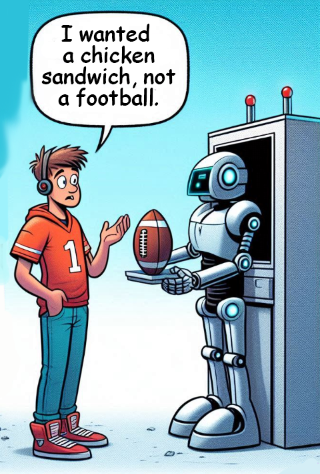
A college student tells the smart software system at a local restaurant that his order was misinterpreted. Thanks, MSFT Copilot. How your “recall” today? What about system security? Oh, that’s too bad.
The write up reports with the glee of a kid getting a happy meal:
McDonald’s automated order taker with IBM received scores of complaints in recent years, for example — with many taking to social media to document the chatbot misunderstanding their orders.
Consequently, the IBM fast food service has been terminated.
Time’s write up included a statement from Big Blue too:
In an initial statement, IBM said that “this technology is proven to have some of the most comprehensive capabilities in the industry, fast and accurate in some of the most demanding conditions," but did not immediately respond to a request for further comment about specifics of potential challenges.
IBM suggested its technology could help fight cancer in Houston a few years ago. How did that work out? That smart software worker had an opportunity to find its future elsewhere. The career trajectory, at first glance, seems to be from medicine to grilling burgers. One might interpret this as an interesting employment trajectory. The path seems to be heading down to Sleepy Town.
What’s the future of the IBM smart software test? The write up points out:
Both IBM and McDonald’s maintained that, while their AI drive-throughs partnership was ending, the two would continue their relationship on other projects. McDonalds said that it still plans to use many of IBM’s products across its global system.
But Ronald McDonald has to be practical. The article adds:
In December, McDonald’s launched a multi-year partnership with Google Cloud. In addition to moving restaurant computations from servers into the cloud, the partnership is also set to apply generative AI “across a number of key business priorities” in restaurants around the world.
Google’s smart software has been snagged in some food controversies too. The firm’s smart system advised some Googlers to use glue to make the cheese topping stick better. Yum.
Several observations seem to be warranted:
- Practical and money-saving applications of IBM’s smart software do not have the snap, crackle, and pop of OpenAI’s PR coup with Microsoft in January 2023. Time is writing about IBM, but the case example is not one that makes me crave this particular application. Customers want a sandwich, not something they did not order.
- Examples of reliable smart software applications which require spontaneous reaction to people ordering food or asking basic questions are difficult to find. Very narrow applications of smart software do result in positive case examples; for example, in some law enforcement software (what I call policeware), the automatic processes of some vendors’ solutions work well; for example, automatic report generation in the Shadowdragon Horizon system.
- Big companies spend money, catch attention, and then have to spend more money to remediate and clean up the negative publicity.
Net net: More small-scale testing and less publicity chasing seem to be two items to add to the menu. And, Watson, keep on trying. Google is.
Stephen E Arnold, June 19, 2024
x
Who Is On First? It Is a Sacrifice Play, Sports Fans
June 19, 2024
 This essay is the work of a dinobaby. Unlike some folks, no smart software improved my native ineptness.
Apologies to Abbott and Costello. Who is on first when it comes to running “search” at Google. I thought it was Prabhakar Raghavan, that master of laughs and one half of the Sundar & Prabhakar Comedy Show. But I was, it seems, once again wrong. “Google’s Head of Search Tells Employees That AI Will Keep Making Absurd Mistakes, but They’re Gonna Keep Pushing It Out” contains several shockers to my worn out dinobaby systems.
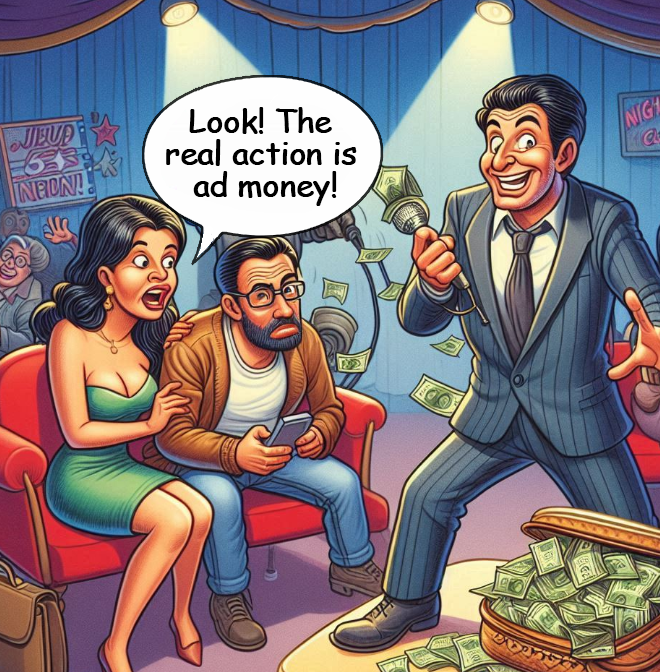
The comedian tells a joke about AI and then reveals the punch line. “It’s ad money.” Thanks, MSFT Copilot. Good enough.
First, forget Prabhakar, that master of the comedy demonstrations. “Hey, it is only a fact. So what if it is wrong, you user.” The head of search is Liz Reid. I know. You may be asking, “Who?” Ms. Reid has been employed at Google for decades. But don’t fret, Comedy Central fans, Prabhakar is in charge, according to the pooh-bah at The Verge. Whew. That’s a relief.
Second, the crazy outputs from Google’s smart software are nothing to get excited about. The write up reports Ms. Reid said:
“I don’t think we should take away from this that we shouldn’t take risks,” Reid said during the meeting. “We should take them thoughtfully. We should act with urgency. When we find new problems, we should do the extensive testing but we won’t always find everything and that just means that we respond.”
That’s the spirit. A Minimum Viable Product.
Third, Google’s real love is advertising. While this head of search and don’t worry AI dust up is swirling, please, ignore Google’s “new” advertising network. If you must learn about what Google is doing behind the dust cloud of AI, navigate to “Google Is Putting Unskippable In-Stream Ads in Your Free TV Channels.” The AI stuff is interesting, but the Googzilla is definitely interested in creating new video advertising streams. AI, meh. Ads, yeah, let’s go.
The head of search articulates what I would call the “good enough” and Minimum Viable Product attitude. The Absurd Mistakes article reports:
When reached by CNBC, a defensive Google spokesperson said the “vast majority” of AI Overview responses were accurate and that upon its own internal testing, the company found issues on “less than one in every 7 million unique queries on which AI Overviews appeared.”
Is there another character in the wings ready to take over the smart software routine? Sure. Sundar & Prabhakar are busy with the ad play. That will make it to Broadway. AI can open in Pittsburgh or Peoria.
Stephen E Arnold, June 19, 2014
DeepMind Is Going to Make Products, Not Science
June 18, 2024
 This essay is the work of a dinobaby. Unlike some folks, no smart software improved my native ineptness.
Crack that Google leadership whip. DeepMind is going to make products. Yes, just like that. I am easily confused. I thought Google consolidated its smart software efforts. I thought Dr. Jeffrey Dean did a lateral arabesque making way for new leadership. The company had new marching orders under the calming light of a Red Alert, hair-on-fire, OpenAI and Microsoft will be the new Big Dogs.
From Google DeepMind to greener pastures. Thanks, OpenAI art thing.
Now I learn from “Google’s DeepMind Shifting From Research Powerhouse To AI Product Giant, Redefining Industry Dynamics”:
Alphabet Inc‘s subsidiary Google DeepMind has decided to transition from a research lab to an AI product factory. This move could potentially challenge the company’s long-standing dominance in foundational research… Google DeepMind, has merged its two AI labs to focus on developing commercial services. This strategic change could potentially disrupt the company’s traditional strength in fundamental research
From wonky images of the US founding fathers to weird outputs which appear to be indicative of Google’s smart software and its knowledge of pizza cheese interaction, the company seems to be struggling. To further complicate matters, Google’s management finesse created this interesting round of musical chairs:
…the departure of co-founder Mustafa Suleyman to Microsoft in March adds another layer of complexity to DeepMind’s journey. Suleyman’s move to Microsoft, where he has described his experience as “truly transformational,” indicates the competitive and dynamic nature of the AI industry.
Several observations:
- Microsoft seems to be suffering the AI wobblies. The more it tries to stabilize its AI activities, the more unstable the company seems to be
- Who is in charge of AI at Google?
- Has Google turned off the blinking red and yellow alert lights and operates in what might be called low lumen normalcy?
- xx
However, Google’s thrashing may not matter. OpenAI cannot get its system to stay online. Microsoft has a herd of AI organizations to manage and has managed to create a huge PR gaffe with its “smart” Recall feature. Apple deals in “to be” smart products and wants to work with everyone just without paying.
Net net: Is Google representative of the unraveling of the Next Big Thing?
Stephen E Arnold, June 18, 2024
x
x
x
Free AI Round Up with Prices
June 18, 2024
 This essay is the work of a dinobaby. Unlike some folks, no smart software improved my native ineptness.
EWeek (once PCWeek and a big fat Ziff publication) has published what seems to be a mash up of MBA-report writing, a bit of smart software razzle dazzle, and two scoops of Gartner Group-type “insight.” The report is okay, and its best feature is that it is free. Why pay a blue-chip or mid-tier consulting firm to assemble a short monograph? Just navigate to “21 Best Generative AI Chatbots.”
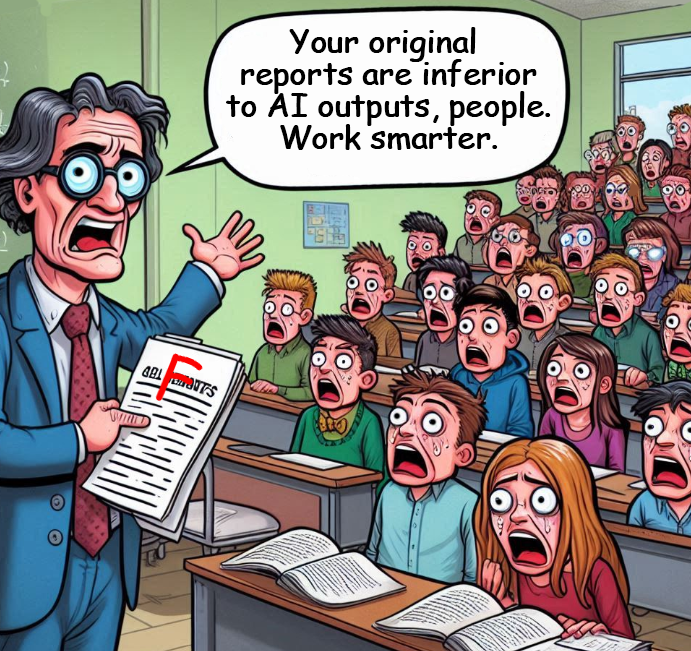
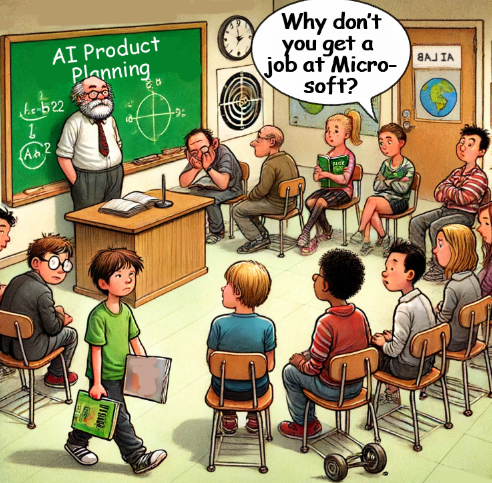
A lecturer shocks those in the presentation with a hard truth: Human-generated reports are worse than those produced by a “leading” smart software system. Is this the reason a McKinsey professional told interns, “Prompts are the key to your future.” Thanks, MSFT Copilot. Good enough.
The report consists of:
A table with the “leading” chatbots presented in random order. Forget that alphabetization baloney. Sorting by “leading” chatbot name is so old timey. The table presents these evaluative/informative factors:
- Best for use case; that is, in the opinion of the “analysts” when one would use a specific chatbot in the opinion of the EWeek “experts” I assume
- Query limit. This is baffling since recyclers of generative technology are eager to sell a range of special plans
- Language model. This column is interesting because it makes clear that of the “leading” chatbots 12 of them are anchored in OpenAI’s “solutions”; Claude turns up three times, and Llama twice. A few vendors mention the use of multiple models, but the “report” does not talk about AI layering or the specific ways in which different systems contribute to the “use case” for each system. Did I detect a sameness in the “leading” solutions? Yep.
- The baffling Chrome “extension.” I think the idea is that the “leading” solution with a Chrome extension runs in the Google browser. Five solutions do run as a Chrome extension. The other 16 don’t.
- Pricing. Now prices are slippery. My team pays for ChatGPT, but since the big 4o, the service seems to be free. We use a service not on the list, and each time I access the system, the vendor begs — nay, pleads — for more money. One vendor charges $2,500 per month paid annually. Now, that’s a far cry from Bing Chat Enterprise at $5 per month, which is not exactly the full six pack.
The bulk of the report is a subjective score for each service’s feature set, its ease of use, the quality of output (!), and support. What these categories mean is not provided in a definition of terms. Hey, everyone knows about “quality,” right? And support? Have you tried to contact a whiz-bang leading AI vendor? Let me know how that works out? The screenshots vary slightly, but the underlying sameness struck me. Each write up includes what I would call a superficial or softball listing of pros and cons.
The most stunning aspect of the report is the explanation of “how” the EWeek team evaluated these “leading” systems. Gee, what systems were excluded and why would have been helpful in my opinion. Let me quote the explanation of quality:
To determine the output quality generated by the AI chatbot software, we analyzed the accuracy of responses, coherence in conversation flow, and ability to understand and respond appropriately to user inputs. We selected our top solutions based on their ability to produce high-quality and contextually relevant responses consistently.
Okay, how many queries? How were queries analyzed across systems, assuming similar systems received the same queries? Which systems hallucinated or made up information? What queries causes one or more systems to fail? What were the qualifications of those “experts” evaluating the system responses? Ah, so many questions. My hunch is that EWeek just skipped the academic baloney and went straight to running queries, plugging in a guess-ti-mate, and heading to Starbucks? I do hope I am wrong, but I worked at the Ziffer in the good old days of the big fat PCWeek. There was some rigor, but today? Let’s hit the gym?
What is the conclusion for this report about the “leading” chatbot services? Here it is:
Determining the “best” generative AI chatbot software can be subjective, as it largely depends on a business’s specific needs and objectives. Chatbot software is enormously varied and continuously evolving, and new chatbot entrants may offer innovative features and improvements over existing solutions. The best chatbot for your business will vary based on factors such as industry, use case, budget, desired features, and your own experience with AI. There is no “one size fits all” chatbot solution.
Yep, definitely worth the price of admission.
Stephen E Arnold, June 18, 2024
The Gray Lady Tap Dances
June 17, 2024
 This essay is the work of a dinobaby. Unlike some folks, no smart software improved my native ineptness.
The collision of myth, double talk, technology, and money produces some fascinating tap dancing. Tip tap tip tap. Tap tap. That’s the sound of the folks involved with explaining that technology is no big deal. Drum roll. Then the coda. Tip tap tip tap. Tap tap tap. It is not money. Tip tap tip tap. tap tap.
I think quite a few business decisions are about money; specifically, getting a bonus or a hefty raise because “efficiency” improves “quality.” One can dance around the dead horse, but at some point that horse needs to be relocated.

The “real” Mona Lisa. Can she be enhanced, managed, and be populated with metadata without a human art director? Yep. Thanks, MSFT Copilot. Good enough.
I read “New York Times Union Urges Management to Reconsider 9 Art Department Cuts as Paper Ramps Up AI Tools | Exclusive.” The write up weaves a number of themes together. There is the possibility of management waffling, a common practice these days. Recall, an incident, Microsoft? The ever-present next big thing makes an appearance. Plus, there is the Gray Lady, working hard to maintain its position as the newspaper for for the USA today. (That sounds familiar, doesn’t it?)
The main point of the write up is that the NYT’s art department might lose staff. The culprit is not smart software. Money is not the issue. Quality will not suffer. Yada yada. The write up says:
The Times denies that the reductions are in any way related to the newspaper’s AI initiatives.
And the check is in the mail.
I also noted:
A spokesman for the Times said the affected employees are being offered a buyout, and have nothing to do with the use of AI. “Last month, The Times’s newsroom made the difficult decision to reduce the size of its art production team with workflow changes to make photo toning and color correction work more efficient,” Charlie Stadtlander told TheWrap.”On May 30th, we offered generous voluntary buyouts for 9 employees to accept. These changes involve the adoption of new workflows and the expanded use of industry-standard tools that have been in use for years — they are not related to The Times’s AI efforts.”
Nope. Never. Impossible. Unthinkable.
What is the smart software identified as a staff reducer? It is Claro but that is not the name of the company. The current name of the service is Pixometry, which is a mashup of Claro and Elpical. So what does this controversial smart software do? The firm’s Web site says:
Pixometry is the latest evolution of Claro, the leading automated image enhancement platform for Publishers and Retailers around the globe. Combining exceptional software with outstanding layered AI services, Pixometry delivers a powerful image processing engine capable of creating stunning looking images, highly accurate cut-outs and automatic keywording in seconds. Reducing the demands upon the Photoshop teams, Pixometry integrates seamlessly with production systems and prepares images for use in printed and digital media.
The Pixometry software delivers:
Cloud based automatic image enhancement & visual asset management solutions for publishers & retail business.
Its functions include:
- Automatic image “correction” because “real” is better than real
- Automatic cut outs and key wording (I think a cut out is a background remover so a single image can be plucked from a “real” photo
- Consistent, high quality results. None of that bleary art director eye contact.
- Multi-channel utilization. The software eliminates telling a Photoshop wizard I need a high-res image for the magazine and a then a 96 spot per inch version for the Web. How long will that take? What? I need the images now.
- Applied AI image intelligence. Hey, no hallucinations here. This is “real” image enhancement and better than what those Cooper Union space cadets produce when they are not wandering around looking for inspiration or whatever.
Does that sound like reality shaping or deep fake territory? Hmmm. That’s a question none of the hair-on-fire write ups addresses. But if you are a Photoshop and Lightroom wizard, the software means hasta la vista in my opinion. Smart software may suck at office parties but it does not require vacays, health care (just minor system updates), or unions. Software does not argue, wear political buttons, or sit around staring into space because of a late night at the “library.”
Pretty obscure unless you are a Photoshop wizard. The Pixometry Web site explains that it provides a searchable database of images and what looks like one click enhancement of images. Hey, every image needs a bit of help to be “real”, just like “real” news and “real” management explanations. The Pixometry Web site identifies some organizations as “loving” Pixometry; for example, the star-crossed BBC, News UK, El Mercurio, and the New York Times. Yes, love!
Let’s recap. Most of the reporting about this use of applied smart software gets the name of the system wrong. None of the write ups point out that art director functions in the hands of a latte guzzling professional are not quick, easy, or without numerous glitches. Furthermore, the humans in the “art” department must be managed.
The NYT is, it appears, trying to do the two-step around software that is better, faster, and cheaper than the human powered options. Other observations are:
- The fast-talking is not going to change the economic benefit of smart software
- The notion of a newspaper fixing up photos underscores that deep fakes have permeated institutions which operate as if it were 1923 skidoo time
- The skilled and semi-skilled workers in knowledge industries may taste blood when the titanium snake of AI bites them on the ankle. Some bites will be fatal.
Net net: Being up front may have some benefits. Skip the old soft shoe, please.
Stephen E Arnold, June 17, 2024
-

- Subscribe to Beyond Search
Feature archive
News archive

-


