

Software in 2026: Whoa, Nellie! You Lame, Girl?
December 31, 2025
 Another dinobaby post. No AI unless it is an image. This dinobaby is not Grandma Moses, just Grandpa Arnold.
When there were Baby Bells, I got an email from a person who had worked with me on a book. That person told me that one of the Baby Bells wanted to figure out how to do their Yellow Pages as an online service. The problem, as I recall my contact’s saying, was “not to screw up the ad sales in the dead tree version of the Yellow Pages.” I won’t go into the details about the complexities of this project. However, my knowledge of how pre- and post-Judge Green was supposed to work and some on-site experience creating software for what did business as Bell Communications Research gave me some basic information about the land of Bell Heads. (If you don’t get the reference, that’s okay. It’s an insider metaphor but less memorable than Achilles’ heel.)
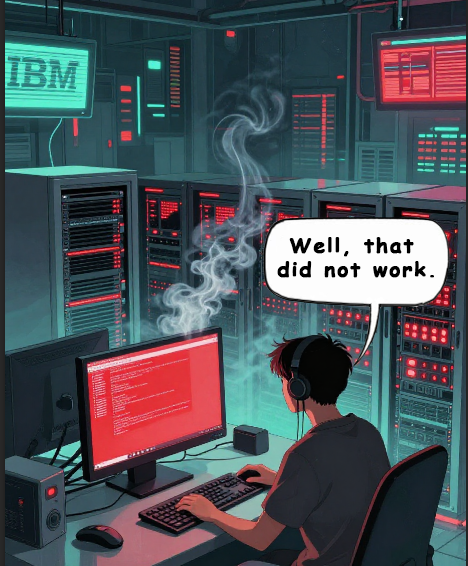
A young whiz kid from a big name technology school experiences a real life learning experience. Programming the IBM MVS TSO set up is different from vibe coding an app from a college dorm room. Thanks, Qwen, good enough.
The point of my reference to a Baby Bell was that a newly minted stand alone telecommunications company ran on what was a pretty standard line up of IBM and B4s (designed by Bell Labs, the precursor to Bellcore) plus some DECs, Wangs, and other machines. The big stuff ran on the IBM machines with proprietary, AT&T specific applications on the B4s. If you are following along, you might have concluded that slapping a Yellow Pages Web application into the Baby Bell system was easy to talk about but difficult to do. We did the job using my old trick. I am a wrapper guy. Figure out what’s needed to run a Yellow Pages site online, what data are needed and where to get it and where to put it, and then build a nice little Web set up and pass data back and forth via what I call wrapper scripts and code. The benefits of the approach are that I did not have to screw around with the software used to make a Baby Bell actually work. When the Web site went down, no meetings were needed with the Regional Manager who had many eyeballs trained on my small team. Nope, we just fixed the Web site and keep on doing Yellow Page things. The solution worked. The print sales people could use the Web site to place orders or allow the customer to place orders. Open the valve to the IBM and B4s, push in data just the way these systems wanted it, and close the valve. Hooray.
Why didn’t my team just code up the Web stuff and run it on one of those IBM MVS TSO gizmos? The answer appears, quite surprisingly in a blog post published December 24, 2025. I never wrote about the “why” of my approach. I assumed everyone with some Young Pioneer T shirts knew the answer. Guess not. “Nobody Knows How Large Software Products Work” provides the information that I believed every 23 year old computer whiz kid knew.
The write up says:
Software is hard. Large software products are prohibitively complicated.
I know that the folks at Google now understand why I made cautious observations about the complexity of building interlocking systems without the type of management controls that existed at the pre break up AT&T. Google was very proud of its indexing, its 150 plus signal scores for Web sites, and yada yada. I just said, “Those new initiatives may be difficult to manage.” No one cared. I was an old person and a rental. Who really cares about a dinobaby living in rural Kentucky. Google is the new AT&T, but it lacks the old AT&T’s discipline.
Back to the write up. The cited article says:
Why can’t you just document the interactions once when you’re building each new feature? I think this could work in theory, with a lot of effort and top-down support, but in practice it’s just really hard….The core problem is that the system is rapidly changing as you try to document it.
This is an accurate statement. AT&T’s technical regional managers demanded commented code. Were the comments helpful? Sometimes. The reality is that one learns about the cute little workarounds required for software that can spit out the PIX (plant information exchange data) for a specific range of dialing codes. Google does some fancy things with ads. AT&T in the pre Judge Green era do some fancy things for the classified and unclassified telephone systems for every US government entity, commercial enterprises, and individual phones and devices for the US and international “partners.”
What does this mean? In simple terms, one does not dive into a B4 running the proprietary Yellow Page data management system and start trying to read and write in real time from a dial up modem in some long lost corner of a US state with a couple of mega cities, some military bases, and the national laboratory.
One uses wrappers. Period. Screw up with a single character and bad things happen. One does not try to reconstruct what the original programming team actually did to make the PIX system “work.”
The write up says something that few realize in this era of vibe coding and AI output from some wonderful system like Claude:
It’s easier to write software than to explain it.
Yep, this is actual factual. The write up states:
Large software systems are very poorly understood, even by the people most in a position to understand them. Even really basic questions about what the software does often require research to answer. And once you do have a solid answer, it may not be solid for long – each change to a codebase can introduce nuances and exceptions, so you’ve often got to go research the same question multiple times. Because of all this, the ability to accurately answer questions about large software systems is extremely valuable.
Several observations are warranted:
- One gets a “feel” for how certain large, complex systems work. I have, prior to my retiring, had numerous interactions with young wizards. Most were job hoppers or little entrepreneurs eager to poke their noses out of the cocoon of a regular job. I am not sure if these people have the ability to develop a “feel” for a large complex of code like the old AT&T had assembled. These folks know their code, I assume. But the stuff running a machine lost in the mists of time. Probably not. I am not sure AI will be much help either.
- The people running some of the companies creating fancy new systems are even more divorced from the reality of making something work and how to keep it going. Hence, the problems with computer systems at airlines, hospitals, and — I hate to say it — government agencies. These problems will only increase, and I don’t see an easy fix. One sure can’t rely on ChatGPT, Gemini, or Grok.
- The push to make AI your coding partner is sort of okay. But the old-fashioned way involved a young person like myself working side by side with expert DEC people or IBM professionals, not AI. What one learns is not how to do something but how not to do something. Any one, including a software robot, can look up an instruction in a manual. But, so far, only a human can get a “sense” or “hunch” or “intuition” about a box with some flashing lights running something called CB Unix. There is, in my opinion, a one way ticket down the sliding board to system failure with the today 2025 approach to most software. Think about that the next time you board an airplane or head to the hospital for heart surgery.
Net net: Software excitement ahead. And that’s a prediction for 2026. I have a high level of confidence in this peek at the horizon.
Stephen E Arnold, December 31, 2025
Comments
Got something to say?
-

- Subscribe to Beyond Search
Feature archive
News archive

-


