

Yep, Making the AI Hype Real Will Be Expensive. Hundreds of Billions, Probably More, Says Microsoft
December 26, 2025
 Another dinobaby post. No AI unless it is an image. This dinobaby is not Grandma Moses, just Grandpa Arnold.
I really don’t want to write another “if you think it, it will become real.” But here goes. I read “Microsoft AI CEO Mustafa Suleyman Says It Will Cost Hundreds of Billions to Keep Up with Frontier AI in the Next Decade.”
What’s the pitch? The write up says:
Artificial general intelligence, or AGI, refers to AI systems that can match human intelligence across most tasks. Superintelligence goes a step further — systems that surpass human abilities.
So what’s the cost? Allegedly Mr. AI at Microsoft (aka Microsoft AI CEO Mustafa Suleyman) asserts:
it’s going to cost “hundreds of billions of dollars” to compete at the frontier of AI over the next five to 10 years….Not to mention the prices that we’re paying for individual researchers or members of technical staff.
Microsoft seems to have some “we must win” DNA. The company appears to be willing to ignore users requests for less of that Copilot goodness.
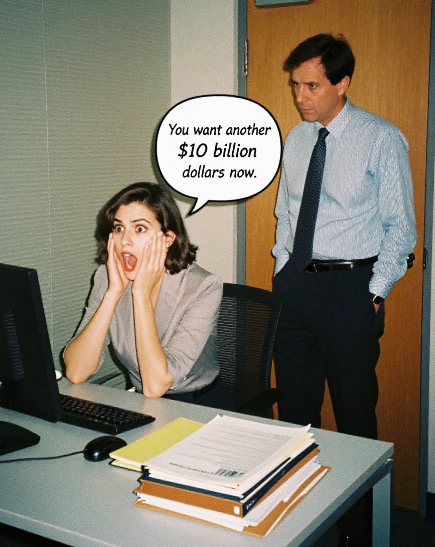
The vice president of AI finance seems shocked by an AI wizard’s request for additional funds… right now. Thanks, Qwen. Good enough.
Several observations:
- The assumption is that more money will produce results. When? Who knows?
- The mental orientation is that outfits like Microsoft are smart enough to convert dreams into reality. That is a certain type of confidence. A failure is a stepping stone, a learning experience. No big deal.
- The hype has triggered some non-AI consequences. The lack of entry level jobs that AI will do is likely to derail careers. Remember the baloney that online learning was better than sitting in a classroom. Real world engagement is work. Short circuiting that work in my opinion is a problem not easily corrected.
Let’s step back. What’s Microsoft doing? First, the company caught Google by surprise in 2022. Now Google is allegedly as good or better than OpenAI’s technology. Microsoft, therefore, is the follower instead of the pace setter. The result is mild concern with a chance of fear tomorrow. the company’s “leadership” is not stabilizing the company, its messages, and its technology offerings. Wobble wobble. Not good.
Second, Microsoft has demonstrated its “certain blindness” to two corporate activities. The first is the amount of money Microsoft has spent and apparently will continue to spend. With inputs from the financially adept Mr. Suleyman, the bean counters don’t have a change. Sure, Microsoft can back out of some data center deals and it can turn some knobs and dials to keep the company’s finances sparkling in the sun… for a while. How long? Who knows?
Third, even Microsoft fan boys are criticizing the idea of shifting from software that a users uses for a purpose to an intelligent operating system that users its users. My hunch is that this bulldozing of user requests, preferences, and needs may be what some folks call a “moment.” Google’s Waymo killed a cat in the Mission District. Microsoft may be running over its customers. Is this risky? Who knows.
Fourth, can Microsoft deliver AI that is not like AI from other services; namely, the open source solutions that are available and the customer-facing apps built on Qwen, for example. AI is a utility and not without errors. Some reports suggest that smart software is wrong two thirds of the time. It doesn’t matter what the “real” percentage is. People now associate smart software with mistakes, not a rock solid tool like a digital tire pressure gauge.
Net net: Mr. Suleyman will have an opportunity to deliver. For how long? Who knows?
Stephen E Arnold, December 26, 2025
Comments
Got something to say?
-

- Subscribe to Beyond Search
Feature archive
News archive

-


