

Modern Management Method with and without Smart Software
December 22, 2025
 Another dinobaby post. No AI unless it is an image. This dinobaby is not Grandma Moses, just Grandpa Arnold.
I enjoy reading and thinking about business case studies. The good ones are few and far between. Most are predictable, almost as if the author was relying on a large language model for help.
“I’m a Tech Lead, and Nobody Listens to Me. What Should I Do?” is an example of a bright human hitting on tactics to become more effective in his job. You can work through the full text of the article and dig out the gems that may apply to you. I want to focus on two points in the write up. The first is the matrix management diagram based on or attributed to Spotify, a music outfit. The second is a method for gaining influence in a modern, let’s go fast company.
Here’s the diagram that caught my attention:
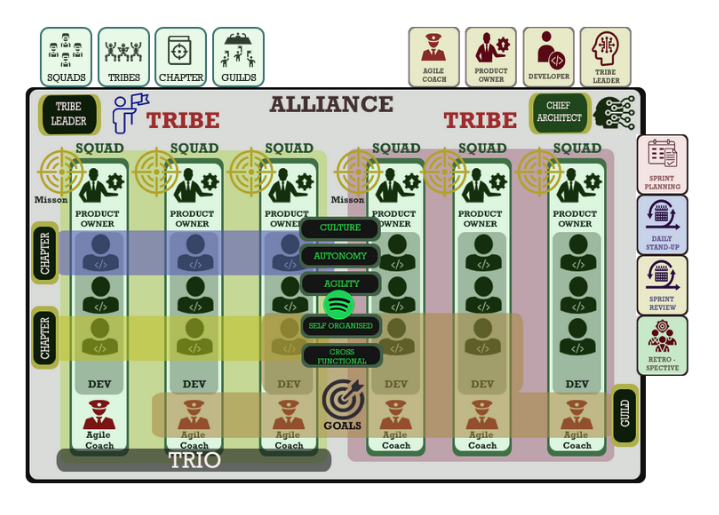
Instead of the usual business school lingo, you will notice “alliance,” “tribe,” “squad,” and “trio.” I am not sure what these jazzy words mean, but I want to ask you a question, “Looking at this matrix, who is responsible when a problem occurs?” Take you time. I did spend some time looking at this chart, and I formulated several hypotheses:
- The creator wanted to make sure that a member of leadership would have a tough time figuring out who screwed up. If you disagree, that’s okay. I am a dinobaby, and I like those old fashioned flow diagrams with arrows and boxes. In those boxes is the name of the person who has to fix a problem. I don’t know about one’s tribe. I know Problem A is here. Person B is going to fix it. Simple.
- The matrix as displayed allows a lot of people to blame other people. For example, what if the coach is like the leader of the Cleveland Browns, who brilliantly equipped a young quarterback with the incorrect game plan for the first quarter of a football game. Do we blame the coach or do we chase down a product owner? What if the problem is a result of a dependency screw up involving another squad in a different tribe? In practical terms, there is no one with direct responsibility for the problem. Again: Don’t agree? That’s okay.
- The matrix has weird “leadership” or “employment categories” distributed across the X axes at the top of the chart. What’s a chapter? What’s an alliance? What’s self organized and autonomous in a complex technical system? My view is that this is pure baloney designed to make people feel important yet shied any one person from responsibility. I bet some reading this numbered point find my statement out of line. Tough.
The diagram makes clear that the organization is presented as one that will just muddle forward. No one will have responsibility when a problem occurs? No one will know how to fix the problem without dropping other work and reverse engineering what is happening. The chart almost guarantees bafflement when a problem surfaces.
The second item I noticed was this statement or “learning” from the individual who presented the case example. Here’s the passage:
When you solve a real problem and make it visible, people join in. Trust is also built that way, by inviting others to improve what you started and celebrating when they do it better than you.
For this passage hooks into the one about solving a problem; to wit:
Helping people debug. I have never considered myself especially smart, but I have always been very systematic when connecting error messages, code, hypotheses, and system behavior. To my surprise, many people saw this as almost magical. It was not magic. It was a mix of experience, fundamentals, intuition, knowing where to look, and not being afraid to dive into third-party library code.
These two passages describe human interactions. Working with others can result in a collective effort greater than the sum of its parts. It is a human manifestation. One fellow described this a interaction efflorescence. Fancy words for what happens when a few people face a deadline and severe consequences for failure.
Why did I spend time pointing out an organizational structure purpose built to prevent assigning responsibility and the very human observations of the case study author?
The answer is, “What will happen when smart software is tossed into this management structure?” First, people will be fired. The matrix will have lots of empty boxes. Second, the human interaction will have to adapt to the smart software. The smart software is not going to adapt to humans. Don’t believe me. One smart software company defended itself by telling a court it is in our terms of service that suicide in not permissible. Therefore, we are not responsible. The dead kid violated the TOS.
How functional will the company be as the very human insight about solving real problems interfaces with software? Man machine interface? Will that be an issue in a go fast outfit? Nope. The human will be excised as a consequence of efficiency.
Stephen E Arnold, December 23, 2025
Comments
Got something to say?
-

- Subscribe to Beyond Search
Feature archive
News archive
-


