

AI Year in Review: The View from an Expert in France
December 11, 2025
 Another dinobaby post. No AI unless it is an image. This dinobaby is not Grandma Moses, just Grandpa Arnold.
I suggest you read “Stanford, McKinsey, OpenAI: What the 2025 Reports Tell Us about the Present and Future of AI (and Autonomous Agents) in Business.” The document is in French. You can get an okay translation via the Google or Yandex.
I have neither the energy nor the inclination to do a blue chip consulting type of analysis of this fine synthesis of multiple source documents. What I will do in this blog post is highlight several statements and offer a comment or two. For context, I have read some of the sources the author Fabrice Frossard has cited. M. Frossard is a graduate of Ecole Supérieure Libre des Sciences Commerciales Appliquées and the Ecole de Guerre Economique in Paris I think. Remember: I am a dinobaby and generally too lazy and inept to do “real” research. These are good places to learn how to think about business issues.
Let’s dive into his 2000 word write up.
The first point that struck me is that he include what I think is a point not given sufficient emphasis by the experts in the US. This theme is not forced down the reader’s throat, but it has significant implications for M. Frossard’s comments about the need to train people to use smart software. The social implication of AI and the training creates a new digital divide. Like the economic divide in the US and some other countries, crossing the border is not going to possible for many people. Remember these people have been trained to use the smart software deployed. When one cannot get from ignorance to informed expertise, that person is likely to lose a job. Okay, here’s the comment from the source document:
To put it another way: if AI is now everywhere, its real mastery remains the prerogative of an elite.
Is AI a winner today? Not a winner, but it is definitely an up and comer in the commercial world. M. Frossard points out:
- McKinsey reveals that nearly two thirds of companies are still stuck in the experimentation or piloting phase.
- The elite escaping: only 7% of companies have successfully deployed AI in a fully integrated manner across the entire organization.
- Peak workers use coding or data analysis tools 17 times more than the median user.
These and similar facts support the point that “the ability to extract value creates a new digital divide, no longer based on access, but on the sophistication of use.” Keep this in mind when it comes to learning a new skill or mastering a new area of competence like smart software. No, typing a prompt is not expert use. Typing a prompt is like using an automatic teller machine to get money. Basic use is not expert level capabilities.
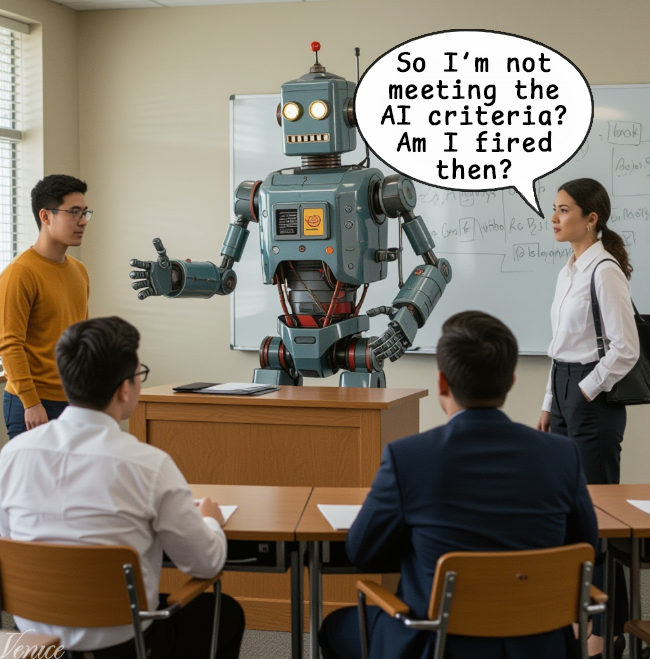
If Mary cannot “learn” AI and demonstrate exceptional skills, she’s going to be working as an Etsy.com reseller. Thanks, Venice.ai. Not what I prompted but I understand that you are good enough, cash strapped, and degrading.
The second point is that in 2025, AI does not pay for itself in every use case. M. Frossard offers:
EBIT impact still timid: only 39% of companies report an increase in their EBIT (earnings before interest and taxes) attributable to AI, and for the most part, this impact remains less than 5%.
One interesting use case comes from a McKinsey report where billability is an important concept. The idea is that a bit of Las Vegas type thinking is needed when it comes to smart software. M. Frossard writes:
… the most successful companies [using artificial intelligence] are paradoxically those that report the most risks and negative incidents.
Takes risks and win big seems to be one interpretation of this statement. The timid and inept will be pushed aside.
Third, I was delighted to see that M. Frossard picked up on some of the crazy spending for data centers. He writes:
The cost of intelligence is collapsing: A major accelerating factor noted by the Stanford HAI Index is the precipitous fall in inference costs. The cost to achieve performance equivalent to GPT-3.5 has been divided by 280 in 18 months. This commoditization of intelligence finally makes it possible to make complex use cases profitable which were economically unviable in 2023. Here is a paradox: the more efficient and expensive artificial intelligence becomes produce (exploding training costs), the less expensive it is consume (free-fall inference costs). This mental model suggests that intelligence becomes an abundant commodity, leading not to a reduction, but to an explosion of demand and integration.
Several ideas bubble from this passage. First, we are back to training. Second, we are back to having significant expertise. Third, the “abundant commodity” idea produces greater demand. The problem (in addition to not having power for data centers will be people with exceptional AI capabilities).
Fourth, the replacement of some humans may not be possible. The essay reports:
the deployment of agents at scale remains rare (less than 10% in a given function according to McKinsey), hampered by the need for absolute reliability and data governance.
Data governance is like truth, love, and ethics. Easy to say and hard to define. The reliability angle is slightly less tricky. These two AI molecules require a catalyst like an expert human with significant AI competence. And this returns the essay to training. M. Frossard writes:
The transformation of skills: The 115K report emphasizes the urgency of training. The barrier is not technological, it is human. Businesses face a cultural skills gap. It’s not about learning to “prompt”, but about learning to collaborate with non-human intelligence.
Finally, the US has a China problem. M. Frossard points out:
… If the USA dominates investment and the number of models, China is closing the technical gap. On critical benchmarks such as mathematics or coding, the performance gap between the US and Chinese models has narrowed to nothing (less than 1 to 3 percentage points).
Net net: If an employee cannot be trained, that employee is likely to be starting a business at home. If the trained employees are not exceptional, those folks may be terminated. Elites like other elite things. AI may be good enough, but it provides an “objective” way to define and burn dead wood.
Stephen E Arnold, December 11, 2025
Comments
Got something to say?
-

- Subscribe to Beyond Search
Feature archive
News archive

-


