

MIT Iceberg: Identifying Hotspots
December 10, 2025
Another dinobaby post. No AI unless it is an image. This dinobaby is not Grandma Moses, just Grandpa Arnold.
I like the idea of identifying exposure hotspots. (I hate to mention this, but MIT did have a tie up with Jeffrey Epstein, did it not? How long did it take for that hotspot to be exposed? The dynamic duo linked in 2002 and wound down the odd couple relationship in 2017. That looks to me to be about 15 years.) Therefore, I approach MIT-linked research from some caution. Is this a good idea? Yep.)
What is this iceberg thing? I won’t invoke the Titanic’s encounter with an iceberg, nor will I point to some reports about faulty engineering. I am confident had MIT been involved, that vessel would probably be parked in a harbor, serving as a museum.
I read “The Iceberg Index: Measuring Skills-centered Exposure in the AI Economy.” You can too. The paper is free at least for a while. It also has 10 authors who generated 21 pages to point out that smart software is chewing up jobs. Of course, this simple conclusion is supported by quite a bit of academic fireworks.
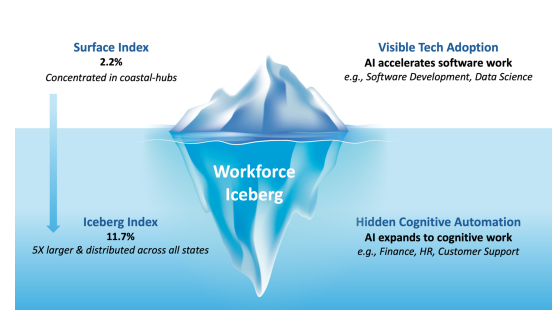
The iceberg chart which reminds me of the Dark Web charts. I wonder if Jeffrey Epstein surfed the Dark Web while waiting for a meet and greet at MIT? The source for this image is MIT or possibly an AI system helping out the MIT graphic artist humanoid.
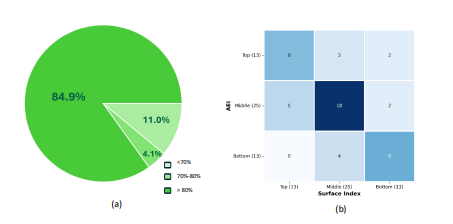
I love these charts. I find them eye catching and easily skippable.
Even though smart software makes up stuff, appears to have created some challenges for teachers and college professors (except those laboring in Jeffrey Epstein’s favorite grove of academic, of course), and people looking for jobs. The as is smart software can eliminate about 10 to 11 percent of here and now jobs. The good news is that 90 percent of the workers can wait for AI to get better and then eliminate another chunk of jobs. For those who believe that technology just gets better and better, the number of jobs for humanoids is likely to be gnawed and spat out for the foreseeable future.
I am not going to cause the 10 authors to hire SEO spam shops in Africa to make my life miserable. I will suggest, however, that there may be what I call de-adoption in the near future. The idea is that an organization is unhappy with the cost / value for its AI installation. A related factor is that some humans in an organization may introduce some work flow friction. The actions can range from griping about services interrupting work like Microsoft’s enterprise Copilot to active sabotage. People can fake being on a work related video conference, and I assume a college graduate (not from MIT, of course) might use this tactic to escape these wonderful face to face innovations. Nor will I suggest that AI may continue to need humans to deliver successful work task outcomes. Does an AI help me buy more of a product? Does AI boost your satisfaction with an organization pushing and AI helper on each of its Web pages?
And no academic paper (except those presented at AI conferences) are complete without some nifty traditional economic type diagrams. Here’s an example for the industrious reader to check:
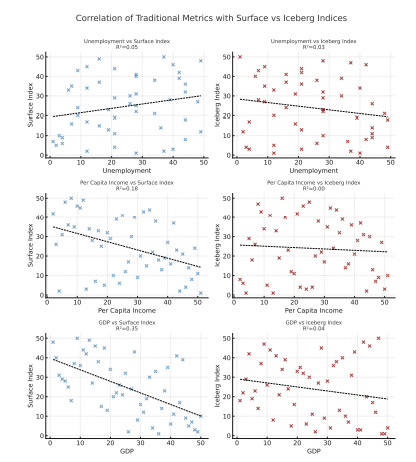
Source: the MIT Report. Is it my imagination or five of the six regression lines pointing down? What’s negative correlation? (Yep, dinobaby stuff.)
Several observations:
- This MIT paper is similar to blue chip consulting “thought pieces.” The blue chippers write to get leads and close engagements. What is the purpose of this paper? Reading posts on Reddit or LinkedIn makes clear that AI allegedly is replacing jobs or used as an excuse to dump expensive human workers.
- I identified a couple of issues I would raise if the 10 authors had trooped into my office when I worked at a big university and asked for comments. My hunch is that some of the 10 would have found me manifesting dinobaby characteristics even though I was 23 years old.
- The spate of AI indexes suggests that people are expressing their concern about smart software that makes mistakes by putting lipstick on what is a very expensive pig. I sense a bit of anxiety in these indexes.
Net net: Read the original paper. Take a look at your coworkers. Which will be the next to be crushed because of the massive investments in a technology that is good enough, over hyped, and perceived as the next big thing. (Measure the bigness by pondering the size of Meta’s proposed data center in the southern US of A.) Remember, please, MIT and Epstein Epstein Epstein.
Stephen E Arnold, December 10, 2025
Comments
Got something to say?
-

- Subscribe to Beyond Search
Feature archive
News archive

-


