

A New McKinsey Report Introduces New Jargon for Its Clients
December 3, 2025
 Another dinobaby original. If there is what passes for art, you bet your bippy, that I used smart software. I am a grandpa but not a Grandma Moses.
I read “Agents, Robots, and Us: Skill Partnerships in the Age of AI.” The write up explains that lots of employees will be terminated. Think of machines displacing seamstresses. AI is going to do that to jobs, lots of jobs.
I want to focus on a different aspect of the McKinsey Global Institute Report (a PR and marketing entity not unlike Telegram’s TON Foundation in my view).
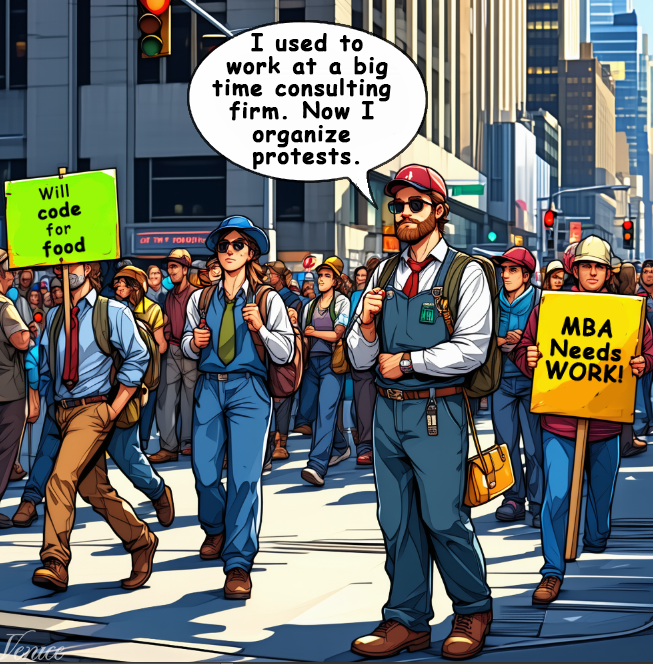
Thanks, Vencie. Your cartoon contains neither females nor minorities. That’s definitely a good enough approach. But you have probably done a number on a few graphic artists.
First, the report offers you the potential client an opportunity to use McKinsey’s AI chatbot. The service is a test, but I have a hunch that it is not much of a test. The technology will be deployed so that McKinsey can terminate those who underperform in certain work related tasks. The criteria for keeping one’s job at a blue chip consulting firm varies from company to company. But those who don’t quit to find greener or at least less crazy pastures will now work under the watchful eye of McKinsey AI. It takes a great deal of time to write a meaningful analysis of a colleague’s job performance. Let AI do it with exceptions made for “special” hires of course. Give it a whirl.
Second, the report what I call consultant facts. These are statements which link the painfully obvious with a rationale. Let me give you an example from this pre-Thanksgiving sales document. McKinsey states:
Two thirds of US work hours require only nonphysical capabilities
The painfully obvious: Most professional work is not “physical.” That means 67 percent of an employee’s fully loaded cost can be shifted to smart or semi-smart, good enough AI agentic systems. Then the obvious and the implication of financial benefits is supported by a truly blue chip chart. I know because as you can see, the graphics are blue. Here’s a segment of the McKinsey graph:
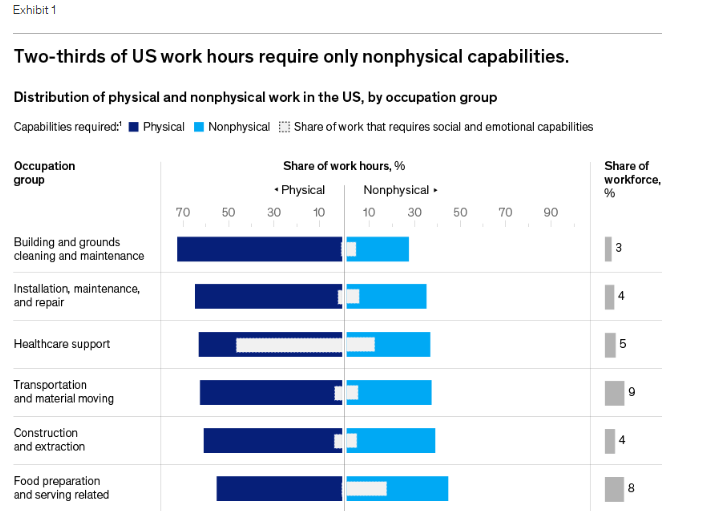
Notice that the chart is presented so that a McKinsey professional can explain the nested bar charts and expand on such data as “5 percent of a health care workforce can be agentized.” Will that resonate with hospital administrators working for roll up of individual hospitals. That’s big money. Get the AI working in one facility and then roll it out. Boom. An upside that seems credible. That’s the key to the consultant facts. Additional analysis is needed to tailor these initial McKinsey graph data to a specific use case. As a sales hook, this works and has worked for decades. Fish never understand hooks with plastic bait. Deer never quite master automobiles and headlights.
Third, the report contains sales and marketing jargon for 2026 and possibly beyond. McKinsey hopes for decades to come I think. Here’s a small selection of the words that will be used, recycled, and surface in lectures by AI experts to quite large crowds of conference attendees:
AI adjacent capabilities
AI fluency
Embodied AI
HMC or human machine collaboration
High prevalence skills
Human-agent-robot roles
technical automation potential
If you cannot define these, you need to hire McKinsey. If you want to grow as a big time manager, send that email or FedEx with a handwritten note on your engraved linen stationery.
Fourth, some humans will be needed. McKinsey wants to reassure its clients that software cannot replace the really valuable human. What do you think makes a really valuable worker beyond AI fluency? [a] A professional who signed off on a multi-million McKinsey consulting contract? [b] A person who helped McKinsey consultants get the needed data and interviews from an otherwise secretive client with compartmentalized and secure operating units? [b] A former McKinsey consultant now working for the firm to which McKinsey is pitching an AI project.
Fifth, the report introduces a new global index. The data in this free report is unlikely to be free in the future. McKinsey clients can obtain these data. This new global index is called the Skills Change Index. Here’s an example. You can get a bit more marketing color in the cited report. Just feast your eyes on this consultant fact packed chart:
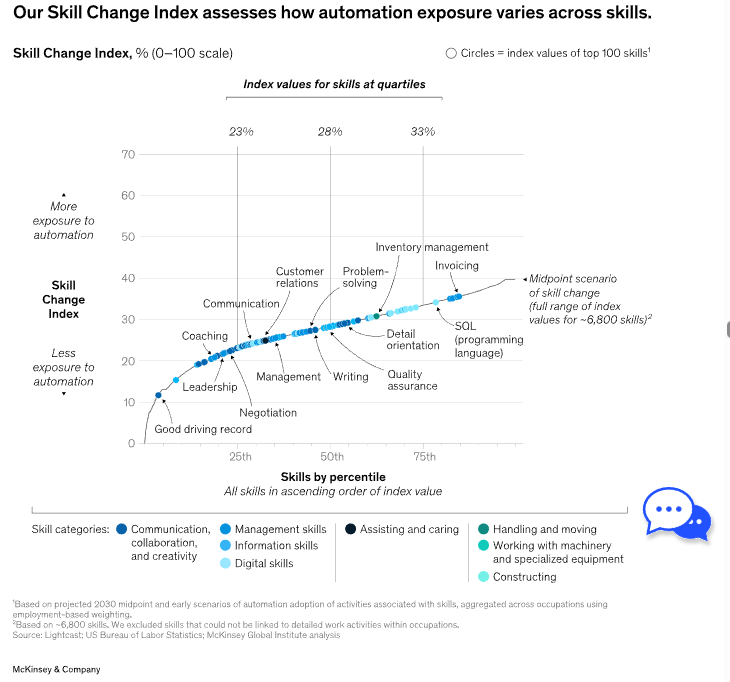
Several comments. The weird bubble in the right hand page’s margin is your link to the McKinsey AI system. Give it a whirl, please. Look at the wonderland of information in a single chart presented in true blue, “just the facts, mam” style. The hawk-eyed will see that “leadership” seems immune to AI. Obviously senior management smart enough to hire McKinsey will be AI fluent and know the score or at least the projected financial payoff resulting from terminating staff who fail to up their game when robots do two thirds of the knowledge workers’ tasks.
Why has McKinsey gone to such creative lengths to create an item like this marketing collateral? Multiple teams labored on this online brochure. Graphic designers went through numerous versions of the sliding panels. McKinsey knows there is money in those AI studies. The firm will apply its intellectual method to the wizards who are writing checks to AI companies to build big data centers. Even Google is hedging its bets by packaging its data centers as providers to super wary customers like NATO. Any company can benefit from AI fluency-centric efficiency inputs. Well, not any. The reason is that only companies who can pay McKinsey fees quality to be clients.
The 11 people identified as the authors have completed the equivalent of a death march. Congratulations. I applaud you. At some point in your future career, you can look back on this document and take pride in providing a road map for companies eager to dump human workers for good enough AI systems. Perhaps one of you will be able to carry a sign in a major urban area that calls attention to your skills? You can look back and tell your friends and family, “I was part of this revolution.” So Happy holidays to you, McKinsey, and to the other blue chip firms exploiting good enough smart software.
Stephen E Arnold, December 3, 2025
Comments
Got something to say?
-

- Subscribe to Beyond Search
Feature archive
News archive

-


