

Palantir Channels Moses, Blue Chip Consulting Baloney, and PR
December 2, 2025
 Another dinobaby original. If there is what passes for art, you bet your bippy, that I used smart software. I am a grandpa but not a Grandma Moses.
Palantir Technologies is a company in search of an identity. You may know the company latched on to the Lord of the Rings as a touchstone. The Palantir team adopted the “seeing stone.” The idea was that its technology could do magical things. There are several hundred companies with comparable technology. Datawalk has suggested that its system is the equivalent of Palantir’s. Is this true? I don’t know, but when one company is used by another company to make sales, it suggests that Palantir has done something of note.
I am thinking about Palantir because I did a small job for i2 Ltd. when Mike Hunter still was engaged with the firm. Shortly after this interesting work, I learned that Palantir was engaged in litigation with i2 Ltd. The allegations included Palantir’s setting up a straw man company to license the i2 Ltd.’s Analyst Notebook software development kit. i2 was the ur-intelware. Many of the companies marketing link analysis, analytics focused on making sense of call logs, and other arcana of little interest to most people are relatives of i2. Some acknowledge this bloodline. Others, particularly young intelware company employees working trade shows, just look confused if I mention i2 Ltd. Time is like sandpaper. Facts get smoothed, rounded, or worn to invisibility.
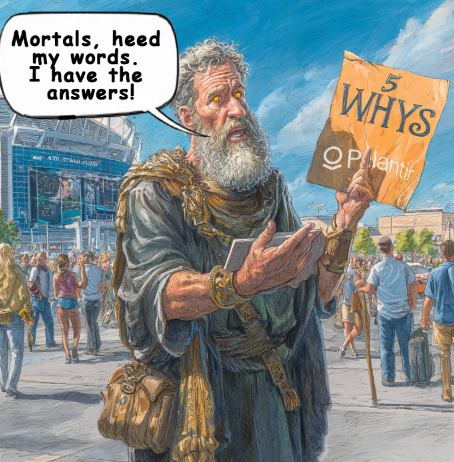
We have an illustration output by MidJourney. It shows a person dressed in a wardrobe that is out of step with traditional business attired. The machine-generated figure is trying to convince potential customers that the peculiarly garbed speaker can be trusted. The sign would have been viewed as good marketing centuries ago. Today it is just peculiar, possibly desperate on some level.
I read “Palantir Uses the ‘5 Whys’ Approach to Problem Solving — Here’s How It Works.” What struck me about the article is that Palantir’s CEO Alex Karp is recycling business school truisms as the insights that have powered the company to record government contracts. Toyota was one of the first company’s to focus on asking “why questions.” That firm tried to approach selling automobiles in a way different from the American auto giants. US firms were the world leaders when Toyota was cranking out cheap vehicles. The company pushed songs, communal exercise, and ideas different from the chrome trim crowd in Detroit; for example, humility, something called genchi genbutsu or go and see first hand, employee responsibility regardless of paygrade, continuous improvement (usually not adding chrome trim), and thinking beyond quarterly results. To an America, Mr. Toyoda’s ideas were nutso.
The write up reports:
Karp is a firm believer in the Five Whys, a simple system that aims to uncover the root cause of an issue that may not be immediately apparent. The process is straightforward. When an issue arises, someone asks, “Why?” Whatever the answer may be, they ask “why?” again and again until they have done so five times. “We have found is that those who are willing to chase the causal thread, and really follow it where it leads, can often unravel the knots that hold organizations back” …
The article adds this bit of color:
Palantir’s culture is almost as iconoclastic as its leader.
We have the Lord of the Rings, we have a Japanese auto company’s business method, and we have the CEO as an iconoclast.
Let’s think about this type of PR. Obviously Palantir and its formal and informal “leadership” want to be more than an outfit known for ending up in court as a result of a less-than-intelligent end run about an outfit whose primary market was law enforcement and intelligence professionals. Palantir is in the money or at least money from government contract, and it rarely mentions its long march to today’s apparent success. The firm was founded in May 2003. After a couple of years, Palantir landed its first customer: The US Central Intelligence Agency.
The company ingested about $3 billion in venture funding and reported its first profitable quarter in 2022. That’s 19 years, one interesting legal dust up, and numerous attempts to establish long-term relationships with its “customers.” Palantir did some work for do-good outfits. It tried its hand at commercial projects. But the firm remained anchored to government agencies in the US and the UK.
But something was lacking. The article is part of a content marketing campaign to make the firm’s CEO a luminary among technology leaders. Thus, we have the myth building block like the five why’s. These are not exactly intellectual home runs. The method is not proprietary. The method breaks down in many engagements. People don’t know why something happened. Consultants or forward deployed engineers scurry around trying to figure out what’s going. At some blue chip consulting firms, trotting out Toyota’s precepts as a way to deal with social media cyber security threats might result in the client saying, “No, thanks. We need a less superficial approach.”
I am not going to get a T shirt that says, “The knots that hold organizations back.” I favor
From my point of view, there are a couple of differences between the Toyota and it why era and Palantir today; for instance, Toyota was into measured, mostly disciplined process improvement. Palantir is more like the “move fast, break things” Silicon Valley outfit. Toyota was reasonably transparent about its processes. I did see the lights out factory near the Tokyo airport which was off limits to Kentucky people like. Palantir is in my mind associated with faux secrecy, legal paperwork, and those i2-related sealed documents.
Net net: Palantir’s myth making PR campaign is underway. I have no doubt it will work for many people. Good for them.
Stephen E Arnold, December x, 2025
Comments
Got something to say?
-

- Subscribe to Beyond Search
Feature archive
News archive

-


