

AI Can Be a Critic Unless Biases Are Hard Wired
June 26, 2025
The Internet has made it harder to find certain music, films, and art. It was supposed to be quite the opposite, and it was for a time. But social media and its algorithms have made a mess of things. So asserts the blogger at Tadaima in, “If Nothing Is Curated, How Do We Find Things?” The write up reports:
“As convenient as social media is, it scatters the information like bread being fed to ducks. You then have to hunt around for the info or hope the magical algorithm gods read your mind and guide the information to you. I always felt like social media creates an illusion of convenience. Think of how much time it takes to stay on top of things. To stay on top of music or film. Think of how much time it takes these days, how much hunting you have to do. Although technology has made information vast and reachable, it’s also turned the entire internet into a sludge pile.”
Slogging through sludge does take the fun out of discovery. The author fondly recalls the days when a few hours a week checking out MTV and Ebert and Roeper, flipping through magazines, and listening to the radio was enough to keep them on top of pop culture. For a while, curation websites deftly took over that function. Now, though, those have been replaced by social-media algorithms that serve to rake in ad revenue, not to share tunes and movies that feed the soul. The write up observes:
“Criticism is dead (with Fantano being the one exception) and Gen Alpha doesn’t know how to find music through anything but TikTok. Relying on algorithms puts way too much power in technology’s hands. And algorithms can only predict content that you’ve seen before. It’ll never surprise you with something different. It keeps you in a little bubble. Oh, you like shoegaze? Well, that’s all the algorithm is going to give you until you intentionally start listening to something else.”
Yep. So the question remains: How do we find things? Big tech would tell us to let AI do it, of course, but that misses the point. The post’s writer has settled for a somewhat haphazard, unsatisfying method of lists and notes. They sadly posit this state of affairs might be the “new normal.” This type of findability “normal” may be very bad in some ways.
Cynthia Murrell, June 26, 2025
The Secret to Business Success
June 18, 2025
 Just a dinobaby and a tiny bit of AI goodness: How horrible is this approach?
I don’t know anything about psychological conditions. I read “Why Peter Thiel Thinks Asperger’s Is A Key to Succeeding in Business.” I did what any semi-hip dinobaby would do. I logged into You.com and ask what the heck Asperger’s was. Here’s what I learned:
- The term "Asperger’s Syndrome" was introduced in the 1980s by Dr. Lorna Wing, based on earlier work by Hans Asperger. However, the term has become controversial due to revelations about Hans Asperger’s involvement with the Nazi regime
- Diagnostic Shift: Asperger’s Syndrome was officially included in the DSM-IV (1994) and ICD-10 (1992) but was retired in the DSM-5 (2013) and ICD-11 (2019). It is now part of the autism spectrum, with severity levels used to indicate the level of support required.

Image appeared with the definition of Asperger’s “issue.” A bit of a You.com bonus for the dinobaby.
These factoids are new to me.
The You.com smart report told me:
Key Characteristics of Asperger’s Syndrome (Now ASD-Level 1)
- Social Interaction Challenges:
- Difficulty understanding social cues, body language, and emotions.
- Limited facial expressions and awkward social interactions.
- Conversations may revolve around specific topics of interest, often one-sided
- Restricted and Repetitive Behaviors:
- Intense focus on narrow interests (e.g., train schedules, specific hobbies).
- Adherence to routines and resistance to change
- Communication Style:
- No significant delays in language development, but speech may be formal, monotone, or unusual in tone.
- Difficulty using language in social contexts, such as understanding humor or sarcasm
- Motor Skills and Sensory Sensitivities:
- Clumsiness or poor coordination.
- Sensitivity to sensory stimuli like lights, sounds, or textures.
Now what does the write up say? Mr. Thiel (Palantir Technology and other interests) believes:
Most of them [people with Asperger’s] have little sense of unspoken social norms or how to conform to them. Instead they develop a more self-directed worldview. Their beliefs on what is or is not possible come more from themselves, and less from what others tell them they can do or cannot do. This causes a lot anxiety and emotional hardship, but it also gives them more freedom to be different and experiment with new ideas.
The idea is that the alleged disorder allows certain individuals with Asperger’s to change the world.
The write up says:
The truth is that if you want to start something truly new, you almost by definition have to be unconventional and do something that everyone else thinks is crazy. This is inevitably going to mean you face criticism, even for trying it. In Thiel’s view, because those with Aspergers don’t register that criticism as much, they feel freer to make these attempts.
Is it possible for universities with excellent reputations and prestigious MBA programs to create people with the “virtues” of Aspberger’s? Do business schools aspire to impart this type of “secret sauce” to their students?
I suppose one could ask a person with the blessing of Aspberger’s but as the You.com report told me, some of these lucky individuals may [a] use speech may formal, monotone, or unusual in tone and [b] difficulty using language in social contexts, such as understanding humor or sarcasm.
But if one can change the world, carry on in the spirit of Hans Asperger, and make a great deal of money, it is good to have this unique “skill.”
Stephen E Arnold, June 18, 2025
AI Search: Go Retro
May 27, 2025
CIO’s article, “Invest In AI Search As An Enterprise Business Asset” reads like a blast from the pasta circa early 2000s. Back then it was harder to find decent information, ergo the invention of Google. However, it was also a tad easier to get ranked. With the advent of AI search the entire game has shifted so these tips are questionable.
CIO shares helpful stats about AI: 90% of AI projects never develop beyond proof of concept and 97% of organizations have trouble demonstrating the business value of generative AI. Then this apt paragraph is tossed at readers:
- “A major reason is that many cautious business leaders treat AI as a source of incremental improvements to existing processes rather than a tool to reshape core business functions. Too often, business leaders underestimate the people, behavior, and organizational changes entailed by strategically using AI.”
- Generative AI is still a new technology so it’s rational not everyone understands its implications and potential. The article then transitions into the difficulties employees have finding information. Another apt observation is made:
- “They have become accustomed to instant gratification on the web, but the lack of investment many organizations make in relevance and content curation makes searching inside the corporate firewall maddeningly unproductive.”
Then readers are treated to sales pitch that’s been heard since every new search technology emerged (well before Google):
“AI search not only incrementally improves productivity but can radically reshape core business capabilities. It replaces simple keyword searches with advanced semantic techniques that understand the intent and context behind a query. Semantic search combines technologies including natural language processing, vector data stores, and machine learning to deliver results that more closely match what users need than keywords without requiring major investments in content curation.”
There is something new that Steve Mayzak, the global managing director of Search at Elastic said: “With semantic search, you can search across an entire book instead of relying on the index alone.”
Now that has my attention. Indices are great but are limited. When I’m doing research, I love having a digital copy and physical copy of the book. The physical copy is easier to maneuver and read, while I have the searching feature, copy/paste, and notes tool in the digital version.
Helpful? Sort of.
Whitney Grace, May 27, 2025
Bing Goes AI: Metacrawler Outfits Are Toast
May 15, 2025
![dino-orange_thumb_thumb_thumb_thumb_[1]_thumb](https://www.arnoldit.com/wordpress/wp-content/uploads/2025/05/dino-orange_thumb_thumb_thumb_thumb_1_thumb-1.gif "dino-orange_thumb_thumb_thumb_thumb_[1]_thumb") No AI, just the dinobaby expressing his opinions to Zillennials.
No AI, just the dinobaby expressing his opinions to Zillennials.
The Softies are going to win in the AI-centric search wars. In every war, there will be casualties. One of the casualties will be metasearch companies. What’s metasearch? These are outfits that really don’t crawl the Web. That is expensive and requires constant fiddling to keep pace with the weird technical “innovations” purveyors of Web content present to the user. The metasearch companies provide an interface and then return results from cooperating and cheap primary Web search services. Most users don’t know the difference and have demonstrated over the years total indifference to the distinction. Search means Google. Microsoft wants to win at search and become the one true search service.
The most recent fix? Kill off the Microsoft Bing application programming interface. Those metasearch outfits will have to learn to love Qwant, SwissCows, and their ilk or face some-survive-or-die decisions. Do these outfits use YaCy, OpenSearch, Mwmbl, or some other source of Web indexing?
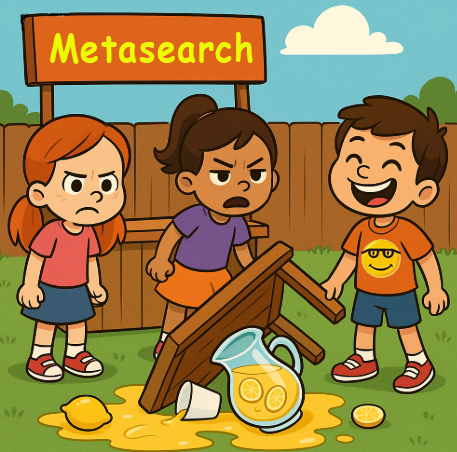
Bob Softie has just tipped over the metasearch lemonade stand. The metasearch sellers are not happy with Bob. Bob seems quite thrilled with his bold move. Thanks, ChatGPT, although I have not been able to access your wonder 4.1 service, the cartoon is good enough.
The news of this interesting move appears in “Retirement: Bing Search APIs on August 11, 2025.” The Softies say:
Bing Search APIs will be retired on August 11, 2025. Any existing instances of Bing Search APIs will be decommissioned completely, and the product will no longer be available for usage or new customer signup. Note that this retirement will apply to partners who are using the F1 and S1 through S9 resources of Bing Search, or the F0 and S1 through S4 resources of Bing Custom Search. Customers may want to consider Grounding with Bing Search as part of Azure AI Agents. Grounding with Bing Search allows Azure AI Agents to incorporate real-time public web data when generating responses with an LLM. If you have questions, contact support by emailing Bing Search API’s Partner Support. Learn more about service retirements that may impact your resources in the Azure Retirement Workbook. Please note that retirements may not be visible in the workbook for up to two weeks after being announced.
Several observations:
- The DuckDuckGo metasearch system is exempted. I suppose its super secure approach to presenting other outfits’ search results is so darned wonderful
- The feisty Kagi may have to spend to get new access deals or pay low profile crawlers like Dassault Exalead to provide some content (Let’s hope it is timely and comprehensive)
- The beneficiaries may be Web search systems not too popular with some in North America; for example, Yandex.com. I have found that Yandex.com and Yandex.ru are presenting more useful results since the re-juggling of the company’s operations took place.
Why is Microsoft taking this action? My hunch is paranoia. The AI search “thing” is going to have to work if Microsoft hopes to cope with Google’s push into what the Softies have long considered their territory. Those enterprise, cloud, and partnership set ups need to have an advantage. Binging it with AI may be viewed as the winning move at this time.
My view is that Microsoft may be edging close to another Bob moment. This is worth watching because the metasearch disruption will flip over some rocks. Who knows if Yandex or another non-Google or non-Bing search repackager surges to the fore? Web search is getting slightly more interesting and not because of the increasing chaos of AI-infused search results.
Stephen E Arnold, May 15, 2025
Apple and Google Relationship: Starting to Fray?
May 8, 2025
 No AI, just the dinobaby expressing his opinions to Zellenials.
I spotted a reference to an Apple manager going out on a limb of the old, Granny Smith tree. At the end of the limb, the Apple guru allegedly suggested that the Google search ain’t what it used to be. Whether true or not, Apple pays the Google lots of money to be the really but formerly wonderful Web search system for the iPhone and Safari “experience.”
That assertion of decline touched a nerve at the Google. I noted this statement in the Google blog. I am not sure which one because Google has many pages of smarmy talk. I am a dinobaby and easily confused. Here’s that what Google document with the SEO friendly title “Here’s Our Statement on This Morning’s Press Reports about Search Traffic” says:
We continue to see overall query growth in Search. That includes an increase in total queries coming from Apple’s devices and platforms. More generally, as we enhance Search with new features, people are seeing that Google Search is more useful for more of their queries — and they’re accessing it for new things and in new ways, whether from browsers or the Google app, using their voice or Google Lens. We’re excited to continue this innovation and look forward to sharing more at Google I/O.
Several observations:
- I love the royal “we”. I think that the Googlers who are nervous about search include the cast of the Sundar & Prabhakar Comedy Act. Search means ads. Ads mean money. Money means Wall Street. Therefore, a decline in search makes the Wall Street types jumpy, twitchy, and grumpy. Do not suggest traffic declines when controlling the costs of the search plumbing are becoming quite interesting for the Googley bean counters.
- Apple device users are searching Google a lot. I believe it. Monopolies like to have captives who don’t know that there are now alternatives to the somewhat uninspiring version of Jon Kleinberg’s CLEVER inventions spiced with some Fancy Dan weighting. These “weights” are really useful for boosting I believe.
- The leap to user satisfaction with Google search is unsupported by audited data. Those happy faces don’t convey why millions of people are using ChatGPT or why people complain that Google search results are mostly advertising. Oh, well, when one is a monopoly controlling what’s presented to users within the content of big spending advertisers, reality is what the company chooses to present.
- The Google is excited about its convention. Will it be similar to the old network marketing conventions or more like the cheerleading at Telegram’s Gateway Conference? It doesn’t matter. Google is excited.
Net net: The alleged Apple remark goosed the Google to make “our statement.” Outstanding defensive tone and posture. Will the pair seek counseling?
Stephen E Arnold, May 8, 2025
Extra Effort Required to Find Some Google Information
April 10, 2025
 Dinobaby says, “No smart software involved. That’s for “real” journalists and pundits.
We are plugging along on a little project. As part of our checking assorted publicly accessible sources for being publicly accessible, we were delighted to verify that Exploit Database is alive and kicking. Plus, it appears to be current as of August 2024.

Since we are doing some poking around for information related to the newly-almost-free Pavel Durov, we were interested in the Google Hacking Database. You can locate that list of “Google dorks” at this link. The most recent additions or dorks provide some information about finding files containing passwords.
Here’s the little discovery. None of the almost 8,000 dorks are Telegram specific. However, many of the methods can be applied to Pavel Durov’s interesting outfit. We tried a handful and learned that Google’s index either is filtering Telegram-related content or simply does not make much of an effort to provide pointers to certain types of public Telegram information.
How does an analyst or researcher locate current, comprehensive information about bots, Groups, Channels, and third-party specialized services for that platform? That is an excellent question which leads to some Russian resources which are often presented in Russian, semi low profile outfits like Forbidden Stories.
Net net: OSINT professionals depend on Google. However, certain large services engaged in a wide range of activities require pushing beyond the Google and its ever-helpful smart software.
Stephen E Arnold, April 10, 2025
Read AI Implements AI Into Enterprise Search
April 3, 2025
Enterprise search is an essential tool for an organization to function. There have been major shifts in enterprise search, including more accurate search results, and ability to search across multiple platforms. The Seattle startup Read AI wants to be the next enterprise search revolution says Geek Wire: “Seattle Startup Takes A Swing At Enterprise Search With New AI-Fueled Discovery Tool.”
There have been major upgrades in enterprise search before, including AI, but Read AI is doing it at level not before seen. The startup from Seattle began in 2021 with sentiment and engagement products for meetings. Later Read AI developed software tools that analyzed information across various communication channels. Now their latest product upgrade is for enterprise search that enables users to quickly locate and access information across terabytes of data and applications.
Read AI’s enterprise search tool upgrade is for Microsoft Copilot:
“Users can choose what data is discoverable. Search Copilot gets “smarter” as more workers add more data, and allows for collaboration. The new tool can also nudge users to take action based on past interactions with colleagues or customers.
The product is free to use with certain limits. Read AI CEO David Shim said reducing barriers is a key differentiator.
“People haven’t been able to understand the value of enterprise search because they haven’t had access to it,” he said.
Shim said Read AI’s ability to determine what’s important for an individual user also gives Search Copilot an edge over other AI search tools.”
Read AI wants to differentiate itself from its rivals, built-in-platform tools from Zoom, Google, and Microsoft. Read AI does have an advantage over out-of-the-box solutions, because experience tells us those tools stink. Proprietary developed tools are usually better because they’re specifically designed to enhance a specific feature, while out-of-the-box solutions are designed to with the “it’s okay to get by” mentality.
While Read AI made a smart move to upgrade Copilot with the latest AI technology, someone else would have done it eventually.
Whitney Grace, April 3, 2025
Old School Search: Scrunch Can Help You
March 25, 2025
Google, DuckDuckGo, Bing, and other search engines have incorporated AI into their search algorithms. AI, however, remains regulated to generative text and chatbots. It’s also doing very little to assist companies with their Web presences Tech Crunch shares how one startup wants to change that: “Scrunch AI Is Helping Companies Stand Out In AI Search.”
Scrunch AI developed a platform that assists companies with auditing and optimizing how their appear on AI search platforms. The platform shows how a company’s online information interacts with AI Web crawlers. Scrunch also funds inaccuracies and gaps in information.
The CEO and co-founder of Crunch AI Chris Andrew said he got the idea for the platform when he realized that he expected ChatGPT to do the browsing for him. He shared the idea with CMOs who noticed that their companies received high-quality traffic from AI search engines. The rub, however, was that the companies received different results from different platforms.
While there are companies that concentrate o this task, he says Scrunch goes further than then:
“Andrew thinks his startup stands out thanks to its focus on the customer journey as opposed to just how a brand shows up in initial search results. He feels the company is also taking it a step further by not just focusing on search results by a human through an AI search engine, but rather on searches performed by AI agents. ‘I think people were like, ‘How do we use AI to make our website better?’ And my mindset was like, ‘Your website’s going to need to be for an agent or crawler in the future,’” Andrew said. ‘That theory has kind of really played out with our customer base at the enterprise level saying our brand is no longer what we say it is. It’s what ChatGPT, Gemini, Siri, Google AI Overviews say it is.’”
Consistency and accuracy is important in this digital age. Andrew has a great idea but will Scrunch optimize search engine AI or will it generate AI slop?
Whitney Grace, March 25, 2025
Another New Search System with AI Too
March 7, 2025
There’s a new AI engine in town down specifically designed to assist with research. The Next Web details the newest invention that comes from a big name in the technology industry: “Tech mogul Launches AI Research Engine Corpora.ai.” Mel Morris is a British tech mogul and the man behind the latest research engine: Corpora.ai.
Morris had Corpora.ai designed to provided in-depth research from single prompts. It is also an incredibly fast engine. It can process two million documents per second. Corpora.ai works by reading a prompt then the AI algorithm scans information, including legal documents, news articles, academic papers, and other Web data. The information is then compiled into summaries or reports.
Morris insists that Corpora.ai is a research engine, not a search engine. He invested $15 million of his personal fortune into the project. Morris doesn’t want to compete with other AI projects, instead he wants to form working relationships:
“His funding aims to create a new business model for LLMs. Rather than challenge the leading GenAI firms, Corpora plans to bring a new service to the sector. The research engine can also integrate existing models on the market. ‘We don’t compete with OpenAI, Google, or Deepseek,’ Morris said. ‘The nice thing is, we can play with all of these AI vendors quite nicely. As they improve their models, our output gets better. It’s a really great symbiotic relationship.’
Mel Morris is a self-made businessman who is the former head of King, the Candy Crush game creator. He also owned and sold the dating Web site, uDate. He might see a return on his Corpora.ai investment .
Whitney Grace, March 7, 2025
Microsoft Still Searching after All These Years
January 28, 2025
Finally, long-suffering Windows users will get a better Windows Search. But only if they are willing to mix AI with their OS. The Register reports, "Improved Windows Search Arrives… But Only for Copilot+ PCs." Reporter Richard Speed writes:
"Windows Search has been the punchline to many a Windows joke over the years. The service is intended to provide an easy way of finding content on a local machine, and has previously been mocked for being slow and unreliable. It was blamed for various failures, from causing high CPU usage and toppling over when bits of infrastructure had issues, to tripping up other applications, such as Outlook. Microsoft is making improvements in the latest Dev Channel release – although only for Copilot+ PCs – and is ‘introducing semantic indexing along with traditional indexing.’ This means typing some natural phrases into the Windows search box on the taskbar or searching in File Explorer, which will produce a list of documents that include items close to or related to the search terms."
For now, Windows Search continues to only work on files stored locally. However, Microsoft plans to expand that to documents in the cloud in a future release. The firm promises "no data gathered during the indexing is sent to the company or used to train AI models." Sure.
How many search systems does Microsoft have? How many work as users expect? Our suggestion: Use Everything search. Not only does that freeware tool work well, it does not require one to embrace AI to function. Oh, Microsoft, keep searching. One day you may find a way to locate information in a Windows system. Maybe?
Cynthia Murrell, January 28, 2025
-

- Subscribe to Beyond Search
Feature archive
News archive

-


