

Sam AI-Man Is Not Impressing ZDNet
December 9, 2025
 Another dinobaby post. No AI unless it is an image. This dinobaby is not Grandma Moses, just Grandpa Arnold.
In the good old days of Ziff Communication, editorial and ad sales were separated. The “Chinese wall” seemed to work. It would be interesting to go back in time and let the editorial team from 1985 check out the write up “Stop Using ChatGPT for Everything: The AI Models I Use for Research, Coding, and More (and Which I Avoid).” The “everything” is one of those categorical affirmatives that often cause trouble for high school debaters or significant others arguing with a person who thinks a bit like a Silicon Valley technology person. Example: “I have to do everything around here.” Ever hear that?

Yes, granny. You say one thing, but it seems to me that you are getting your cupcakes from a commercial bakery. You cannot trust dinobabies when they say “I make everything” can you?
But the subtitle strikes me as even more exciting; to wit:
From GPT to Claude to Gemini, model names change fast, but use cases matter more. Here’s how I choose the best model for the task at hand.
This is the 2025 equivalent to a 1985 article about “Choosing Character Sets with EGA.” Peter Norton’s article from November 26, 1985, was mostly arcana, not too much in the opinion game. The cited “Stop Using ChatGPT for Everything” is quite different.
Here’s a passage I noted:
(Disclosure: Ziff Davis, ZDNET’s parent company, filed an April 2025 lawsuit against OpenAI, alleging it infringed Ziff Davis copyrights in training and operating its AI systems.)
And what about ChatGPT as a useful online service? Consider this statement:
However, when I do agentic coding, I’ve found that OpenAI’s Codex using GPT-5.1-Max and Claude Code using Opus 4.5 are astonishingly great. Agentic AI coding is when I hook up the AIs to my development environment, let the AIs read my entire codebase, and then do substantial, multi-step tasks. For example, I used Codex to write four WordPress plugin products for me in four days. Just recently, I’ve been using Claude Code with Opus 4.5 to build an entire complex and sophisticated iPhone app, which it helped me do in little sprints over the course of about half a month. I spent $200 for the month’s use of Codex and $100 for the month’s use of Claude Code. It does astonish me that Opus 4.5 did so poorly in the chatbot experience, but was a superstar in the agentic coding experience, but that’s part of why we’re looking at different models. AI vendors are still working out the kinks from this nascent technology.
But what about “everything” as in “stop using ChatGPT for everything”? Yeah, well, it is 2025.
And what about this passage? I quote:
Up until now, no other chatbot has been as broadly useful. However, Gemini 3 looks like it might give ChatGPT a run for its money. Gemini 3 has only been out for a week or so, which is why I don’t have enough experience to compare them. But, who knows, in six months this category might list Gemini 3 as the favorite model instead of GPT-5.1.
That “everything” still haunts me. It sure seems to me as if the ZDNet article uses ChatGPT a great deal. By the author’s own admission, he “doesn’t have enough experience to compare them.” But, but, but (as Jack Benny used to say) and then blurt “stop for everything!” Yeah, seems inconsistent to me. But, hey, I am a dinobaby.
I found this passage interesting as well:
Among the big names, I don’t use Perplexity, Copilot, or Grok. I know Perplexity also uses GPT-5.1, but it’s just never resonated with me. It’s known for search, but the few times I’ve tried some searches, its results have been meh. Also, I can’t stand the fact that you have to log in via email.
I guess these services suck as much as the ChatGPT system the author uses. Why? Yeah, log in method. That’s substantive stuff in AI land.
Observations:
- I don’t think this write up is output by AI or at least any AI system with which I am familiar
- I find the title and the text a bit out of step
- The categorical affirmative is logically loosey goosey.
Net net: Sigh.
Stephen E Arnold, December 9, 2025
Guess Who Will Not Advertise on Gizmodo? Give Up?
December 8, 2025
 Another dinobaby post. No AI unless it is an image. This dinobaby is not Grandma Moses, just Grandpa Arnold.
I have
I spotted an interesting write up on Gizmodo. The article “438 Reasons to Doubt that David Sacks Should Work for the Federal Government” suggests that none of the companies in which David Sacks has invested will throw money at Gizmodo. I don’t know that Mr. Sacks will direct his investments to avoid Gizmodo, but I surmise that the cited article may not induce him to tap his mobile and make ad buys on the Gizmodo thing.
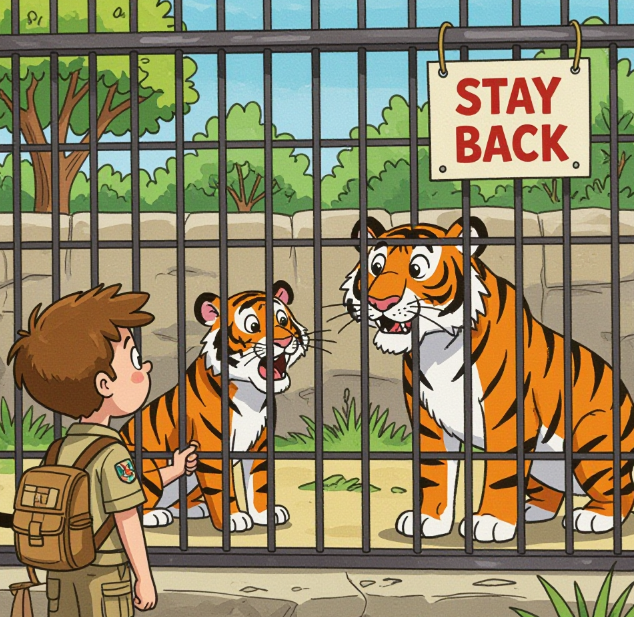
A young trooper contemplates petting one of the animals. Good enough, Venice.ai. I liked that you omitting my instruction to have the young boy scout put his arm through the bars in order to touch the tiger. But, hey, good enough is the gold standard.
The write up reports as actual factual:
His investments may expose him to conflicts of interest. They also probably distort common sense.
Now wait a Silicon Valley illegal left turn: “Conflicts of interest?”
The write up explains:
The presence of such a guy—who everyone knows has a massive tech-based portfolio of investments—totally guarantees the perception that public policy is being shaped by self-dealing in the tech world, which in turn distorts common sense.
The article prances forth:
When you zoom out, it looks like this: As an advisor, Trump hired a venture capitalist who held a $500,000-per-couple dinner for him last year in San Francisco. It turns out that guy has a stake in a company that makes AI night vision goggles. When he writes you an AI action plan calling for AI in the military, and your Pentagon ends up contracting with that very company, that’s just sensible government policy. After all, the military needs AI-powered night vision goggles, doesn’t it?
Several observations:
- The cited article appears to lean heavily on reporting by the New York Times. The Gray Lady does not seem charmed by David Sacks, but that’s just my personal interpretation.
- The idea that Silicon Valley viewpoints appear to influence some government projects is interesting. Combine streamlining of US government procurement policies, and I wonder if it possible that some projects get slipstreamed. I don’t know. Maybe?
- Online media that poke the tender souls of some big time billionaires strikes me as a risk-filled approach to creating actionable information. I think the action may not be what Gizmodo wants, however.
Net net: This new friskiness in itself is interesting. A thought crossed my mind about the performance capabilities of AI or maybe Anduril’s drones? But that’s a different type of story to create. It is just easier to recycle the Gray Lady. It is 2025, right after a holiday break?
Stephen E Arnold, December 8, 2025
Mother Nature Does Not Like AI
December 1, 2025
 Another dinobaby original. If there is what passes for art, you bet your bippy, that I used smart software. I am a grandpa but not a Grandma Moses.
Nature, the online service and still maybe a printed magazine, published a sour lemonade story. Its title is “Major AI Conference Flooded with Peer Reviews Written Fully by AI.” My reaction was, “Duh! Did you expect originality from AI professionals chasing big bucks?” In my experience, AI innovation appears in the marketing collateral, the cute price trickery for Google Gemini, and the slide decks presented to VCs who don’t want to miss out on the next big thing.
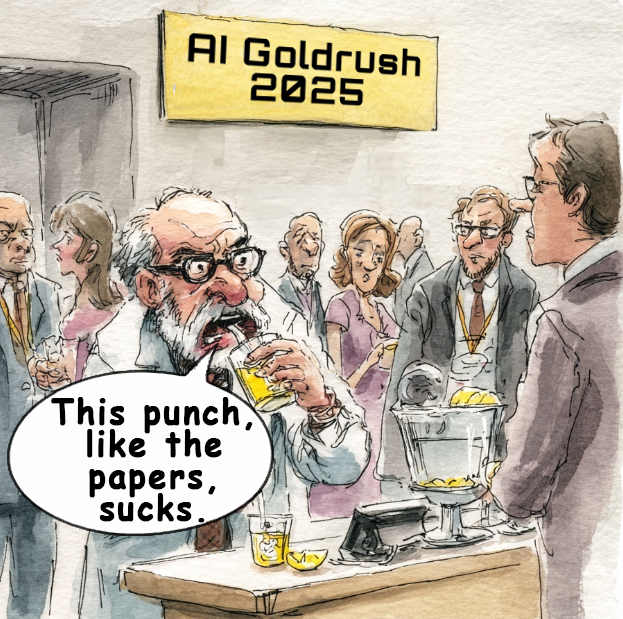
The Nature article states this shocker:
Controversy has erupted after 21% of manuscript reviews for an international AI conference were found to be generated by artificial intelligence.
Once again: Duh!
How about this statement from the write up and its sources?
The conference organizers say they will now use automated tools to assess whether submissions and peer reviews breached policies on using AI in submissions and peer reviews. This is the first time that the conference has faced this issue at scale, says Bharath Hariharan, a computer scientist at Cornell University in Ithaca, New York, and senior program chair for ICLR 2026. “After we go through all this process … that will give us a better notion of trust.”
Yep, trust. That’s a quality I admire.
I want to point out that Nature, a publication interested in sticking to the facts, does a little soft shoe and some fancy dancing in the cited article. For example, there are causal claims about how conferences operate. I did not spot any data, but I am a dinobaby prone to overlook the nuances of modern scientific write ups. Also, the article seems to want a fix now. Yeah, well, that is unlikely. LLMs change so that smart software tuned to find AI generated content are not exactly as reliable as a 2025 Toyota RAV.
Also, I am not sure fixes implemented by human reviewers and abstract readers will do the job. When I had the joyful opportunity to review submissions for a big time technical journal, I did a pretty good job on the first one or two papers tossed at me. But, to be honest, by paper three I was not sure I had the foggiest idea what I was doing. I probably would have approved something written by a French bulldog taking mushrooms for inspiration.
If you are in the journal article writing game or giving talks at conferences, think about AI. Whether you use it or not, you may be accused of taking short cuts. That’s important because professional publishers and conference organizers never take short cuts. They take money.
Stephen E Arnold, December 1, 2025
A Newsletter Firm Appears to Struggle for AI Options
October 17, 2025
 This essay is the work of a dumb dinobaby. No smart software required.
I read “Adapting to AI’s Evolving Landscape: A Survival Guide for Businesses.” The premise of the article will be music to the ears of venture funders and go-go Silicon Valley-type AI companies. The write up says:
AI-driven search is upending traditional information pathways and putting the heat on businesses and organizations facing a web traffic free-fall. Survival instincts have companies scrambling to shift their web strategies — perhaps ending the days of the open internet as we know it. After decades of pursuing web-optimization strategies that encouraged high-volume content generation, many businesses are now feeling that their content-marketing strategies might be backfiring.
I am not exactly sure about this statement. But let’s press forward.
I noted this passage:
Without the incentive of web clicks and ad revenue to drive content creation, the foundation of the web as a free and open entity is called into question.
Okay, smart software is exploiting the people who put up SEO-tailored content to get sales leads and hopefully make money. From my point of view, technology can be disruptive. The impacts, however, can be positive or negative.
What’s the fix if there is one? The write up offers these thought starters:
- Embrace micro transactions. [I suppose this is good if one has high volume. It may not be so good if shipping and warehouse costs cannot be effectively managed. Vendors of high ticket items may find a micro-transaction for a $500,000 per year enterprise software license tough to complete via Venmo.]
- Implement a walled garden. [That works if one controls the market. Google wants to “register” Android developers. I think Google may have an easier time with the walled-garden tactic than a local bakery specializing in treats for canines.]
- Accepts the monopolies. [You have a choice?]
My reaction to the write up is that it does little to provide substantive guidance as smart software continues to expand like digital kudzu. What is important is that the article appears in the consumer oriented publication from Kiplinger of newsletter fame. Unfortunately the article makes clear that Kiplinger is struggling to find a solution to AI. My hunch is that Kiplinger is looking for possible solutions. The firm may want to dig a little deeper for options.
Stephen E Arnold, October 17, 2025
Fabulous Fakes Pollute Publishing: That AI Stuff Is Fatuous
September 4, 2025
New York Times best selling author David Baldacci testified before the US Congress about regulating AI. Medical professionals are worried about false information infiltrating medical knowledge like the scandal involving Med-Gemini and an imaginary body part. It’s getting worse says ZME Science: “A Massive Fraud Ring Is Publishing Thousands of Fake Studies and the Problem is Exploding. ‘These Networks Are Essentially Criminal Organizations.’”
Bad actors in scientific publishing used to be a small group, but now it’s a big posse:
“What we are seeing is large networks of editors and authors cooperating to publish fraudulent research at scale. They are exploiting cracks in the system to launder reputations, secure funding, and climb academic ranks. This isn’t just about the occasional plagiarized paragraph or data fudged to fool reviewers. This is about a vast and resilient system that, in some cases, mimics organized crime. And it’s infiltrating the very core of science.”
Luís Amaral discovered in a study he conducted that analyzed five million papers across 70,000 scientific journals that there is a fraudulent paper mill for publishing. You’ve heard of paper mill colleges where students can buy so-called degrees. This is similar except the products are authorship slots and journal placements from artificial research and compromised editors.
Outstanding, AI champions!
This is a way for bad actors to pad their resumes and gain undeserved creditability.
Fake science has always been a problem but it’s outpacing fact-based science. It’s cheaper to produce fake science than legitimate truth. The article then waxes poetic about the need for respectability, the dangerous consequences of false science, and how the current tools aren’t enough. It’s devastating but the expected cultural shift needed to be more respectful of truth and hard facts is not equipped to deal with the new world. Thanks, AI.
Whitney Grace, September 4, 2025
Is Reading Necessary, Easy, and Fun? Sure
August 25, 2025
 No AI. Just a dinobaby working the old-fashioned way.
The GenAI service person answered my questions this way:
- Is reading necessary? Answer: Not really
- Is reading easy? No, not for me
- Is reading fun? For me, no.
Was I shocked? No. I almost understand. Note: I said “almost.” The idea that the mental involvement associated with reading is, for my same of one, is not on the radar.
“Reading for Pleasure in Freefall: Research Finds 40% Drop Over Two Decades” presents information that caught my attention for two reasons:
- The decline appears to be gradual; that is, freefall. The time period in terms of my dinobaby years is wildly inaccurate.
- The inclusion of a fat round number like 40 percent strikes me as understatement
On what basis do I make these two observations about the headline? I have what I call a Barnes & Noble toy ratio. A bookstore is now filled with toys, knick-knacks and Temu-type products. That’s it. Book stores are tough to find. When one does locate a book store, it often is a toy store.
The write up is much more scientific than my toy algorithm. I noted this passage from a study conducted by two universities I view as anchors of opposite ends of the academic spectrum: The University of Florida and University College London. Here’s the passage:
the study analyzed data from over 236,000 Americans who participated in the American Time Use Survey between 2003 and 2023. The findings suggest a fundamental cultural shift: fewer people are carving out time in their day to read for enjoyment. This is not just a small dip—it’s a sustained, steady decline of about 3% per year…
I don’t want to be someone who criticizes the analysis of two esteemed institutions. I would suggest that the decrease is going to take much less time than a couple of centuries if the three percent erosion continues. I acknowledge that in the US print book sales in 2024 reached about 700 million (depending on whom one believes), an increase of over 2023. These data do not reflect books generated by smart software.
But book sales does not mean more people are reading material that requires attention. Old people read more books than a grade school student or a young person who is not in what a dinobaby would call a school. Hats off to the missionary who teaches one young person in a tough spot to read and provides the individual with access to books.
I want to acknowledge this statement in the write up:
The researchers also noted some more promising findings, including that reading with children did not change over the last 20 years. However, reading with children was a lot less common than reading for pleasure, which is concerning given that this activity is tied to early literacy development, academic success and family bonding….
I interpreted the two stellar institutions as mostly getting at these points:
- Some people read and read voraciously. Pleasure or psychological problem? Who knows. It happens.
- Many people don’t value books, don’t read books, and won’t by choice or mental set up can’t read books.
- The distractions of just existing today make reading a lower priority for some than other considerations; for example, not getting hit by a kinetic in a war zone, watching TikTok, creating YouTube videos about big thoughts, a mobile phone, etc.
Let’s go back to the book store and toys. The existence of toys in a book store make clear that selling books is a very tough business. To stay open, Temu-type stuff has to be pushed. If reading were “fun,” the book stores would be as plentiful as unsold bourbon in Kentucky.
Net net: We have reached a point at which the number of readers is a equivalent to the count of snow leopards. Reading for fun marks an individual as one at risk of becoming a fur coat.
Stephen E Arnold, August 29, 2025
News Flash: Google Does Not Care about Publishers
August 21, 2025
 No AI. Just a dinobaby working the old-fashioned way.
I read another Google is bad story. This one is titled “Google Might Not Believe It, But Its AI Summaries Are Bad News for Publishers.” The “news” service reports that a publishing industry group spokesperson said:
“We must ensure that the same AI ‘answers’ users see at the top of Google Search don’t become a free substitute for the original work they’re based on.”
When this sentence was spoken was the industry representative’s voice trembling? Were there tears in his or her eyes? Did the person sniff to avoid the embarrassment of a runny nose?
No idea.
The issue is that Google looks at its metrics, fiddles with its knobs and dials on its ad sales system, and launches AI summaries. Those clicks that used to go to individual sites now provide the “summary space” which is a great place for more expensive, big advertising accounts to slap their message. Yep, it is the return to the go-go days of television. Google is the only channel and one of the few places to offer a deal.
What does Google say? Here’s a snip from the “news” story:
"Overall, total organic click volume from Google Search to websites has been relatively stable year-over-year," Liz Reid, VP and Head of Google Search, said earlier this month. "Additionally, average click quality has increased, and we’re actually sending slightly more quality clicks to websites than a year ago (by quality clicks, we mean those where users don’t quickly click back — typically a signal that a user is interested in the website). Reid suggested that reports like the ones from Pew and DCN are "often based on flawed methodologies, isolated examples, or traffic changes that occurred prior to the rollout of AI features in Search."
Translation: Haven’t you yokels figured out after 20 years of responding to us, we are in control now. We don’t care about you. If we need content, we can [a] pay people to create it, [b] use our smart software to write it, and [c] offer inducements to non profits, government agencies, and outfits with lots of writers desperate for recognition a deal. TikTok has changed video, but TikTok just inspired us to do our own TikTok. Now publishers can either get with the program or get out.
PC News apparently does not know how to translate Googlese.
It’s been 20 plus years and Google has not changed. It is doing more of the game plan. Adapt or end up prowling LinkedIn for work.
Stephen E Arnold, August 21, 2025
Inc. Magazine May Find that Its MSFT Software No Longer Works
August 20, 2025
![Dino 5 18 25_thumb[3]](https://www.arnoldit.com/wordpress/wp-content/uploads/2025/08/Dino-5-18-25_thumb3.gif "Dino 5 18 25_thumb[3]") No AI. Just a dinobaby and a steam-powered computer in rural Kentucky.
No AI. Just a dinobaby and a steam-powered computer in rural Kentucky.
I am not sure if anyone else has noticed that one must be very careful about making comments. A Canadian technology dude found himself embroiled with another Canadian technology dude. To be frank, I did not understand why the Canadian tech dudes were squabbling, but the dust up underscores the importance of the language, tone, rhetoric, and spin one puts on information.
An example of a sharp-toothed article which may bite Inc. Magazine on the ankle is the story “Welcome to the Weird New Empty World of LinkedIn: Just When Exactly Did the World’s Largest Business Platform Turn into an Endless Feed of AI-Generated Slop?” My teeny tiny experience as a rental at the world’s largest software firm taught me three lessons:
-
Intelligence is defined many ways. I asked a group of about 75 listening to one of my lectures, “Who is familiar with Kolmogorov?” The answer was for that particular sampling of Softies was exactly zero. Subjective impression: Rocket scientists? Not too many.
-
Feistiness. The fellow who shall remain nameless dragged me to a weird mixer thing in one of the buildings on the “campus.” One person (whose name and honorifics I do not remember) said, “Let me introduce you to Mr. X. He is driving the Word project.” I replied with a smile. We walked to the fellow, were introduced, and I asked, “Will Word fix up its autonumbering?” The Word Softie turned red, asked the fellow who introduced me to him, “Who is this guy?” The Word Softie stomped away and shot deadly sniper eyes at me until we left after about 45 minutes of frivolity. Subjective impression: Thin skin. Very thin skin.
-
Insecurity. At a lunch with a person whom I had met when I was a contractor at Bell Labs and several other Softies, the subject of enterprise search came up. I had written the Enterprise Search Report, and Microsoft had purchased copies. Furthermore, I wrote with Susan Rosen “Managing Electronic Information Projects.” Ms. Rosen was one of the senior librarians at Microsoft. While waiting for the rubber chicken, a Softie asked me about Fast Search & Transfer, which Microsoft had just purchased. The question posed to me was, “What do you think about Fast Search as a technology for SharePoint?” I said, “Fast Search was designed to index Web sites. The enterprise search functions were add ons. My hunch is that getting the software to handle the data in SharePoint will be quite difficult?” The response was, “We can do it.” I said, “I think that BA Insight, Coveo, and a couple of other outfits in my Enterprise Search Report will be targeting SharePoint search quickly.” The person looked at me and said, “What do these companies do? How quickly do they move?” Subjective impression: Fire up ChatGPT and get some positive mental health support.
The cited write up stomps into a topic that will probably catch some Softies’ attention. I noted this passage:
The stark fact is that reach, impressions and engagement have dropped off a cliff for the majority of people posting dry (read business-focused) content as opposed to, say, influencer or lifestyle-type content.
The write up adds some data about usage of LinkedIn:
average platform reach had fallen by no less than 50 percent, while follower growth was down 60 percent. Engagement was, on average, down an eye-popping 75 percent.
The main point of the article in my opinion is that LinkedIn does filter AI content. The use of AI content produces a positive for the emitter of the AI content. The effect is to convert a shameless marketing channel into a conduit for search engine optimized sales information.
The question “Why?” is easy to figure out:
-
Clicks if the content is hot
-
Engagement if the other LinkedIn users and bots become engaged or coupled
-
More zip in what is essentially a one dimension, Web 1 service.
How will this write up play out? Again the answers strike me as obvious:
-
LinkedIn may have some Softies who will carry a grudge toward Inc. Magazine
-
Microsoft may be distracted with its Herculean efforts to make its AI “plays” sustainable as outfits like Amazon say, “Hey, use our cloud services. They are pretty much free.”
-
Inc. may take a different approach to publishing stories with some barbs.
Will any of this matter? Nope. Weird and slop do that.
Stephen E Arnold, August 20, 2025
What Killed Newspapers? Speed and User Preference Did
August 13, 2025
 No AI. Just a dinobaby being a dinobaby.
I read “Did Craigslist Decimate Newspapers? Legend Meets Reality?” I liked the essay. I wanted to capture a few thoughts on this newspaper versus electronic shift.
I left Booz, Allen to join the Courier Journal & Louisville Times Co. I had a short hiatus because I was going to become an officer. I couldn’t officially start work until the CJ’s board voted. The question I was asked by my colleagues at the blue chip consulting firm before I headed to Louisville, Kentucky, from the real world of Washington, DC, Manhattan, and other major cities was, “Why?” One asked, “Where’s Louisville?”
I had a hunch that electronic information access was going to become a very big deal. In 1982, I was dumping the big time for what looked like a definite backwater, go-nowhere-fast place. Louisville made liquor, had a horse race, and a reputation for racial disharmony.
But electronic information was important to Barry Bingham, Junior, the top dog at the CJ. When I showed up, my office was next to a massage parlor on Fifth Street. I wasn’t in the main building. In fact, the office was not much more than a semi-slum. An abandoned house was visible from my office window. I left my nifty office overlooking Bethesda High School for a facility that did not meet GSA standards for storage space.
But here I was. My work focused on databases owned by the CJ, but these were actually described by a hardened newspaper person as “Barry’s crazy hobby.” The databases were ABI / INFORM, a bunch of technical indexes, and Pharmaceutical News Index. Nevertheless, the idea of using a computer, a dial up modem, and a database provided something of great value: A way to get smart really fast.
I had dabbled in indexing content, a fluke that got me a job at Halliburton Nuclear. And now I was leaving the land of forced retirement at 55, juicy bonuses, and the prospect of managing MBA drones on thrilling projects. In the early 1980s, not too many people knew about databases.
A relatively modest number of companies used online databases. Most of ABI / INFORM’s online customers were from the Fortune 1000, big time consulting firms, and research-type outfits around the world. The engineering databases did not have that magnetic appeal, so we sold these as a lot to an outfit called Cambridge Scientific Abstracts. I have no idea what happened to the databases nor to CSA. The PNI product was a keeper because it generated money online and from a print reference book. But ABI / INFORM was the keeper. It was only online. Shortly before I departed the CJ to join Ziff Communications in Manhattan, we cooperated with a publisher to bring out topical collections of content based on the abstracts in the ABI / INFORM database.
My arrival disrupted the database unit, and miraculously it became profitable within six months of my arrival. Barry credited me with the win, but I did nothing but do what I had learned at Booz, Allen. We then created Business Dateline, the first online database that included publisher corrections. As far as I know, Business Dateline held that distinction for many years. (That’s why I don’t trust online content. It is often incorrect, outdated, or a fabrication of a crazed “expert.)
But what about the CJ? I can tell you that only Barry Bingham wanted to put the text, the images, and the obituaries online in electronic form. The board of directors thought that move was stupid. The newsroom knew it was stupid. The printers thought the idea was the dumbest thought ever.
But there were three factors Barry understood and I knew were rock solid:
- Online access delivered benefits that would make 100 percent sense to people who needed to find high value, third-party information. (ABI / INFORM abstracted and indexed important articles from more than 1,200 business and management journals, and it was ideal for people in the consulting game)
- Print was a problem because of [a] waste, [b] cost of paper, and [c] the general and administrative expenses required to “do” print newspapers and magazine
- Electronic information was faster. For those to whom rapid access to current information was important, online was the future. Calling someone, like the newspaper reporters liked to do, was time consuming, expensive, and subject to delays.
Now Craigslist.org shows up. What happens? People who want to sell stuff can plug the ad into the Craigslist interface, click a button, and wait for a buyer. Contrast that with the process of placing a print ad. At the CJ, and employment ad could not use the abbreviation “cv.” I asked. No one knew. That’s the way it was. Traditional publishing outfits have a lot of the “that’s the way it was.”
Did Craigslist cause the newspaper sector to implode. No. The way technology works is that it chugs along, confined to a few narrow spaces. Then, when no one is looking, boom. It is the only way to go. To seize the advantage, traditional publishing outfits had to move fast.
That’s like telling a turtle to run in the Kentucky Debry. Why couldn’t newspapers and magazines adapt? Easy. The smell of ink, the tangible deliverable, and the role of gatekeeper combine to create a variant of fentanyl. Addled people cannot easily see what is obvious to those not on the drug.
Read the “Decimate” article. It’s interesting but in my opinion, making Mr. Newmark associate with the death of newspapers is colorful writing. Not the reality I witnessed in the go-go period from 1980 to 2006 for online information.
Stephen E Arnold, August 13, 2025
Paywalls. Users Do Not Want Them. Wow. Who Knew?
August 12, 2025
Sometimes research simply confirms the obvious. The Pew Research Center declares, “Few Americans Pay for News when they Encounter Paywalls.” Anyone still hoping the death of journalism could be forestalled with paywalls should reconsider. Writers Emily Tomasik and Michael Lipka cite a March Pew survey that found 83% of Americans have not paid for news in the past year. What do readers do when they hit a paywall? A mere 1% of those surveyed have forked over the dough to continue. However, 53% say they seek the same information elsewhere and 32% just give up on accessing it. Why? The write-up summarizes:
“Among the 83% of U.S. adults who have not paid for news in the past year, the most common reason they cite is that they can find plenty of other news articles for free. About half of those who don’t pay for news (49%) say this is the main reason. Indeed, many news websites do not have paywalls. Others have recently loosened paywalls or removed them for certain content like public emergencies or public interest stories. Another common reason people don’t pay for news is that they are not interested enough (32%). Smaller shares of Americans who don’t pay for news say the main reason is that it’s too expensive (10%) or that the news provided isn’t good enough to pay for (8%).”
The study did find some trends around who does pay for journalism. We learn:
“Overall, 17% of U.S. adults pay for news. However, highly educated adults, Democrats and older Americans – among other demographic groups – are more likely to have paid for news.
For example, 27% of college graduates say they have directly paid a news source by subscribing, donating or becoming a member in the last year – triple the share of those with a high school diploma or less formal education who have done so.”
So, those who paid to acquire knowledge are willing to pay to acquire knowledge. Who could have guessed? The survey also found senior citizens, wealthy folks, and white Americans more often pay up. Anyone curious about the survey’s methodology can read about it here.
The rule of thumb I use is that if one has 100 “readers”, two will pay if the content is really good. Must-have content bumps up the number a bit, but online publishers have to spend big on marketing to move the needle. Stick with ads and sponsored content.
Cynthia Murrell, August 12, 2025
-

- Subscribe to Beyond Search
Feature archive
News archive

-


