

More Google Gems: The January 2024, Week 3
January 23, 2024
 This essay is the work of a dumb dinobaby. No smart software required.
Quite a big week in the Google gem store. I suppose I have to identify a couple which I found authentic knee slappers. This is tough because the GOOG was performing at a peak level of excellence.

I enjoyed selecting this week’s Google Gems. Sparkly and not cubic zirconia. Thanks, MSFT Copilot second string thing. Good enough.
In the midst of the news coverage of Google’s smart software new skill, there was a bit of a “we are heading out, pardner” excitement. Okay, what can Google’s AI do? Sit down. I don’t want to be responsible for an injury. The Googley AI can solve geometry problems. I know, I know. Geometry. Well, the Google smart software can solve difficult geometry problems. Read about the achievement at this link to the Technology Review story. (Has anyone checked out Stephen Wolfram’s software lately? No, okay, never mind.)
My number one story (which may not be spot on but it is a zinger) is “California Google Engineer Found Spattered With Blood, ‘Staring Blankly’ Next to Wife’s Severely Beaten Body, Prosecutors Say.” The Messenger write up reports:
… officers with the Santa Clara Police Department made entry into the home and found Chen “spattered with blood” and “with his wife’s body nearby,” prosecutors said. She [spokesperson] said “blunt force injuries to her head” and swelling in her right hand. And Chen’s arm was scratched up, and he had blood on his clothing.
I am definitely going to mind my Ps and Qs when around Googlers
My number two favorite is the revelation that Google’s incognito mode is not. Who knew? I think this type of word play is the core strength of the mobile phone companies which have made clear that “unlimited” does not mean “without limits.” But Google is in the game of slippery lingo.
My number three favorite is that Leo Laporte and Steve Gibson, hosts of Security Now, love Google’s putting ad auction technology in the Chrome browser. Well, sort of. The This Week in Google program offered a different point of view; namely, not so fast. You can find links to both of these programs (once supported by advertising and now supported by begging for dollars) at this link. (No, I don’t subscribe. I do what is called play at 1.5 speed and fast forward through the sponsored messages.) But the key point here is that one’s Chrome browser is going to need a beefy infrastructure to do the heavy lifting for Google’s money machine in my opinion.
Okay, here are the other gems:
- Some of Google’s smart software team seem to be heading for greener pastures. More personnel management excitement for the GOOG’s crack HR professionals. Another former Google AI wizard opined that AI could run one’s business in five years. Hmm. Maybe AI will run Google? And a Googler opined that AI is a labor replacing “tool.” There you go.
- The brilliant Googler who directed Googzilla’s epic online game initiative has been RIFFed. Did someone say, “We got him.”
- Another Google professional is finding his future elsewhere and documenting the anguish of the journey. Read that document at this link.
- Another write up about how lousy Google Web search results are. (I am suggesting you give Google Dorks a whirl.)
- Google explains that it is not really, no, really, not slowing YouTube when ad blockers are used by a “user.” Believe it not after you read this story. Oh, there is some management musical chairs underway at YouTube as well.
- Google is a good boy. Search results in Europe conform to the EU’s Digital Markets Act (DMA). Good boy. Does Googzilla want a cookie?
More next week.
Stephen E Arnold, January 23, 2024
IBM Charges Toward Consulting Services: Does Don Quixote Work at Big Blue?
January 23, 2024
 This essay is the work of a dumb dinobaby. No smart software required.
It is official. IBM consultants will use smart software to provide answers to clients. Why not ask the smart software directly and skip the consultants? Why aren’t IBM consultants sufficiently informed and intelligent to answer a client’s questions directly? Is IBM admitting that its consultants lack the knowledge depth and insight necessary to solve a client’s problems? Hmmm.
“IBM Introduces IBM Consulting Advantage, an AI Services Platform and Library of Assistants to Empower Consultants” asserts in corporate marketing lingo:
IBM Consulting Assistants are accessed through an intuitive conversational interface powered by IBM Watsonx, IBM’s AI and data platform. Consultants can toggle across multiple IBM and third-party generative AI models to compare outputs and select the right model for their task, and use the platform to rapidly build and share prompts and pre-trained assistants across teams or more widely across the consulting organization. The interface also enables easy uploading of project-specific documents for rapid insights that can then be shared into common business tools.
One of the key benefits of using smart software is to allow the IBM consultants to do more in the same billable hour. Thus, one can assume that billable hours will go up. “Efficiency” may not equate to revenue generation if the AI-assisted humanoids deliver incorrect, off-point, or unverifiable outputs.

A winner with a certain large company’s sure fire technology. Thanks, MSFT second string Copilot Bing thing. Good enough.
What can the AI-turbo charged system do? A lot. Here’s what IBM marketing asserts:
The IBM Consulting Advantage platform will be applied across the breadth of IBM Consulting’s services, spanning strategy, experience, technology and operations. It is designed to work in combination with IBM Garage, a proven, collaborative engagement model to help clients fast-track innovation, realize value three times faster than traditional approaches, and transparently track business outcomes. Today’s announcement builds on IBM Consulting’s concrete steps in 2023 to further expand its expertise, tools and methods to help accelerate clients’ business transformations with enterprise-grade AI…. IBM Consulting helps accelerate business transformation for our clients through hybrid cloud and AI technologies, leveraging our open ecosystem of partners. With deep industry expertise spanning strategy, experience design, technology, and operations, we have become the trusted partner to many of the world’s most innovative and valuable companies, helping modernize and secure their most complex systems. Our 160,000 consultants embrace an open way of working and apply our proven, collaborative engagement model, IBM Garage, to scale ideas into outcomes.
I have some questions; for example:
- Will IBM hire less qualified and less expensive humans, assuming that smart software lifts them up to super star status?
- Will the system be hallucination proof; that is, what procedure ensures that decisions based on smart software assisted outputs are based on factual, reliable information?
- When a consulting engagement goes off the rails, how will IBM allocate responsibility; for example, 100 percent to the human, 50 percent to the human and 50 percent to those who were involved in building the model, or 100 percent to the client since the client made a decision and consultants just provide options and recommendations?
I look forward to IBM Watsonx’s revolutionizing consulting related to migrating COBOL from a mainframe to a hybrid environment relying on a distributed network with diverse software. Will WatsonX participate in Jeopardy again?
Stephen E Arnold, January 23, 2024
The Future of One Kind of Publishing: It Is Unusual (Sorry, Tom Jones)
January 23, 2024
 This essay is the work of a dumb dinobaby. No smart software required.
Today’s equivalent of a famous journalist like Walter Winchell, Paul Harvey, or (bow down now) Edward R. Murrow owe their fame to Twitter.com. Now that service has changed, so the new ink stained celebrities take their followers and move to aggregation platforms. Some of these notables charge subscriptions. Unencumbered by the miserable newsroom management ethos, these super stars of wordsmithing want things like their online vehicles to be just so.
Now in an X.com world, a duel of influencers is playing out in the blogosphere. At issue: Substack’s alleged Nazi problem. The kerfuffle began with a piece in The Atlantic by Jonathan M. Katz, but has evolved into a debate between Platformer’s Casey Newton and Jesse Singal of Singal-Minded. Both those blogs are hosted by Substack.
To get up to speed on the controversy, see the original Atlantic article. Newton wrote a couple posts about Substack’s responses and detailing Platformer’s involvement. In “Substack Says It Will Remove Nazi Publications from the Platform,” he writes:
“Substack is removing some publications that express support for Nazis, the company said today. The company said this did not represent a reversal of its previous stance, but rather the result of reconsidering how it interprets its existing policies. As part of the move, the company is also terminating the accounts of several publications that endorse Nazi ideology and that Platformer flagged to the company for review last week.”
How many publications did Platformer flag, and how many of those did Substack remove? Were they significant publications, and did they really violate the rules? These are the burning questions Sengal sought to answer. He shares his account in, “Platformer’s Reporting on Substack’s Supposed ‘Nazi Problem’ Is Shoddy and Misleading.” But first, he specifies his own perspective on Katz’ Atlantic article:
“In my view, this whole thing is little more than a moral panic. Moreover, Katz cut certain corners to obscure the fact that to the extent there are Nazis on Substack at all, it appears they have almost no following or influence, and make almost no money. In one case, for example, Katz falsely claimed that a white nationalist was making a comfortable living writing on Substack, but even the most cursory bit of research would have revealed that that is completely false.”
Sengal says he plans a detailed article supporting that assertion, but first he must pick apart Platformer’s position. Readers are treated to details from an email exchange between the bloggers and reasons Sengal feels Newton’s responses are inadequate. One can navigate to that post for those details if one wants to get into the weeds. As of this writing, Newton has not published a response to Sengal’s diatribe. Were we better off when such duels took place a hundred characters at a time?
I am looking forward to the next turn of the journalistic wheel. Exciting because “real” journalists are morphing into pundits, consultants, gurus, predictors of the future, and T shirt vendors. What happened to the good old days of “yellow journalism”?
Cynthia Murrell, January 23, 2024
Cyber Security Investing: A Money Pit?
January 22, 2024
 This essay is the work of a dumb dinobaby. No smart software required.
Cyber security is a winner, a sure-fire way to take home the big bucks. Slam dunk. But the write up “Cybersecurity Startup Funding Hits 5-Year Low, Drops 50% from 2022” may signal that some money people have a fear of what might be called a money pit. The write up states:
In 2023, cyber startups saw only about a third of that, as venture funding dipped to its lowest total since 2018. Security companies raised $8.2 billion in 692 venture capital deals last year — per Crunchbase numbers — compared to $16.3 billion in 941 deals in 2022.
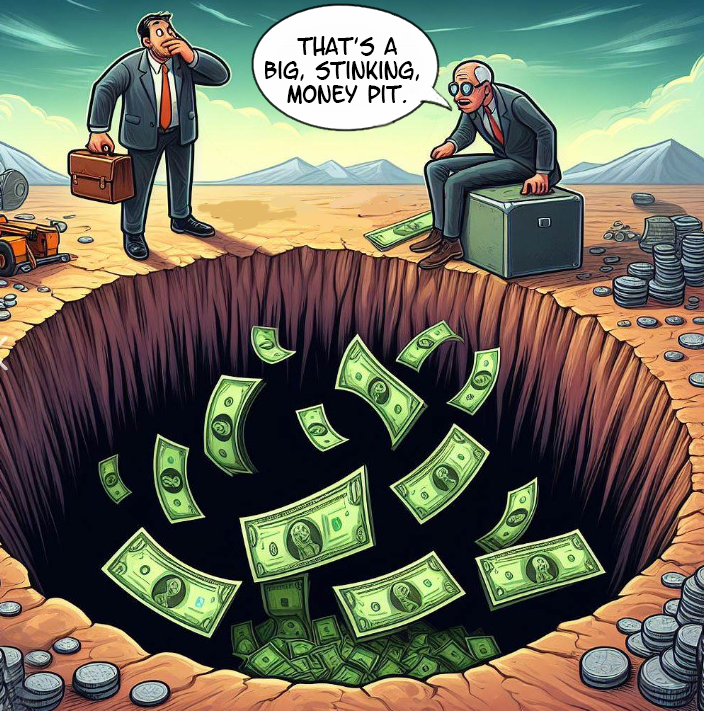
Have investors in cyber security changed their view of a slam-dunk investment? That winning hoop now looks like a stinking money pit perhaps? Thanks, MSFT Copilot Bing thing with security to boot. Good enough.
Let’s believe these data which are close enough for horseshoes. I also noted this passage:
“What we saw in terms of cybersecurity funding in 2023 were the ramifications of the exceptional surge of 2021, with bloated valuations and off-the-charts funding rounds, as well as the wariness of investors in light of market conditions,” said Ofer Schreiber, senior partner and head of the Israel office for cyber venture firm YL Ventures.
The reference to Israel is bittersweet. The Israeli cyber defenses failed to detect, alert, and thus protect those who were in harm’s way in October 2023. How you might ask because Israel is the go-to innovator in cyber security? Maybe the over-hyped, super-duper, AI-infused systems don’t work as well as the marketer’s promotional material assert? Just a thought.
My views:
- Cyber security is difficult; for instance, Microsoft’s announcement that the Son of SolarWinds has shown up inside the Softies’ email
- Bad actors can use AI faster than cyber security firms can — and make the smart software avoid being dumb
- Cyber security requires ever-increasing investments because the cat-and-mouse game between good actors and bad actors is a variant of the cheerful 1950s’ arms race.
Do you feel secure with your mobile, your laptop, and your other computing devices? Do you scan QR codes in restaurants without wondering if the code is sandbagged? Are you an avid downloader? I don’t want to know, but you may want answers.
Stephen E Arnold, January 22, 2024
Microsoft Security: Are the Doors Falling Off?
January 22, 2024
 This essay is the work of a dumb dinobaby. No smart software required.
“Microsoft Network Breached Through Password-Spraying by Russian-State Hackers” begs to be set to music. I am thinking about Chubby Checker and his hit “Let’s Twist Again.” One lyric change. Twist becomes “hacked.” So “let’s hack again like we did last summer.” Hit?

A Seattle-based quality and security engineer finds that his automobile door has fallen off. Its security system is silent. It must be the weather. Thanks, MSFT second class Copilot Bing thing. Good enough but the extra wheel is an unusual and creative touch.
The write up states:
Russia-state hackers exploited a weak password to compromise Microsoft’s corporate network and accessed emails and documents that belonged to senior executives and employees working in security and legal teams, Microsoft said [on January 19, 2024]. The attack, which Microsoft attributed to a Kremlin-backed hacking group it tracks as Midnight Blizzard, is at least the second time in as many years that failures to follow basic security hygiene has resulted in a breach that has the potential to harm customers.
The Ars Technica story noted:
A Microsoft representative said the company declined to answer questions, including whether basic security practices were followed.
Who did this? One of the Axis of Evil perhaps. Why hack Microsoft? Because it is a big, juicy target? Were the methods sophisticated, using artificial intelligence to outmaneuver state-of-the-art MSFT cyber defenses? Nope. It took seven weeks to detect the password guessing tactic.
Did you ever wonder why door fall off Seattle-linked aircraft and security breaches occur at Seattle’s big software outfit? A desire for profits, laziness, indifference, or some other factor is causing these rather high-profile issues. It must be the Seattle water or the rain. That’s it. The rain! No senior manager can do anything about the rain. Perhaps a solar wind will blow and make everything better?
Stephen E Arnold, January 22, 2024
An Astounding Finding! Who Knew This about Mobile Phone Usage by Kids?
January 22, 2024
 This essay is the work of a dumb dinobaby. No smart software required.
Let me answer the question, please. Every parent with a clue.
Why is anyone surprised that yet another round of research demonstrates that too much screen time is bad for kids? ABC News shares the not-so-resounding discovery in: “Screen Time For Kids Under 2 Linked To Sensory Differences In Toddlerhood: Study.” Kids under the age of two exhibit sensory differences when they are exposed to a lot of screen time.
JAMA Pediatrics published a study from Drexel University that analyzed 1500 surveys from parents and caregivers. The surveys asked about kids’ sensory preferences, including questions about preference or avoidance to textures, noises, and lights. The survey only focused on television and not mobile devices because the data was gathered before 2014. The survey results showed that kids who watched TV at 12 months were twice as a likely to develop “atypical sensory processing” by the time they were 3 years old. The more kids were exposed to the boob tube after 1.5 years had a 20% greater chance of having sensory processing differences.
Drexel University’s study augments previous research that found more screen time impacted how kids communicated and felt. Screen time exposure in young kids is linked to developmental delays in problem-solving, critical thinking, and other communication. Sensory processing disordered are linked to other mental aliments, such as autism spectrum disorder, attention deficit disorder, attention deficit hyperactivity disorder, and obsessive compulsive disorder. The study didn’t examine if the kids were diagnosed with these issues.
Johns Hopkins pediatrician and neonatal hospitalist Dr. Jade Cobern encourages parents and caregivers to be mindful of screen time. She notes it is impossible to avoid screens in modern society:
“Cobern also recommends tailoring approaches to the specific family and patient, and collaboratively brainstorming accessible ways to decrease non-interactive screen time and increase healthy developmental activities, such as reading, playing with objects, and socializing with other children, even if those activities might entail screens. “ ‘Everyone has to be realistic when we’re talking about how parents can support their children’s development,’ Cobern said, adding of research like the Drexel study, ‘It’s not to shame screentime exposure because the reality is we live in a world where screens are part of our daily lives.’
She continued,
‘It really is inevitable that most kids will see some screen time even early in life, but it is something I encourage families to be mindful of.’”
Why not pick up a picture book and read to the kid? Or play a game with the kid? Or take the kid outside? Or play an interactive screen game with the kid? It’s hard to find the time but other generations did it.
Whitney Grace, January 22, 2024
Goat Trading: AI at Davos
January 21, 2024
 This essay is the work of a dumb dinobaby. No smart software required.
The AI supercars are racing along the Information Superhighway. Nikkei Asia published what I thought was the equivalent of archaeologists translating a Babylonian clay table about goat trading. Interesting but a bit out of sync with what was happening in a souk. Goat trading, if my understanding of Babylonian commerce, was a combination of a Filene’s basement sale and a hot rod parts swap meet. The article which evoked this thought was “Generative AI Regulation Dominates the Conversation at Davos.” No kidding? Really? I thought some at Davos were into money. I mean everything in Switzerland comes back to money in my experience.
Here’s a passage I found with a nod to the clay tablets of yore:
U.N. Secretary-General Antonio Guterres, during a speech at Davos, flagged risks that AI poses to human rights, personal privacy and societies, calling on the private sector to join a multi-stakeholder effort to develop a "networked and adaptive" governance model for AI.
Now visualize a market at which middlemen, buyers of goats, sellers of goats, funders of goat transactions, and the goats themselves are in the air. Heady. Bold. Like the hot air filling a balloon, an unlikely construct takes flight. Can anyone govern a goat market or the trajectory of the hot air balloons floated by avid outputters?

Intense discussions can cause a number of balloons to float with hot air power. Talk is input to AI, isn’t it? Thanks, MSFT Copilot Bing thing. Good enough.
The world of AI reminds me the ultimate outcome of intense discussions about the buying and selling of goats, horses, and AI companies. The official chatter and the “what ifs” are irrelevant in what is going on with smart software. Here’s another quote from the Nikkei write up:
In December, the European Union became the first to provisionally pass AI legislation. Countries around the world have been exploring regulation and governance around AI. Many sessions in Davos explored governance and regulations and why global leaders and tech companies should collaborate.
How are those official documents’ content changing the world of artificial intelligence? I think one can spot a hot air balloon held aloft on the heated emissions from the officials, important personages, and the individuals who are “experts” in all things “smart.”
Another quote, possibly applicable to goat trading in Babylon:
Vera Jourova, European Commission vice president for values and transparency, said during a panel discussion in Davos, that "legislation is much slower than the world of technologies, but that’s law." "We suddenly saw the generative AI at the foundation models of Chat GPT," she continued. "And it moved us to draft, together with local legislators, the new chapter in the AI act. We tried to react on the new real reality. The result is there. The fine tuning is still ongoing, but I believe that the AI act will come into force."
I am confident that there are laws regulating goat trading. I believe that some people follow those laws. On the other hand, when I was in a far off dusty land, I watched how goats were bought and sold. What does goat trading have to do with regulating, governing, or creating some global consensus about AI?
The marketplace is roaring along. You wanna buy a goat? There is a smart software vendor who will help you.
Stephen E Arnold, January xx, 2024
Google-gies: A New Literary Genre
January 19, 2024
 This essay is the work of a dumb dinobaby. No smart software required.
I think graduate students in American literature have a new genre to analyze. The best way to define an innovation in literature is to take an example and do what soon-to-be-unemployed MA and PhD candidates do best: Examine an original text. I think one word used to describe this type of examination is deconstruction. Close enough for horseshoes.

These former high tech feudal barons lament parties designed to facilitate discussion of dissolution, devolution, and disintegration. Thanks, second tier MSFT Copilot Bing thing. Good enough again.
My name for this new branch of American writing is a combination of Google and elegy or Googlegy. I also considered Googletopsis in honor of William Cullen Bryant, but Googlegy is snappier in my opinion. The point is that the term applies to writing about the death of the Google myth.
Let’s turn to a recent example titled “Mourning Google.” The main idea is that the Google is dead or one facet of the estimable firm has passed into the Great Beyond. The writer is Tim Bray who was a Big Gun at OpenText and other firms before joining the Digital Camelot. He writes:
it really seems like the joy has well and truly departed the Googleplex.
Funereal? Yep. He continues:
And now, in Anno Domini 2024, Google has lost its edge in search. There are plenty of things it can’t find. There are compelling alternatives. To me this feels like a big inflection point, because around the stumbling feet of the Big Tech dinosaurs, the Web’s mammals, agile and flexible, still scurry. They exhibit creative energy and strongly-flavored voices, and those voices still sometimes find and reinforce each other without being sock puppets of shareholder-value-focused private empires.
I like the metaphors and the lingo. (Subsequent sections of the essay use vulgar language. Some of the author’s words appear on Google list of forbidden words, so I won’t repeat them. This is a blog, not English 602, Googlegy: Meaning and Social Impact.
The wrap up of the essay reveals some of the attitude of a Xoogler or former Googler presents this wonderful blend of nostalgia, greed, and personal emotion:
It was ethereal — OK, pretentious — almost beyond belief. Almost entirely vegetarian, rare plants hand-gathered by Zen monks and assembled into jewel-like little platelets-full that probably strengthened eleven different biochemical subsystems just by existing. And the desserts were beyond divine. Admittedly, sometimes when I left, my Norwegian-farmer metabolism grumbled a bit about not having had any proper food, but still. It was wonderful. It was absurd. And I got a $90K bonus that year because Google+ hit its numbers. It’s over, I think. It’s OK to miss it.
Why are Googlegies appearing? I have a theory, and if I were teaching graduate students, I would direct those eager minds toward a research topic in this untrodden intellectual space.
Let me share several observations:
- Using Swisscows.com or another reasonably useful Web search engine, one can locate other articles about the mythical death of the Google
- Medium and Substack harbor essays in this genre
- Conferences featuring speakers who were Googlers provide an opportunity for first-hand data collection
- Apply for a job and learn up close and personal how money assuages one’s conscience, emotions, and ethical whimpers.
I have a different viewpoint. The Google is busy redesigning the Web to maintain its grip on revenue from advertisers. Googley technology will, its senior managers hope, will blunt the rapacious outfits which are equally inspired by the spirit of Andrew Carnegie, Cornelius Vanderbilt, and John D. Rockefeller.
Welcome the birth of a new genre — Google-gies. Refreshing if too late.
Stephen E Arnold, January 19, 2024
Regulators Shift into Gear to Investigate an AI Tie Up
January 19, 2024
 This essay is the work of a dumb dinobaby. No smart software required.
Solicitors, lawyers, and avocats want to mark the anniversary of the AI big bang. About one year ago, Microsoft pushed Google into hitting its Code Red button. Investment firms, developers, and wild-eyed entrepreneurs knew smart software was the real deal, not a digital file of a cartoon like that NFT baloney. In the last 12 months, AI went from jargon and eliciting yawns to the treasure map to the fabled city of El Dorado (even if it was a suburb of Grants, New Mexico. Google got the message quickly. The lawyers. Well, not too quickly.

Regulators look through the technological pile of 2023 gadgets. Despite being last year’s big thing, the law makers and justice deciders move into action mode. Exciting. Thanks, MSFT Copilot Bing thing. Good enough.
“EU Joins UK in Scrutinizing OpenAI’s Relationship with Microsoft” documents what happens when lawyers — after decades of inaction — wake to do something constructive. Social media gutted the fabric of many cultural norms. AI isn’t going to be given a 20 year free pass. No way.
The write up reports:
Antitrust regulators in the EU have joined their British counterparts in scrutinizing Microsoft’s alliance with OpenAI.
What will happen now? Here’s my short list of actions:
- Legal eagles on both sides of the Atlantic will begin grooming their feathers in order to be selected to deal with the assorted forms, filings, hearings, and advisory meetings. Some of the lawyers will call Ferrari to make sure they are eligible to buy a supercar; others may cast an eye on an impounded oligarch-linked yacht. Yep, big bucks ahead.
- Microsoft and OpenAI will let loose an platoon of humanoid art history and business administration majors. These professionals will create a wide range of informative explainers. Smart software will be pressed into duty, and I anticipate some smart automation to provide Teflon the the flow of digital documentation.
- Firms — possibly some based in the EU and a few bold souls in the US — will present information making clear that competition is a good thing. Governments must regulate smart software
- Entities hostile to the EU and the US will also output information or disinformation. Which is what depends on one’s perspective.
In short, 2024 will be an interesting year because one of the major threat to the Google could be converted to the digital equivalent of a eunuch in an Assyrian ruler’s court. What will this mean? Google wins. Unanticipated consequence? Absolutely.
Stephen E Arnold, January 19, 2024
Research: A Slippery Path to Wisdom Now
January 19, 2024
 This essay is the work of a dumb dinobaby. No smart software required.
When deciding whether to believe something on the Internet all one must do is google it, right? Not so fast. Citing five studies performed between 2019 and 2022, Scientific American describes “How Search Engines Boost Misinformation.” Writer Lauren Leffer tells us:
“Encouraging Internet users to rely on search engines to verify questionable online articles can make them more prone to believing false or misleading information, according to a study published today in Nature. The new research quantitatively demonstrates how search results, especially those prompted by queries that contain keywords from misleading articles, can easily lead people down digital rabbit holes and backfire. Guidance to Google a topic is insufficient if people aren’t considering what they search for and the factors that determine the results, the study suggests.”
Those of us with critical thinking skills may believe that caveat goes without saying but, alas, it does not. Apparently evaluating the reliability of sources through lateral reading must be taught to most searchers. Another important but underutilized practice is to rephrase a query before hitting enter. Certain terms are predominantly used by purveyors of misinformation, so copy-and-pasting a dubious headline will turn up dubious sources to support it. We learn:
“For example, one of the misleading articles used in the study was entitled ‘U.S. faces engineered famine as COVID lockdowns and vax mandates could lead to widespread hunger, unrest this winter.’ When participants included ‘engineered famine’—a unique term specifically used by low-quality news sources—in their fact-check searches, 63 percent of these queries prompted unreliable results. In comparison, none of the search queries that excluded the word ‘engineered’ returned misinformation. ‘I was surprised by how many people were using this kind of naive search strategy,’ says the study’s lead author Kevin Aslett, an assistant professor of computational social science at the University of Central Florida. ‘It’s really concerning to me.’”
That is putting it mildly. These studies offer evidence to support suspicions that thoughtless searching is getting us into trouble. See the article for more information on the subject. Maybe a smart LLM will spit it out for you, and let you use it as your own?
Cynthia Murrell, January 19, 2024
-

- Subscribe to Beyond Search
Feature archive
News archive

-


