

Featured
Why Google Dorks Exist and Why Most Users Do Not Know Why They Are Needed This essay is the work of a dumb dinobaby. No smart software required.
Many people in my lectures are not familiar with the concept of “dorks”. No, not the human variety. I am referencing the concept of a “Google dork.” If you do a quick search using Yandex.com, you will get pointers to different “Google dorks.” Click on one of the links and you will find information you can use to retrieve more precise and relevant information from the Google ad-supported Web search system.
Here’s what QDORKS.com looks like:

The idea is that one plugs in search terms and uses the pull down boxes to enter specific commands to point the ad-centric system at something more closely resembling a relevant result. Other interfaces are available; for example, the “1000 Best Google Dorks List." You get a laundry list of tips,commands, and ideas for wrestling Googzilla to the ground, twisting its tail, and (hopefully) yield relevant information. Hopefully. Good work.
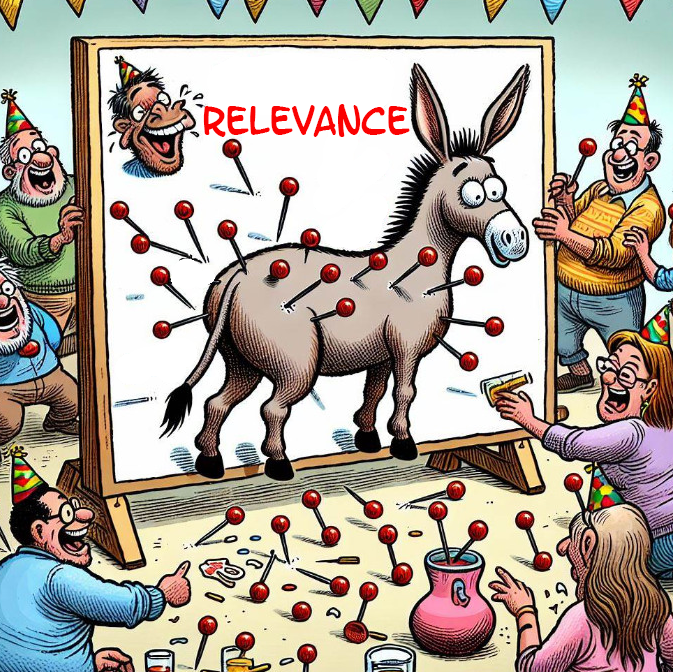
Most people are lousy at pinning the tail on the relevance donkey. Therefore, let someone who knows define relevance for the happy people. Thanks, MSFT Copilot. Nice animal with map pins.
Why are Google Dorks or similar guides to Google search necessary? Here are three reasons:
- Precision reduces the opportunities for displaying allegedly relevant advertising. Semantic relaxation allows the Google to suggest that it is using Oingo type methods to find mathematically determined relationships. The idea is that razzle dazzle makes ad blasting something like an ugly baby wrapped in translucent fabric on a foggy day look really great.
- When Larry Page argued with me at a search engine meeting about truncation, he displayed a preconceived notion about how search should work for those not at Google or attending a specialist conference about search. Rational? To him, yep. Logical? To his framing of the search problem, the stance makes perfect sense if one discards the notion of tense, plurals, inflections, and stupid markers like “im” as in “impractical” and “non” as in “nonsense.” Hey, Larry had the answer. Live with it.
- The goal at the Google is to make search as intellectually easy for the “user” as possible. The idea was to suggest what the user intended. Also, Google had the old idea that a person’s past behavior can predict that person’s behavior now. Well, predict in the sense that “good enough” will do the job for vast majority of search-blind users who look for the short cut or the most convenient way to get information.
Why? Control, being clever, and then selling the dream of clicks for advertisers. Over the years, Google leveraged its information framing power to a position of control. I want to point out that most people, including many Googlers, cannot perceive. When pointed out, those individuals refuse to believe that Google does [a] NOT index the full universe of digital data, [b] NOT want to fool around with users who prefer Boolean algebra, content curation to identify the best or most useful content, and [c] fiddle around with training people to become effective searchers of online information. Obfuscation, verbal legerdemain, and the “do no evil” craziness make the railroad run the way Cornelius Vanderbilt-types implemented.
I read this morning (December 4, 2023) the Google blog post called “New Ways to Find Just What You Need on Search.” The main point of the write up in my opinion is:
Search will never be a solved problem; it continues to evolve and improve alongside our world and the web.
I agree, but it would be great if the known search and retrieval functions were available to users. Instead, we have a weird Google Mom approach. From the write up:
To help you more easily keep up with searches or topics you come back to a lot, or want to learn more about, we’re introducing the ability to follow exactly what you’re interested in.
Okay, user tracking, stored queries, and alerts. How does the Google know what you want? The answer is that users log in, use Google services, and enter queries which are automatically converted to search. You will have answers to questions you really care about.
There are other search functions available in the most recent version of Google’s attempts to deal with an unsolved problem:
As with all information on Search, our systems will look to show the most helpful, relevant and reliable information possible when you follow a topic.
Yep, Google is a helicopter parent. Mom will know what’s best, select it, and present it. Don’t like it? Mom will be recalcitrant, like shaping search results to meet what the probabilistic system says, “Take your medicine, you brat.” Who said, “Mother Google is a nice mom”? Definitely not me.
And Google will make search more social. Shades of Dr. Alon Halevy and the heirs of Orkut. The Google wants to bring people together. Social signals make sense to Google. Yep, content without Google ads must be conquered. Let’s hope the Google incentive plans encourage the behavior, or those valiant programmers will be bystanders to other Googlers’ promotions and accompanying money deliveries.
Net net: Finding relevant, on point, accurate information is more difficult today than at any other point in the 50+ year work career. How does the cloud of unknowing dissipate? I have no idea. I think it has moved in on tiny Googzilla feet and sits looking over the harbor, ready to pounce on any creature that challenges the status quo.
PS. Corny Vanderbilt was an amateur compared to the Google. He did trains; Google does information.
Stephen E Arnold, December 4, 2023
Interviews
DarkCyber, March 29, 2022: An Interview with Chris Westphal, DataWalkChris Westphal is the Chief Analytics Officer of DataWalk, a firm providing an investigative and analysis tool to commercial and government organizations. The 12-minute interview covers DataWalk’s unique capabilities, its data and information resources, and the firm’s workflow functionality. The video can be viewed on YouTube at this location.
Stephen E Arnold, March 29, 2022
Latest News
AI Does Prediction about Humans: What Could Go WrongThis essay is the work of a dumb dinobaby. No smart software required. The academic institution which took money from everyone’s favorite expert on exploitation... Read more »
Not Only Those Chasing Tenure Hallucinate, But Some Citations Are Wonky TooThis essay is the work of a dumb dinobaby. No smart software required. I read “ChatGPT Hallucinates Fake But Plausible Scientific Citations at a Staggering Rate,... Read more »
AI Girlfriends: The Opportunity of a LifetimeThis essay is the work of a dumb dinobaby. No smart software required. Relationships are hard. Navigating each other’s unique desires, personalities, and expectations... Read more »
Telegram Barks, Whines, and Wants a TreatThis essay is the work of a dumb dinobaby. No smart software required. Tucker Carlson, an American TV star journalist lawyer person, had an opportunity to find his... Read more »
AI Versus People? That Is Easy. AIThis essay is the work of a dumb dinobaby. No smart software required. I don’t like to include management information in Beyond Search. I have noticed more stories... Read more »
Kicking Cans Down the Street Is Not Violence. Is It a Type of Fraud Perhaps?This essay is the work of a dumb dinobaby. No smart software required. Ah, spring, when young men’s fancies turn to thoughts of violence. Forget the Iran Israel... Read more »
AI Transforms Memories Into Real ImagesThis essay is the work of a dumb dinobaby. No smart software required. Human memory is unreliable. It’s unreliable because we forget details, remember things incorrectly,... Read more »
Is Grandma Google Making Erratic Decisions?This essay is the work of a dumb dinobaby. No smart software required. Clowny Fish TV is unknown to me. The site published a write up which I found interesting and... Read more »
From the Cyber Security Irony Department: We Market and We Suffer Breaches. Hire Us!This essay is the work of a dumb dinobaby. No smart software required. Irony, according to You.com, means: Irony is a rhetorical device used to express an intended... Read more »
Fake Books: Will AI Cause Harm or Do Good?This essay is the work of a dumb dinobaby. No smart software required. I read what I call a “howl” from a person who cares about “good” books. Now “good”... Read more »
-

- Subscribe to Beyond Search
Feature archive
News archive

-


